


A singer among musicians who listen
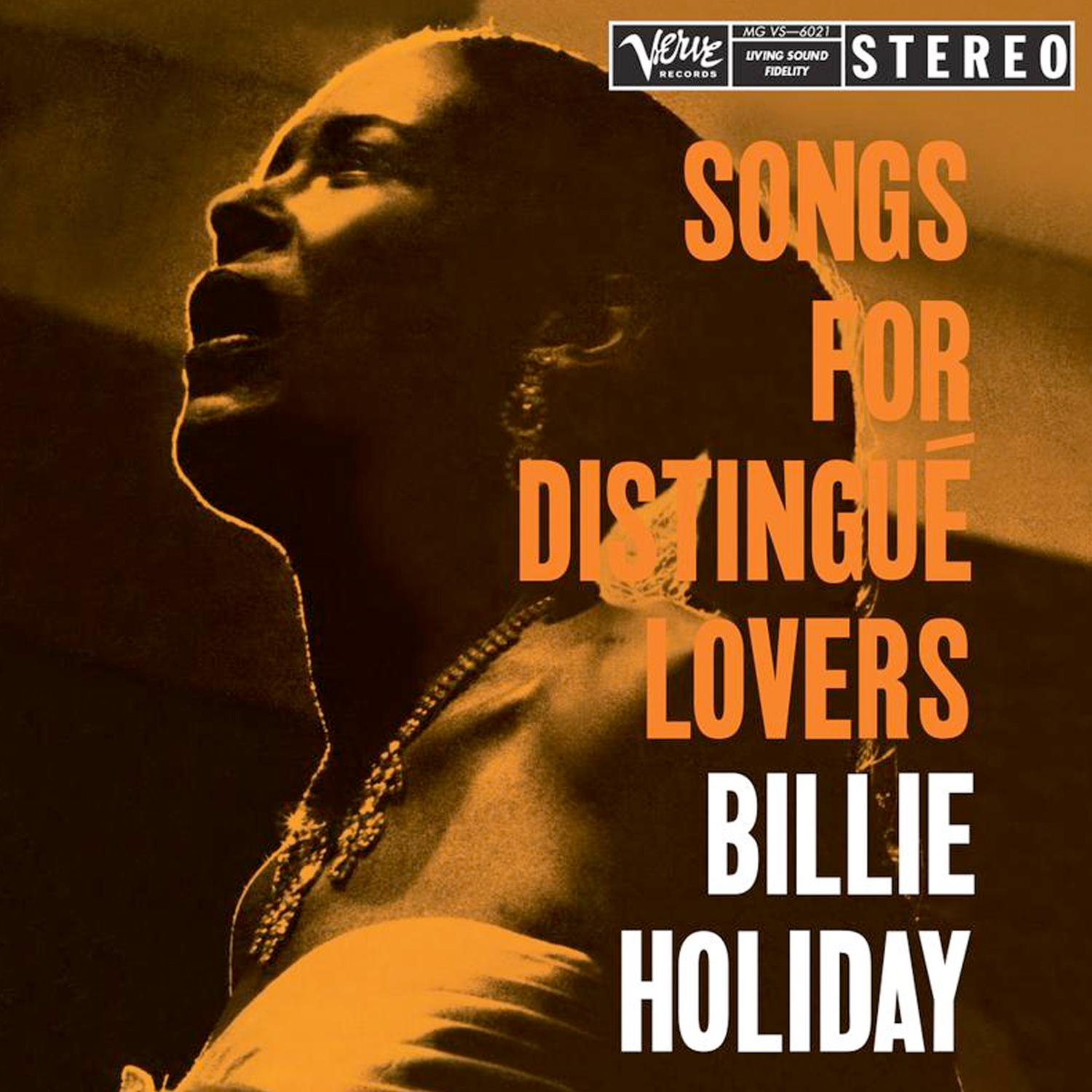
Songs for Distingué Lovers brings Billie Holiday together with a small ensemble whose names evoke a substantial part of jazz history: Harry “Sweets” Edison, Ben Webster, Jimmy Rowles, Barney Kessel, Red Mitchell and Alvin Stoller. The recordings were made in January 1957 at Capitol Studios in Hollywood, with Norman Granz producing. Six songs carry the album. It is a concentrated framework that has no need to impress through the longest possible tracklist. Instead, it gives a singer and her fellow musicians room to make personal decisions within familiar forms: decisions about time, emphasis, proximity and the expressive weight of an individual turn of phrase.
Holiday is naturally at the centre. Yet an account treating the instrumentalists as merely decorative surroundings for her voice would leave the music incompletely described. Edison and Webster are distinctive personalities; Rowles, Kessel, Mitchell and Stoller undertake different responsibilities within the accompaniment. This line-up offers the singer several kinds of musical partner. A horn can answer a phrase, a chord can alter its surroundings, and a rhythmic impulse can give it a different support. Such possibilities belong to the language of a small jazz ensemble. The album invites attention to the voice within this network of relationships, rather than in isolation from the other people in the studio.
Its elegant title should not restrict the record to an idea of polished background music. The selected songs deal with feelings that can resist a smooth surface. Familiar standards offer considerable room precisely because their words and melodies are already shaped, while interpretation decides afresh what they might mean. Holiday’s artistry can be considered here as a way of working with that openness. For a collection of vocal records, this is a significant attraction. The interest is not simply in finding six recognised compositions again, but in encountering a particular voice’s relationship with those songs and with these six instrumental musicians.

A compact songbook with a wide expressive range
“Day In, Day Out” opens the first side, with music by Rube Bloom and lyrics by Johnny Mercer. George and Ira Gershwin’s “A Foggy Day” follows, before “Stars Fell on Alabama”, by Frank Perkins and Mitchell Parish, closes the side. Three different writing partnerships therefore appear together. The programme does not present a portrait of one songwriter; it gathers material offering an interpreter several verbal and melodic approaches. Following its construction allows a listener to consider each song’s individuality without losing the album’s larger connection. The continuity of the small ensemble helps hold this range of writing together within a consistent musical setting.
The second side begins with “One for My Baby”, composed by Harold Arlen with lyrics by Johnny Mercer. “Just One of Those Things” is by Cole Porter, while “I Didn’t Know What Time It Was” comes from Richard Rodgers and Lorenz Hart. Mercer is consequently represented on both sides, working with a different composer each time. Connections of this kind are rewarding because they show how an album can establish relationships within the songbook without announcing itself as a thematic anthology. The titles form a manageable circle in which different ideas of memory, intimacy and distance meet. Their sequence is part of the record’s experience.
Listening need not become a literary seminar. The simple question of how Holiday begins a line, or how much space she gives a particular phrase, leads directly into interpretation. It is equally rewarding to notice the moments when the instruments carry something forward from the voice. In this ensemble a song consists of more than singing placed above accompaniment; it develops through their relationship. Six selections provide time to follow those connections without sacrificing the album’s concentrated character. Its scale is an advantage: the whole sequence can be experienced as one programme, while a return visit allows individual details to receive a different degree of attention.

Edison, Webster and the art of accompaniment
Harry “Sweets” Edison plays trumpet and Ben Webster tenor saxophone. These instruments do not create an anonymous horn texture. Their different tonal possibilities, together with the personalities of the players, give the group two distinguishable voices alongside Holiday. It would therefore be a loss to mention them only in a passing list of famous names. Attention can move between the singing and its instrumental partners. Not every musical response needs to be understood as a contest. In an ensemble like this, restraint can shape a performance as strongly as a prominent entrance; leaving room is as much a part of collective music-making as filling it.
Jimmy Rowles at the piano and Barney Kessel on guitar extend the harmonic surroundings. Red Mitchell is credited on bass and Alvin Stoller on drums. The available sources do not provide a fully secure individual allocation of every contribution to each selection, so the information is presented as album personnel. That does not diminish its usefulness. An honest list identifies the participants without manufacturing false precision from incomplete documentation. The roles are sufficiently clear to encourage attention to less immediately prominent contributions and to the ways in which different responsibilities meet within the shared shape of a song.
Norman Granz was responsible for production and the original accompanying notes; Burt Goldblatt is credited for the cover design. The Hollywood sessions belong to the recording’s origins, while the later Verve album belongs to its release history. Together they frame music that needs no biographical melodrama to establish its significance. Holiday’s voice should not be reduced to a symbol of suffering or an inevitable story of decline. This record presents an experienced musician working with other experienced musicians. Their actual work deserves attention: the relationship to a lyric, the shaping of a melody and the decision about when a phrase should gather weight and when it should move on.
The Acoustic Sounds Series edition
This stereo LP belongs to the Acoustic Sounds Series from Verve and UMe and carries catalogue number AVER 83101. It runs at 33⅓ rpm, is specified as a 180-gram pressing and is manufactured at Quality Record Pressings. A Stoughton tip-on gatefold jacket forms part of the presentation. There is a significant title-specific mastering detail: the edition description credits Bernie Grundman and the original tapes, with metal parts from an earlier cut used for this release. It would therefore be incorrect to assume another mastering name merely because that engineer is frequently associated with other releases in the same series.
This attention to the particular title is worthwhile for discerning collectors. A series can establish a shared visual and manufacturing framework without every release following precisely the same route through all production stages. The documented cutting credit belongs to this record, just as its pressing plant, speed and jacket construction do. Those details make the edition identifiable; they do not replace a listener’s own assessment of the result. Anyone comparing different versions gains a sound basis for placing this release, rather than a generic celebration of the series that overlooks the offered title’s actual and relevant production history.
Three songs on each side preserve the programme’s concentrated form. At 33⅓ rpm, each side remains a connected span, with “One for My Baby” opening the second half after the side change. You order from Michael 45 in Germany. We arrange the US import and dispatch from Hilden. This edition offers collectors an opportunity to take Songs for Distingué Lovers as seriously as an ensemble album as they do as a Billie Holiday record. Her voice remains its centre, but Edison, Webster, Rowles, Kessel, Mitchell and Stoller belong to its musical reality. Listening to them alongside her reveals people participating in the interpretation, helping familiar songs retain their openness rather than simply furnishing a setting around an isolated star.
More by Billie Holiday: All Or Nothing At All · Lady In Satin
Series: Verve – all 34 records: voices, organ and bossa nova
Musicians
Participants and documented credit status. Track references correspond to the tracklist.
- Billie HolidayPortrait: existing portraitvocalsParticipation: Album personnel; track assignments unconfirmed
- Harry EdisonPortrait: existing portraittrumpetParticipation: Album personnel; track assignments unconfirmed
- Ben WebsterPortrait: existing portraittenor saxophoneParticipation: Album personnel; track assignments unconfirmed
- Jimmy RowlesPortrait: existing portraitpianoParticipation: Album personnel; track assignments unconfirmed
- Barney KesselPortrait: existing portraitguitarParticipation: Album personnel; track assignments unconfirmed
- Red MitchellPortrait: existing portraitdouble bassParticipation: Album personnel; track assignments unconfirmed
- Alvin StollerdrumsParticipation: Album personnel; track assignments unconfirmed


Personnel follows edition credits. Red Mitchell’s exact track assignment is unclear in the supplementary source, so participation on every track is not asserted. Six original LP selections only, without CD bonus tracks.

Reviews
There are no reviews yet.