The Poll Winners: three names, three instruments, one shared task
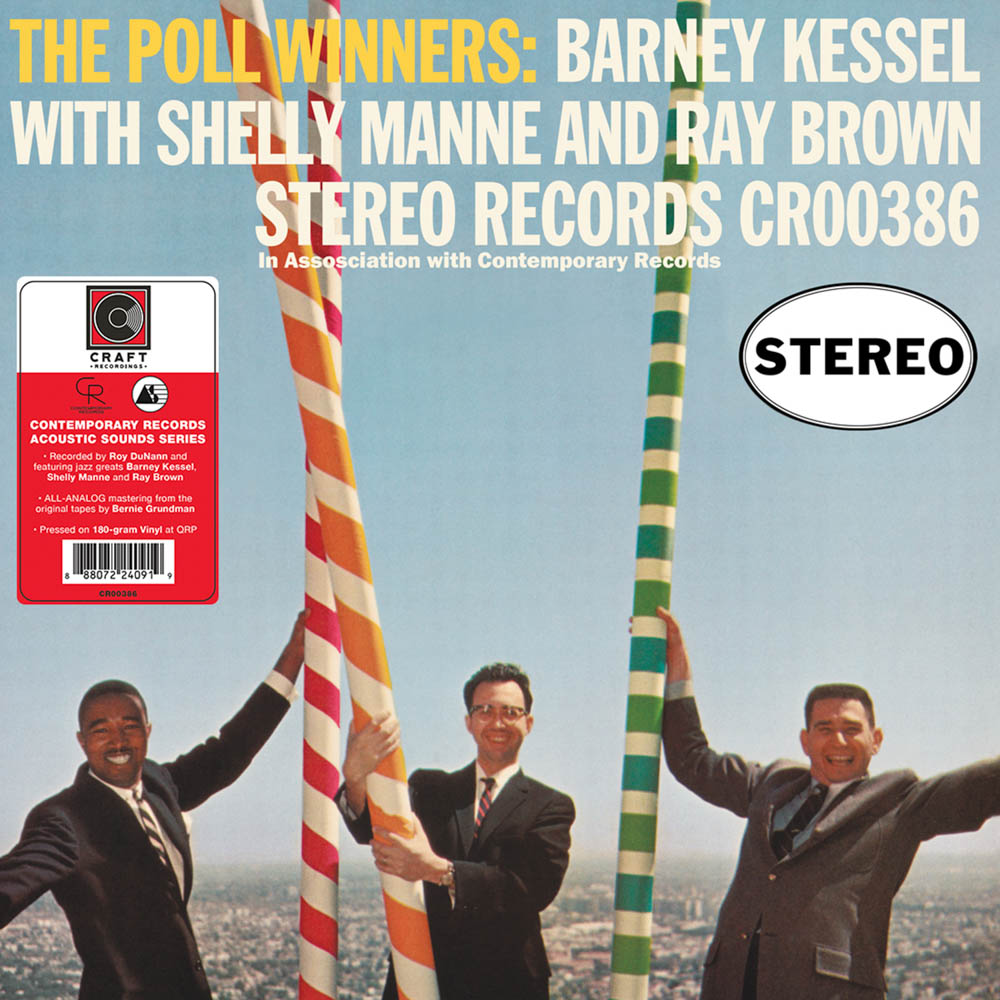
Barney Kessel, Ray Brown and Shelly Manne form a trio without piano on The Poll Winners. Guitar, double bass and drums are the complete ensemble. This is more than a short personnel list: it changes how melody and harmony can be connected, and how much responsibility each musical decision carries. Kessel’s guitar can lead a line while suggesting its harmonic setting. Brown’s bass and Manne’s drums are not simply a backdrop. They belong to the conversation from which each selection acquires its shape and movement, responding to a different set of possibilities from those available in a piano-led group.
The group’s name refers to the readers’ polls in which these three musicians were winners in their time. By itself, that would mainly be an interesting detail about public recognition. The album asks a musical question instead: what happens when those individual personalities share a compact programme? Recorded on March 18 and 19, 1957, at Contemporary Records’ studio, its nine selections form a record whose identity comes from a consistent ensemble exploring different material. The name attracts attention, but it is the relationship between the players that must sustain it across the complete LP.
Listeners discovering jazz guitar receive a particularly clear setting. Without a second chordal instrument, it is easy to consider the guitar’s responsibilities and its relationship with bass and drums. That does not make the music slight or simple. A small ensemble can contain a rich network of connections precisely because each voice has room to be heard. For listeners more familiar with piano trios, the combination offers another attraction: the recognisable relationship of three partners appears with a different attack, a different duration of sound and another way of shaping melodic movement within a shared rhythmic framework.

Nine selections forming a varied sequence
Side A opens with Jordu, followed by Satin Doll, It Could Happen to You and Mean to Me. The opener is relatively compact at 3:26, whereas Satin Doll and Mean to Me each receive more than six minutes. Those differing proportions give the first side its own course. The pieces are not forced into a uniform time span. Some ideas are presented concisely; others receive more room. It can be rewarding to notice how an extended performance holds together and how a shorter one establishes its character quickly, without assuming that one approach necessarily offers more substance than the other.
Side B moves from Don’t Worry ’Bout Me through Green Dolphin Street and You Go to My Head to Minor Mood and Nagasaki. Five pieces answer the four on the first side. Their durations range from just over three minutes to around four and a half, creating a different rhythm of beginnings, development and conclusions. The record is not merely a setting for one outstanding selection. Its variety unfolds through the full running order. The final Nagasaki belongs to that shape, giving the programme an ending rather than functioning as an interchangeable item placed at the back of a compilation.
There are several ways to explore the repertoire. If you already recognise some melodies, begin with that familiarity and then listen to how the guitar shapes its lines. If you arrive without prior knowledge, the changing lengths and characters provide sufficient orientation. The LP format encourages two deliberate listening sections, with a short pause after side A before the five remaining pieces begin. Sequencing is not a trivial detail. It affects the attention given to a new opening and the way a complete album remains in memory after the individual performances have come to an end.

Kessel, Brown and Manne: the possibilities of a pianoless trio
Barney Kessel plays guitar, Ray Brown double bass and Shelly Manne drums throughout all nine tracks. That names the complete ensemble. There is no additional pianist to infer and no unidentified backing band behind the three names. The clarity makes it easy to shift attention. Follow the bass for a while: how does its movement connect with the guitar line? Then consider the drums, their accents and the spaces between them. On a further hearing, those layers can return to the foreground together, producing a fuller understanding of the ensemble without sacrificing the pleasure of hearing it as a whole.
For guitar listeners, one useful focus is the relationship between melody and harmonic suggestion. A single instrument can move between different functions without making those changes sound like separate chapters. In a trio, that movement always involves the other players. Brown and Manne can provide direction, sustain tension or leave space available. Which possibility matters most at a particular moment is something to discover while listening. The album needs no exaggerated claims about individual solos to justify attention. Its documented instrumentation already offers a concrete, useful starting point from which the listener can follow the music more closely.
Lester Koenig produced the record, Roy DuNann engineered it, and Nat Hentoff supplied the sleeve notes. These connections place The Poll Winners alongside other Contemporary releases of the period. Collectors may enjoy encountering the same players in different settings, such as Kessel and Manne in the quartet on Hampton Hawes’s Four!. The difference then lies not simply in the addition of piano, but in all the relationships that change around it. Here, the trio is the album’s complete musical world. Three instruments share all the responsibilities, and that concentration is central to the appeal of this particular line-up.
The specific Contemporary Records Acoustic Sounds Series edition
This version of The Poll Winners carries the catalogue number CR00386, with shop reference ACONC 386, and belongs to the Contemporary Records Acoustic Sounds Series. It presents the album on one 180-gram stereo LP at 33⅓ RPM. Bernie Grundman handled the mastering, with the edition explicitly identifying all-analogue mastering from the original tapes. The record was pressed at Quality Record Pressings. These are specific details about source, preparation and manufacture that can help when selecting a reissue. They do not replace personal comparison and are not extended here into a blanket judgement about all other pressings.
A single LP preserves the album’s clear structure. Four tracks on the first side and five on the second make two coherent listening sections. A collection of guitar recordings gains a sharply defined trio setting; listeners interested in rhythm sections encounter Brown and Manne where their individual responsibilities are readily apparent. Contemporary collectors also receive a concrete connection between familiar players and a documented recording environment. Those links make the record rewarding alongside other albums, while leaving it fully capable of sustaining attention as an independent musical statement rather than simply a bridge towards another release.
The strongest reason to hear The Poll Winners remains the collective playing of three distinct personalities. The name speaks of recognition, the line-up of responsibility, and the programme of different ways to keep a small ensemble alive. Michael 45 dispatches orders from Hilden in Germany, allowing customers in Germany and the EU to order without importing it themselves from the United States or waiting for customs clearance. If you want to buy The Poll Winners on vinyl, this Contemporary edition is presented with its complete running order, all three musician credits and the documented manufacturing details that identify the release.
Current availability and delivery information appear beside the purchase controls; this edition description is not a statement of stock availability.
Series: Contemporary – all 24 records: sunny jazz from Los Angeles
Musicians
Participants and documented credit status. Track references correspond to the tracklist.
- Barney KesselExisting portrait; not a session depictionguitarParticipation: all nine tracks
- Ray BrownPortrait reference: 1976double bassParticipation: all nine tracks
- Shelly ManneExisting portrait; not a session depictiondrumsParticipation: all nine tracks


Production: Lester Koenig. Recording: Roy DuNann. Liner notes: Nat Hentoff. Cover photography: William Claxton. Mastering/lacquer cutting: Bernie Grundman, all-analogue from the original tapes. Pressing: QRP.
How Michael hears this edition
Listening impression · paraphrased from the video
Despite the early stereo recording and widely separated instruments, Michael hears a surprisingly well-filled soundstage. He praises the clear, nuanced presentation and small details. His own copy plays quietly; this is not a guarantee for every pressing.

Reviews
There are no reviews yet.