
Two evenings become a landmark concert album
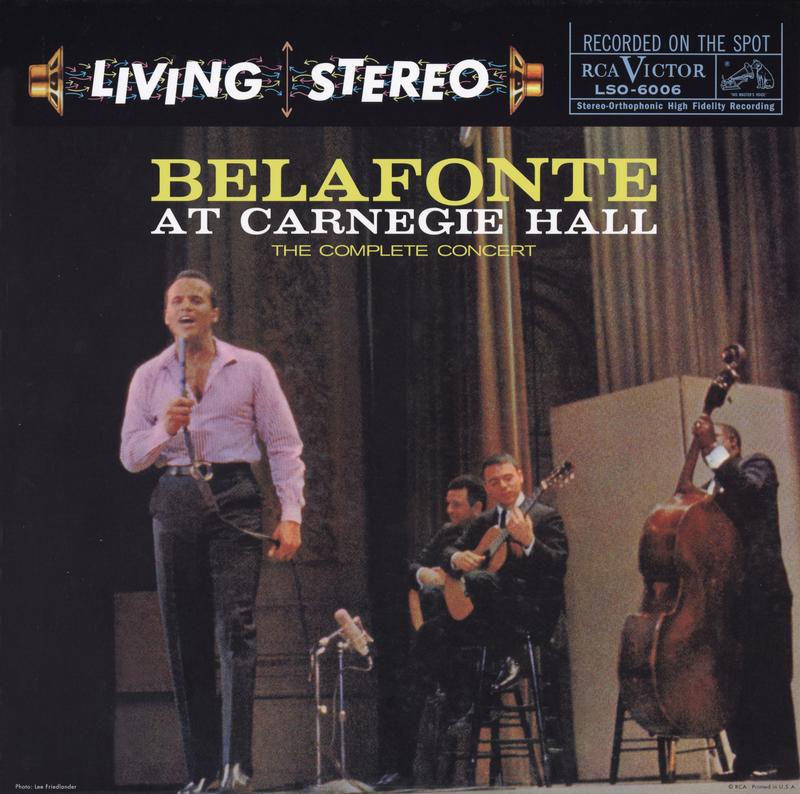
On 19 and 20 April 1959, Harry Belafonte appeared at Carnegie Hall in New York. The concerts benefited the New Lincoln School and the Wiltwyck School. Those evenings became Belafonte at Carnegie Hall, released by RCA as a double album in October 1959. The record remained on the charts for more than three years and received a Grammy nomination for Album of the Year. Behind that remarkable success is a programme presenting Belafonte as singer, storyteller and the centre of a shared concert experience.
His name was already widely known. Calypso had brought exceptional popular success in 1956, but the Carnegie Hall recordings reveal a broader horizon than a single stylistic label might suggest. American songs, Caribbean repertoire and material from other traditions appear alongside one another. The performer and the programme’s organisation provide the connection. A concert album can preserve those relationships differently from a collection of studio hits: it documents a sequence designed for a particular room and an audience present at the event.
The benefit character of the performances belongs to their historical identity. It connects Belafonte’s artistic work with the social engagement that helped define his career. The recording can still be approached first as a musical event. There is no need to treat every line as a political statement to take its setting seriously. The coexistence of entertainment, songs with varied histories and public commitment is part of what makes Belafonte such an interesting figure.

The voice, the accompanists and the work behind the concert
The documented musicians include guitarists Millard Thomas and Raphael Boguslav, Danny Barrajanos on bongos and conga, and Norman Keenan on bass. Bob Corman directed the musical forces. These are concert personnel credits; a secure track-by-track allocation of every accompanist is not available. What matters for the album is that Belafonte’s voice is supported by a deliberately shaped musical setting. Its participants have names of their own and deserve to remain visible alongside the celebrated singer.
Guitars, bass and percussion are among the colours of that setting, with an orchestral contribution under Corman’s direction. Such a framework can connect different types of song while allowing changes in scale within the programme. One useful listening approach is to follow the distribution of attention between singer, accompaniment and audience. A live album is more than a studio record with applause added: the listeners’ presence belongs to the circumstances in which the performances take shape.
Bob Bollard produced the original release and Bob Simpson engineered it. Lee Friedlander supplied the cover photograph, while John Gundelfinger created the interior illustration. These credits show how carefully a concert document was also conceived as a physical object. Recording, selection, sequence and packaging turned two evenings into an album that could circulate independently of the events themselves. The two concert dates provide the established frame; individual selections are not assigned here to one evening without supporting evidence.

A journey through the repertoire
The original programme was divided into three thematic sections. The first carried the historical heading “Moods of the American Negro”, followed by “In the Caribbean” and “Around the World”. The first title belongs to the language of the period’s release. Together, the headings describe the programme’s broad movement without reducing the different histories of its songs to a single origin or meaning.
The first side of this 33⅓ RPM edition moves from the introduction and “Darlin’ Cora” through “Sylvie” and “Cotton Fields” to “John Henry” and “Take My Mother Home”. The second side presents “The Marching Saints”, “Day O” and “Jamaica Farewell”, followed by “Man Piaba” and “All My Trials”. This sequence already brings narrative songs together with numbers closely associated with Belafonte’s public image. Familiarity can provide an accessible entrance, while the album encourages attention to the songs’ relationships inside a planned concert.
The third side contains “Mama Look a Boo Boo”, “Come Back Liza” and “Man Smart (Woman Smarter)”, then “Hava Nagila”, “Danny Boy” and “Merci Bon Dieu”. The fourth side moves through “Cucurrucucú Paloma” and “Shenandoah” to “Matilda”. “Matilda” is particularly associated with Belafonte’s engagement of his listeners and their participation. The publisher’s account highlights this communal aspect. It helps explain why the album is collected as a record of a concert situation as well as a record of a singer.
This double LP contains the original programme of 19 selections. “Merci Bon Dieu” is included explicitly here, although it is absent from an abbreviated shop listing. The additional tracks available in the separate five-LP box are not part of this edition. The distinction preserves the double album’s actual character: it is neither expanded with music that these records do not contain nor diminished by an incomplete tracklist. Belafonte’s journey through the repertoire remains identifiable in the sequence documented for this particular format.
The breadth of material is one reason to stay with the full sequence. A listener may arrive for “Day O”, “Jamaica Farewell” or “Matilda”, then find that the quieter narrative songs or less familiar titles reshape the experience. The album format supplies the context in which those encounters can happen. Belafonte’s name provides continuity, but the repertoire keeps changing the questions asked of him as a performer.
The double album at 33⅓ rpm
The product offered here is AAPF 6006, Analogue Productions’ two-LP stereo edition running at 33⅓ rpm. Ryan K. Smith cut it at Sterling Sound from the original analogue three-track tapes. Gary Salstrom is credited with plating, and this edition is pressed at Quality Record Pressings. These specifications refer to the double album. They should not be merged uncritically with those of the five-LP 45 RPM box, which carries a different catalogue number and includes additional material. Both releases make the same concert document available, but they do not present identical contents across the same number of record sides.
The current supplier heading specifies 180 grams, while a documented earlier edition from 2014 is listed as a 200-gram pressing. The weight of a particular supplied stock batch therefore remains unconfirmed without examining the copy. The established features are two stereo LPs, their speed, the 19 selections, Ryan K. Smith’s cutting credit and manufacture at QRP. This distinction is useful for collectors: it preserves the offered edition’s specific identity without treating characteristics of an older pressing as a promise about every current delivery. The reissue’s manufacturing history complements the original recording history rather than replacing it.
Four record sides allow larger portions of the programme to unfold without interruption than the more extensive 45 RPM box. This is a practical consideration, particularly for a concert album whose interest includes its progression, transitions and relationship with the audience. It need not become a general judgement about the sonic ranking of different speeds. Listeners who appreciate the traditional double-album form receive a clearly organised sequence with three side changes. The technical presentation remains connected to the music: to the songs, the accompanying musicians and Belafonte’s ability to give a wide-ranging programme the coherence of a shared evening.
Belafonte at Carnegie Hall can serve several purposes in a collection: a concert classic, an encounter with Belafonte’s wide-ranging repertoire and a specifically documented recording project. The famous songs provide an entrance; the programme, the accompanists and the audience make the experience larger. You order from Michael 45 in Germany. We arrange the US import and dispatch from Hilden. This double LP keeps attention on the original programme and its internal movement. Anyone beginning with “Day O” or “Matilda” will find enough other stories and song traditions between them to make a complete journey through all four sides rewarding in its own right.
Also on 45 RPM vinyl: Belafonte At Carnegie Hall
More by Harry Belafonte: Belafonte Sings The Blues
Customer question: Buying Analogue Productions records in Europe
Musicians
Participants and documented credit status. Track references correspond to the tracklist.
- Harry BelafontePortrait: 1963vocalsParticipation: Album personnel; track assignments unconfirmed
- Millard ThomasguitarParticipation: Album personnel; track assignments unconfirmed
- Raphael BoguslavguitarParticipation: Album personnel; track assignments unconfirmed
- Danny Barrajanosbongos, congaParticipation: Album personnel; track assignments unconfirmed
- Norman Keenandouble bassParticipation: Album personnel; track assignments unconfirmed
- Bob Cormanorchestra conductorParticipation: Album personnel; track assignments unconfirmed

19 selections following this double LP, including Merci Bon Dieu. The concert’s three acts are not LP side designations. Supporting personnel are album credits without unverified individual track assignments.

Reviews
There are no reviews yet.