A band redraws its lines
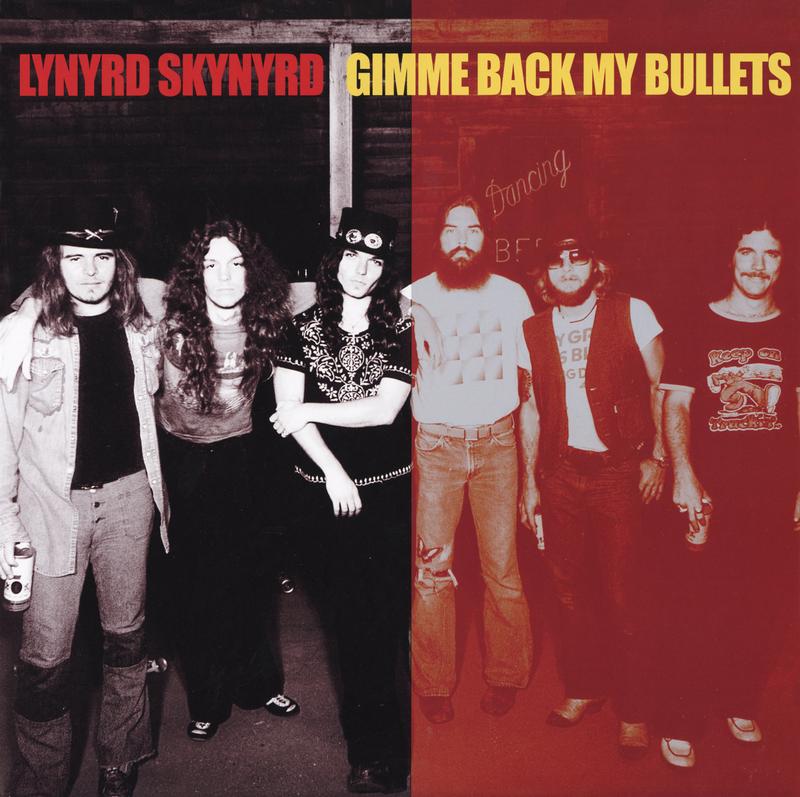
Gimme Back My Bullets catches Lynyrd Skynyrd at an interesting point in their history. Released on February 2, 1976, their fourth studio album preserves the distinctive meeting of rock, blues and country while working with a changed guitar line-up. Gary Rossington and Allen Collins share the guitar duties; Ed King is not part of this recording’s personnel. Listeners who primarily associate Skynyrd with a celebrated three-guitar attack will therefore encounter a different balance. Two guitars can create space, distinguish their responsibilities and propel a song just as decisively. The record deserves to be heard as a particular ensemble configuration.
Ronnie Van Zant remains the storytelling centre. His words and delivery give the songs an identifiable attitude without requiring every number to adopt the same perspective. The album title can be misleading if taken literally. Its “bullets” refer to the chart symbols indicating records with upward momentum, rather than to a request for ammunition. The phrase becomes an image of recovering or demanding renewed impetus. That reading suits a band asserting its position, and a record whose energy often depends on sustained determination rather than on an endless succession of extravagant gestures.
Recording took place at two studios in 1975: the Record Plant in Los Angeles during September, and Capricorn in Macon in late November. Tom Dowd produced the album and also contributed to its technical preparation. The different locations do not turn the record into a miscellaneous collection. Its coherence comes from the musicians, their material and the focus on a tangible ensemble performance. Nine songs provide room for different temperaments without unnecessarily extending the frame. Together they suggest a compact catalogue of human tensions: trust, restlessness, belonging and the desire to say something in one’s own terms.

Ronnie Van Zant, two guitars and a flexible rhythm section
Alongside Rossington and Collins, bassist Leon Wilkeson, keyboard player Billy Powell and drummer Artimus Pyle shape the music. This is a six-piece band whose members do considerably more than support a frontman. Powell’s piano and keyboard work opens another layer between the guitars and the rhythm section. Wilkeson gives the foundation movement, while Pyle supplies the physical emphasis against which the others can work. Van Zant places his vocal lines inside that structure. With a band as familiar as Lynyrd Skynyrd, returning to the exact personnel of an individual album can be especially rewarding.
Guests are part of the story too, but their contributions have clearly defined limits. The Honeycuts provide backing vocals on “Double Trouble” and “Cry for the Bad Man”. Lee Freeman plays harmonica on “Same Old Blues”. Barry Lee Harwood contributes Dobro and mandolin to “All I Can Do Is Write About It”. Those assignments help explain differences in instrumental colour between songs. They should not be broadened into an implication that every additional player appears throughout the record. Precise credits preserve the small distinctions that make an album worth returning to, rather than smoothing them into a generic account of the band.
The movement between electric directness and acoustic instruments connects the music to its several roots. Country is more than decorative flavour, just as blues involves more than a recognisable chord sequence. Both traditions affect how a story is delivered and how a musical phrase reaches its conclusion. Voice, piano, bass and the two guitars can be followed as participants in a conversation. Paying attention to their individual functions does not distract from the band sound. It makes clearer how many small decisions contribute to the apparent ease of a performance that works as a whole.

Nine songs, from insistence to a wider horizon
The title track opens with an unmistakable statement. “Every Mother’s Son” then expands the perspective before “Trust” and the J. J. Cale composition “Same Old Blues” occupy this edition’s second side. The borrowed song is a useful point of reference. It shows that Skynyrd’s identity does not depend exclusively on writing their own material. Another writer’s song can become personal through a band’s interpretation. Lee Freeman’s harmonica is one specific element of this performance, rather than a feature to be assigned indiscriminately to the sessions as a whole.
Side three brings together “Double Trouble”, “Roll Gypsy Roll” and “Searching”. Even their titles suggest different kinds of movement and unease. The album is concise enough for those differences to remain distinct instead of dissolving into a long succession of interchangeable rock numbers. With its additional voices, “Double Trouble” has a personnel colour of its own. There is value in following the sequence as a sequence: each song changes not only what comes next but also the memory of what preceded it. On this pressing, the side breaks organise those relationships into short, clearly defined sections.
“Cry for the Bad Man” and “All I Can Do Is Write About It” complete the programme. The final song opens a different horizon through its Dobro and mandolin. The conclusion comes from a change of resources rather than from one more increase in electric intensity. That is one of the album’s strengths. It does not have to demonstrate its allegiance to rock at every moment. The closing piece can tell its story and leave room around it. For collectors, these nine tracks also identify the original album programme clearly; material from later expanded editions is not folded into the description.
Two records at 45 rpm: a specific edition
Analogue Productions spreads the programme across two 180-gram LPs running at 45 rpm. The four sides contain two, two, three and two tracks respectively. Ryan K. Smith cut the edition at Sterling Sound from the analogue tapes, with manufacturing handled by Quality Record Pressings. A Stoughton gatefold jacket completes the presentation. These details identify AAPP 2170-45 as a particular production, rather than an interchangeable later pressing of a familiar title. A standard 33⅓-rpm issue may tell the same album story, but it is a different physical edition with a different cutting configuration.
The 45-rpm arrangement involves a deliberate exchange: more disc space for each section of music, and more frequent visits to the turntable. Higher speed alone does not guarantee a particular listening impression. The source, cutting decisions, pressing and playback system all remain important. Here, however, the production chain is explicitly identified. For a collector seeking this recording in a carefully supervised audiophile edition, that is more informative than an unsupported promise of greater dynamics or universally superior tone. These are documented manufacturing facts, rather than the language of an invented personal listening session.
Historical references to small runs of earlier pressings do not establish a current limit on availability. An older collector’s entry should therefore not become a present-day numbered-edition promise. The lasting reason to explore this record lies in its ensemble: Van Zant’s presence, the two-guitar relationship, Powell’s additional harmonic voice and a rhythm section with its own character. Gimme Back My Bullets deserves a distinct place within a substantial catalogue. It speaks a recognisable musical language through a particular combination of players, material and emphasis, and this edition gives that combination a clearly documented vinyl presentation.
You order from Michael 45 in Germany. We arrange the US import and ship from Hilden.
More by Lynyrd Skynyrd: Nuthin’ Fancy · Pronounced Leh-nerd Skin-nerd
Customer question: Buying Analogue Productions records in Europe
Musicians
Participants and documented credit status. Track references correspond to the tracklist.
- Ronnie Van ZantPortrait: 1976lead vocalsParticipation: Album personnel
- Gary RossingtonguitarParticipation: Album personnel
- Allen CollinsPortrait: 1975guitarParticipation: Album personnel
- Leon Wilkesonbass, backing vocalsParticipation: Album personnel
- Billy PowellkeyboardsParticipation: Album personnel
- Artimus PylePortrait: 1975–1977drums, percussionParticipation: Album personnel
- The Honeycutsbacking vocalsParticipation: C1, D1
- Lee FreemanharmonicaParticipation: B2
- Barry Lee HarwoodDobro, mandolinParticipation: D2
- Tom Dowdproduction, recording engineerParticipation: Album personnel


Band credits describe the album personnel. Guests are assigned to documented tracks; Tom Dowd is producer and engineer. Ed King is not part of this album line-up.

Reviews
There are no reviews yet.