

A jazz meeting that reaches beyond the television screen
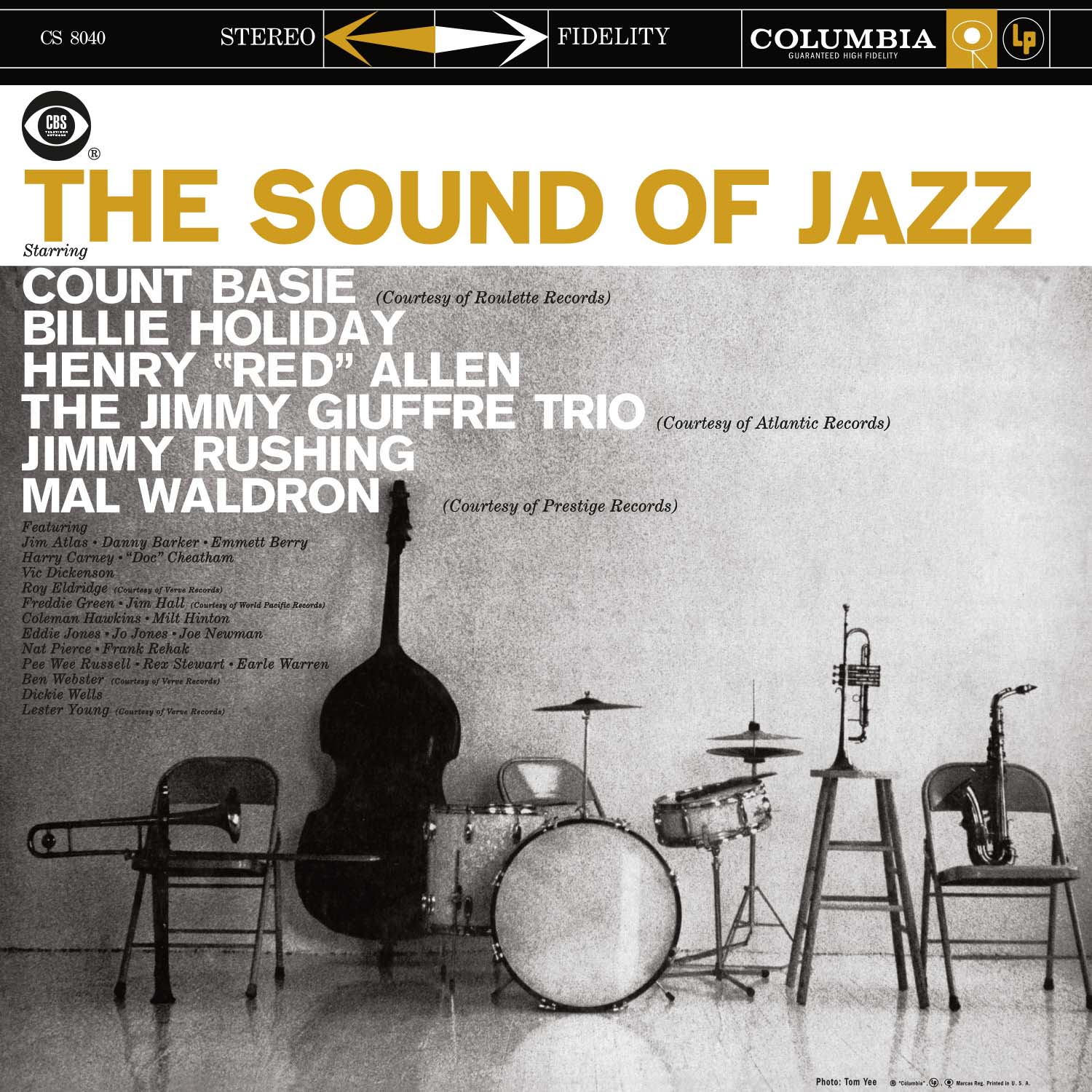
The Sound Of Jazz brings together musicians whose names open different chapters of jazz: Billie Holiday and Count Basie, Coleman Hawkins and Lester Young, Jimmy Giuffre and Mal Waldron. Its background is the celebrated CBS television programme broadcast on December 8, 1957. The record nevertheless requires an important distinction: it documents a separate studio recording made before the programme, rather than simply reproducing its soundtrack. If you want to buy The Sound Of Jazz on vinyl, this Analogue Productions edition presents the independent eight-track album, originally issued by Columbia in 1958, across two LPs playing at 45 RPM.
That independence is part of its appeal. A television picture directs your attention towards a face, a gesture or the next soloist. A record leaves those choices to your ears. You can follow a bass line, trace a response in the horns or concentrate on the way a singer places a phrase against the accompaniment. The programme moves through different group sizes and musical approaches without turning into a classroom history of jazz. Eight pieces are enough to bring markedly different ways of playing together into the same sequence.
The television connection remains an essential part of the background. Within The Seven Lively Arts, established swing musicians encountered players whose smaller groups opened other musical spaces. The album carries that idea forward, but it has its own personnel and running order. Every musician visible in the famous television footage should therefore not automatically be assigned to this LP. The personnel section below follows the documented album credits and maps them to the sides of this particular edition.
You do not need to know the programme to find a way into the music. There are large ensembles, a singer with an accompanying group, a trio, a quartet and a piano solo. Those changes keep the sequence engaging. At the same time, blues, standards and improvisational exchange connect the different formats. The focus is on individual musicians listening to one another and finding their own accents within forms they share. The record offers several perspectives on that process rather than a single answer to what jazz should sound like.

Red Allen, Billie Holiday and a quartet without bass
The first side belongs to Henry “Red” Allen and his All Stars. Wild Man Blues and Rosetta introduce a lineup combining trumpets, trombone, clarinet and tenor saxophone with a rhythm section. Rex Stewart joins Allen; Vic Dickenson plays trombone, Pee Wee Russell clarinet and Coleman Hawkins tenor saxophone. Nat Pierce, Milt Hinton and Jo Jones supply piano, bass and drums. The names already suggest why these two performances deserve attention as more than an interchangeable introduction to the better-known selections that follow.
Groups of this kind depend on the relationship between collective movement and individual voices. One horn line can support, interrupt or comment on another. A rewarding approach is to follow the ensemble first and concentrate on particular players when returning to the record. Wild Man Blues and Rosetta sit next to one another, allowing the same lineup to make more than a fleeting impression. The second side then shifts the centre of attention without abandoning the conversational character established at the beginning.
Billie Holiday sings Fine And Mellow, with Mal Waldron credited on piano, Danny Barker on guitar, Jim Atlas on bass and Jo Jones on drums. The documented horn credits include Ben Webster, Coleman Hawkins and Lester Young. Holiday’s voice is consequently surrounded by pronounced musical personalities. The interest lies in the relationship between the sung narrative and the instrumental contributions. There is no need to turn the performance into a retelling of a legend to understand why this piece forms such a compelling centre within the programme.
Blues follows with Pee Wee Russell, Jimmy Giuffre, Danny Barker and Jo Jones. Two clarinets, guitar and drums establish a different balance from the preceding All-Star group. No bassist is listed for this quartet. That distribution of instruments invites a useful listening question: how does the music move when familiar responsibilities are shared differently? The change within the same record side encourages us to distinguish the number of players from the richness of their conversation. A smaller group need not mean a smaller range of possibilities.

Basie’s ensemble, Giuffre’s trio and Waldron alone
I Left My Baby opens the third side with Count Basie’s All Stars and Jimmy Rushing as vocalist. A substantial horn section meets piano, guitar, bass and drums. Freddie Green, Eddie Jones and Jo Jones are part of that rhythmic foundation. The horns include Harry Carney, Earle Warren, Lester Young, Coleman Hawkins, Roy Eldridge and Joe Newman, among others. The complete list appears below the story. It shows how much individual musical history can come together within a single track without requiring the listener to memorise every name before enjoying it.
The vocal perspective differs from Fine And Mellow. Moving from Holiday to Rushing changes the personality around which the ensemble gathers. A comparison need not become a ranking. It is more interesting to consider how a band responds to a particular voice, and how that voice shapes the progress of the performance. Heard in this way, the album becomes a succession of different relationships between an individual at the centre and the players around them. Familiar instrumentation can still produce a different social and musical balance.
The Train And The River reduces the forces again. On the album recording, Jimmy Giuffre’s trio comprises Giuffre, Jim Hall and Jim Atlas. Giuffre’s credit lists clarinet, tenor saxophone and baritone saxophone; Hall plays guitar and Atlas bass. This describes the credited instrumental range, not three wind instruments played simultaneously. After the larger ensemble, the relationship between separate lines becomes particularly apparent. The trio offers another way of organising movement and exchange, and gives the listener room to follow that organisation closely.
The fourth side begins with Mal Waldron’s solo piano piece Nervous and finishes with Dickie’s Dream, returning to Basie’s All Stars. The change in scale is easy to recognise: a single instrument, followed by an ensemble. Waldron has already appeared accompanying Holiday; here the piano becomes the sole focus. Familiar names returning in altered roles connect the record more strongly than a simple roster of celebrated guests could. Dickie’s Dream brings the sequence back to swing and gives the album a collective ending after its most concentrated instrumental setting.
The Analogue Productions double LP
This edition carries catalogue number AAPJ 111-45. Its eight tracks occupy four sides, with two pieces on each side. Both 180-gram LPs play at 45 revolutions per minute. Ryan K. Smith is credited with mastering at Sterling Sound from the original three-track tape, while Quality Record Pressings manufactured the records. Stoughton Printing supplied the traditional tip-on gatefold jacket. These details identify the offered reissue; they should not be mixed with the technical specifications or mastering credits of other versions of the album.
Four sides also mean more interruptions than a single LP would require. In this case, the concise pairs work naturally with the changing programme. Red Allen’s two performances are followed by Holiday and the clarinet quartet, then Basie and Giuffre’s trio, and finally Waldron and the closing ensemble. The physical format therefore gives the sequence a series of distinct chapters. That is a practical description of how this edition unfolds, rather than an automatic claim that 45 RPM makes every aspect of a recording superior.
The Sound Of Jazz is especially attractive when a collection is beginning to reach beyond individual bandleaders. It links singers, soloists and accompanists without smoothing away their differences. The tracklist supplies orientation; the personnel section suggests further discoveries. A listener arriving through Billie Holiday might leave interested in Waldron or Webster, while someone familiar with Basie encounters Giuffre’s smaller group alongside him. The record opens several doors while remaining a complete programme with a beginning, a changing middle and a satisfying return to the ensemble.
You order from Michael 45 in Germany. We arrange the US import and dispatch from Hilden.
Customer question: Buying Analogue Productions records in Europe
Musicians
Participants and documented credit status. Track references correspond to the tracklist.
- Billie HolidayExisting portrait; not a session depictionvocalsParticipation: B1 · Fine And Mellow
- Milt HintonPortrait reference: 1965bassParticipation: A1, A2
- Pee Wee RussellclarinetParticipation: A1, A2, B2
- Jo JonesPortrait reference: 1959drumsParticipation: A1, A2, B1, B2, C1, D2
- Nat PiercepianoParticipation: A1, A2
- Coleman HawkinsExisting portrait; not a session depictiontenor saxophone, saxophoneParticipation: A1, A2, B1, C1, D2
- Vic DickensonExisting portrait; not a session depictiontromboneParticipation: A1, A2, B1, C1, D2
- Henry “Red” AllentrumpetParticipation: A1, A2
- Rex StewarttrumpetParticipation: A1, A2
- Jim AtlasbassParticipation: B1, C2
- Danny BarkerguitarParticipation: B1, B2
- Mal WaldronExisting portrait; not a session depictionpiano, soloistParticipation: B1, D1
- Ben WebsterExisting portrait; not a session depictiontenor saxophoneParticipation: B1
- Lester Youngtenor saxophone, saxophoneParticipation: B1, C1, D2
- Doc CheathamtrumpetParticipation: B1, C1, D2
- Jimmy Giuffreclarinet, baritone saxophone, tenor saxophoneParticipation: B2, C2
- Eddie JonesbassParticipation: C1, D2
- Freddie GreenExisting portrait; not a session depictionguitarParticipation: C1, D2
- Count BasieExisting portrait; not a session depictionpianoParticipation: C1, D2
- Earle WarrensaxophoneParticipation: C1, D2
- Harry CarneyExisting portrait; not a session depictionsaxophoneParticipation: C1, D2
- Dickie WellstromboneParticipation: C1, D2
- Frank RehaktromboneParticipation: C1, D2
- Emmett BerrytrumpetParticipation: C1, D2
- Joe NewmantrumpetParticipation: C1, D2
- Roy EldridgeExisting portrait; not a session depictiontrumpetParticipation: C1, D2
- Jimmy RushingvocalsParticipation: C1
- Jim HallExisting portrait; not a session depictionguitarParticipation: C2


Original LP credits transferred by track title to this four-side edition. A studio album recorded before the telecast, not the broadcast soundtrack. Secondary sources disagree on December 4/5; no exact studio date asserted here. Irving Townsend: producer; Ryan K. Smith / Sterling Sound: mastering from the original three-track tape; QRP: pressing; Stoughton: jacket. Giuffre’s listed instruments reflect the credit, not simultaneous performance.
How Michael hears this edition
Listening impression · paraphrased from the video
Michael explicitly recommends this 45-RPM edition from Analogue Productions. He praises its sound and the execution of this jazz album featuring musicians such as Count Basie and Billie Holiday. He does not make a direct listening comparison with the earlier 33⅓-RPM edition in this passage.

Reviews
There are no reviews yet.