

Sarah Vaughan and the art of a ballad
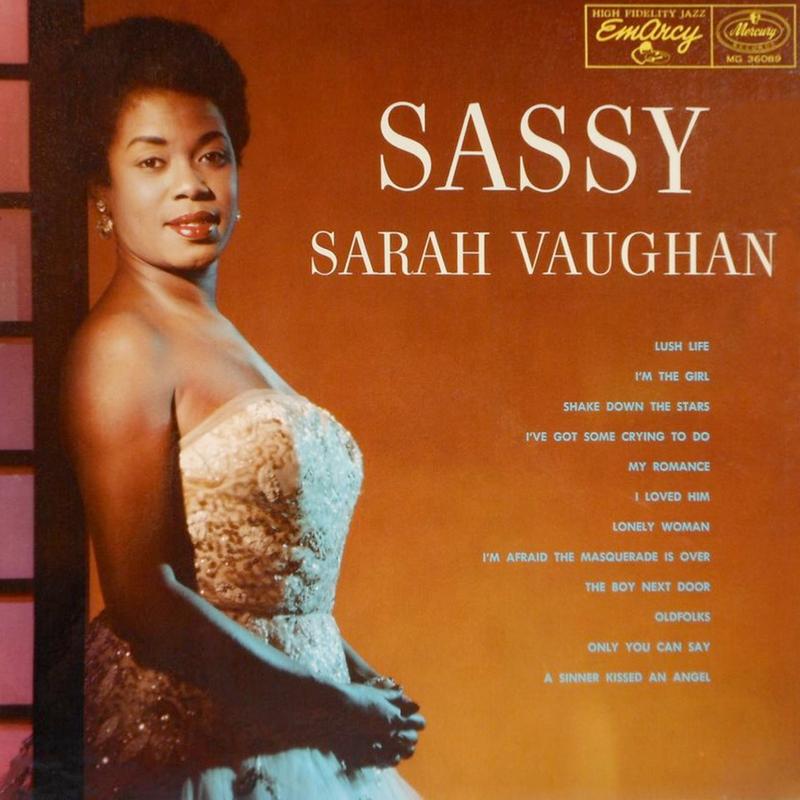
Sassy is one of Sarah Vaughan’s familiar nicknames. As an album title it promises personality, and this 1956 recording shows how much personality can live inside a carefully shaped song. Vaughan sings with Hal Mooney and His Orchestra. The sessions took place in New York on April 1, 2 and 8, with EmArcy releasing the album later that year. Twelve selections form a programme in which intimacy, memory and disappointment receive different emphases. The singer provides the connecting thread.
Compared with the small ensemble of her album with Clifford Brown, the orchestra opens up a different space. Hal Mooney is responsible for both arrangements and conducting. He gives Vaughan a setting in which a song can develop through changing colours, transitions and carefully graded accompaniment. The voice remains the storyteller, but the arrangement helps determine how that story reaches the listener. It deserves attention as an active part of the interpretation and its emotional effect, rather than merely an attractive surrounding texture.

Hal Mooney’s musical setting
An orchestral vocal album requires different decisions from a session with a handful of soloists. Accompaniment has to leave room for words and breath while helping shape the course of a song. On Sassy, Hal Mooney is the documented figure responsible for that work. The individual orchestral players cannot be reliably identified from the available evidence. Their contribution is no less important for that reason; it simply sets a limit on which names can responsibly be attached to this particular recording.
A rewarding listening route leads from the voice into the accompaniment and back again. What turn does the orchestra prepare? Where does Vaughan carry a thought beyond the expected bar line? When does a pause acquire weight? Such details turn a standard into a personal narrative. No theoretical training is needed to appreciate them. Give a song time and notice how delivery and arrangement work together. The care within these small decisions is a substantial part of the album’s enduring appeal.

From “Lush Life” to “Old Folks”
Billy Strayhorn’s “Lush Life” opens the record with a song that asks for particularly close attention to language and melodic direction. “I’m The Girl,” “Shake Down The Stars” and “I’ve Got Some Crying To Do” continue the programme, before “My Romance” and “I Loved Him” complete the first side. These choices allow Vaughan to approach love and recollection from different perspectives. Individual songs illuminate one another without needing to claim a continuous storyline across the whole album.
The second side starts with “Lonely Woman,” followed by “I’m Afraid The Masquerade Is Over,” “The Boy Next Door,” “Old Folks,” “Only You Can Say” and “A Sinner Kissed An Angel.” These juxtapositions invite attention to each song’s character. The shift between intimate address and a broader melodic gesture is particularly rewarding. Listeners who admire Vaughan’s vocal agility can also focus on restraint here: the places where a simply placed note can carry more weight than an elaborate ornament.
The Acoustic Sounds Series mono LP
This reissue, AEMA 512476, contains the twelve-track album programme in mono on one 180-gram LP at 33⅓ RPM. Ryan K. Smith handled mastering and lacquer cutting at Sterling Sound. The publisher identifies the original analogue tapes as the source. The presentation combines pressing by Quality Record Pressings with a Stoughton Printing tip-on gatefold jacket, and Chad Kassem supervises the reissue. These details identify this specific EmArcy edition within the Acoustic Sounds Series and distinguish it from other releases of the album.
The care behind an edition like this matters most when it brings renewed attention to the music. Sassy suits an evening when each song has time to make its impression before the next begins. Vaughan and Mooney provide the changing forms and colours; the listener discovers the connections. Between celebrated standards and less constantly encountered selections, the record reveals a singer whose gifts extend beyond range and virtuosity. They include the ability to give a single line an unmistakably human character, and to make that character remain with us.
You order from Michael 45 in Germany. We arrange the US import and dispatch from Hilden.
More by Sarah Vaughan: Crazy and Mixed Up · How Long Has This Been Going On?
Musicians
Participants and documented credit status. Track references correspond to the tracklist.
- Sarah VaughanvocalsParticipation: Album personnel
- Hal Mooneyarrangements, bandleaderParticipation: Album personnel
- Hal Mooney and His OrchestraorchestraParticipation: Album personnel

Sarah Vaughan (vocals) with Hal Mooney and His Orchestra; arranged and conducted by Hal Mooney. Recorded April 1, 2 and 8, 1956; originally released as EmArcy MG 36089 (1956). Individual orchestra personnel, producer and recording engineer are not documented. This edition (Acoustic Sounds Series, mono): mastered and lacquer cut by Ryan K. Smith at Sterling Sound; pressed at Quality Record Pressings, gatefold jacket by Stoughton Printing (publisher’s information); reissue supervised by Chad Kassem.
🎧 Review video: 12 Amazing New Reissues!
This video is hosted by YouTube (Google). It only loads once you switch on “Functional” in the cookie settings.

Reviews
There are no reviews yet.