

The beginning of an individual musical language
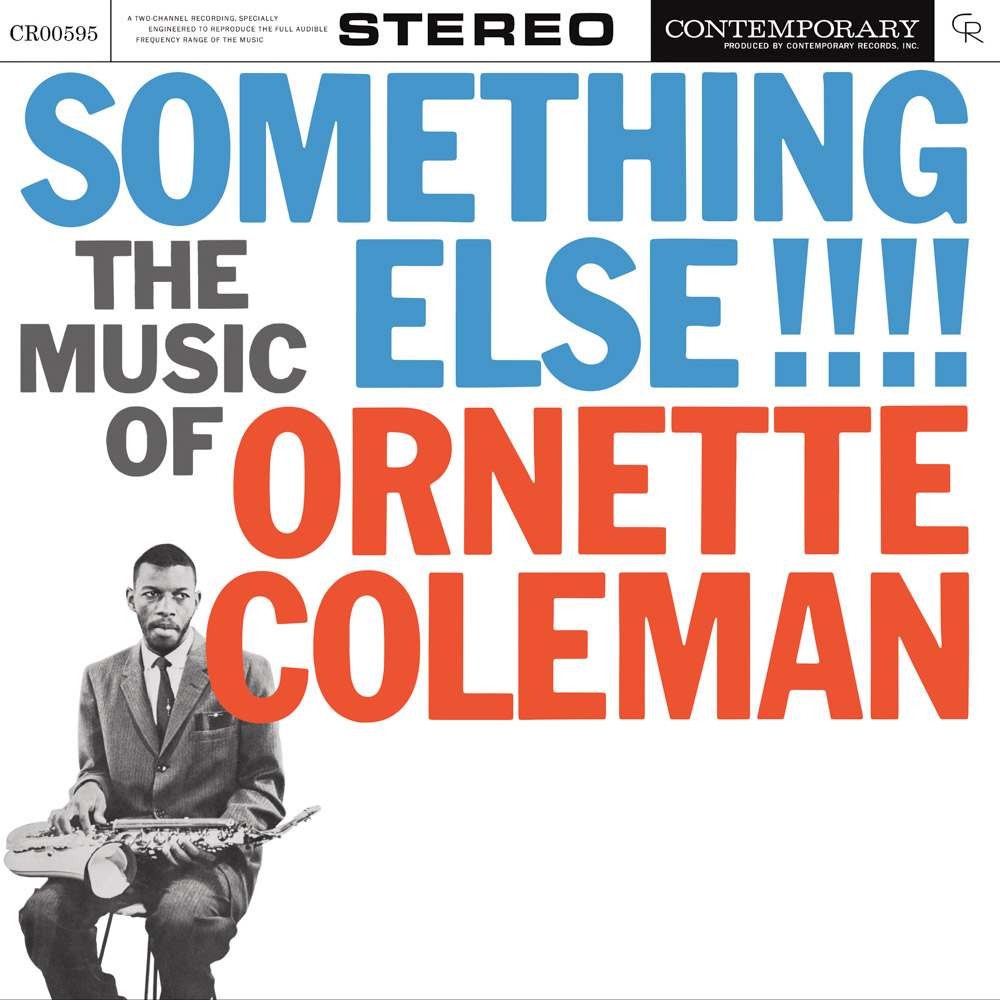
Something Else!!!! is Ornette Coleman’s debut album, and its title already announces an encounter with an individual voice. Contemporary Records released it in September 1958, following sessions on 10 and 22 February and 24 March. Lester Koenig produced the recording, with Roy DuNann as engineer. Nine compositions, all written by Coleman, form the programme. That is a clear statement for a first record: the musician introduces himself through his own themes and the possibilities he finds within them, rather than through a selection of standards already familiar to his audience.
It is useful to begin with the actual five people making the music. Coleman plays alto saxophone, Don Cherry cornet, Walter Norris piano, Don Payne double bass and Billy Higgins drums. At first glance, this is a recognisable modern-jazz instrumentation. That familiarity is part of the album’s interest. An individual language is emerging within a framework whose instruments and customary roles were not fundamentally alien to listeners. Knowing the later Coleman recordings is not a prerequisite for following these themes or the relationships between the five participants in this particular group.
Approaching the record backwards from the celebrated debates surrounding Coleman can turn listening into a search for signs of what was to come. That risks overlooking the debut’s own present tense. Something Else!!!! has a complete programme, a particular band and a clearly defined period of creation. For collectors, it is certainly the starting point of an important discography. For music lovers, it is also an invitation to encounter nine pieces without having to demonstrate a historical revolution in every bar. Much of its interest lies in how much individuality can exist within the manageable scale of a quintet.

Five voices and the particular place of the piano
One important difference from many later Coleman recordings is Walter Norris at the piano. A chordal instrument is an integral part of this ensemble. Its presence encourages attention to the relationship between established harmonic surroundings and the freedom of movement available to the horns. Norris belongs to the identity of this specific record, not to a supposedly dispensable preliminary stage. Placing the album beside later recordings can make his contribution especially revealing: a discography consists of different encounters and groups, as well as the continuing development of a musician’s ideas.
Don Cherry is credited with cornet on this album. That is a distinction worth retaining. His later association with the pocket trumpet does not justify applying that description to every earlier instrument. Coleman and Cherry establish a relationship between two different horn voices, and their collaboration extends beyond this debut. Billy Higgins is another musician who continues to play an important part in Coleman’s subsequent work. Don Payne completes this recording’s rhythm section on double bass. These five names should not be replaced in the imagination by the personnel of a more famous later ensemble.
A helpful route into the music is to follow transitions: a shared theme becoming an individual line, a horn returning to the group, a melodic idea meeting a response from the rhythm section. How much of the piece remains present in the accompaniment while one voice moves elsewhere? What difference does the contrast between cornet and alto saxophone make? Such questions require no theoretical qualification. They direct attention to a basic pleasure of small-group jazz: musicians share a starting point without necessarily making the same decisions about where it should lead them next.
The piano also offers a point of comparison within the record itself. It is possible to focus on Norris for a passage, then return attention to the horns and notice how the perspective changes. The album need not be treated as an argument that only one player wins. Its character arises from the coexistence of these participants, and that is one reason a historically important debut can remain a satisfying individual listening experience rather than simply a chapter heading in a larger narrative.

Nine originals, from a theme to an open question
“Invisible” opens side one, followed by “The Blessing”, “Jayne” and “Chippie”. This sequence immediately makes the record a concentrated introduction to Coleman as a composer. His individuality is presented not only through improvisation but through a different written theme for each selection. At a little over seven minutes, “Jayne” is the longest track on this edition; the other pieces occupy more compact spans. The musical conversations therefore have different amounts of room to develop while remaining within the album’s relatively concise overall frame.
Side two begins with “The Disguise”, followed by “Angel Voice” and “Alpha”. “When Will the Blues Leave?” poses a question that is suggestive in approaching Coleman. The blues and an individual musical language need not be opposites. The title can encourage attention to relationships with the blues without forcing the entire album into a single formal category. “The Sphinx” closes the programme. Since all nine pieces are Coleman compositions, the record is as much an early portrait of his writing as an introduction to his alto saxophone playing.
The sequence can be approached as a succession of small, distinct musical worlds. A particularly memorable theme may offer the first point of entry, with the other pieces opening up around it. Alternatively, a complete side allows the listener to follow differences in duration, texture and the arrival of individual voices. The record does not demand a distance of obligatory reverence. Historical importance and immediate curiosity about the five musicians can coexist. A debut gains something when it is allowed to function as an accessible album in the present, rather than only as evidence about the past.
Contemporary, Bernie Grundman and this edition
The edition offered here, ACONC 595 / CR00595, is part of the Contemporary Records Acoustic Sounds Series, a collaboration between Craft Recordings and Acoustic Sounds. It is a 180-gram stereo LP playing at 33⅓ RPM. The publisher specifies all-analogue mastering from the original tapes by Bernie Grundman for the series. The records are manufactured at Quality Record Pressings and presented in classic Stoughton tip-on jackets. Grundman also has a personal professional history with Contemporary; for this release, the relevant point is his specifically identified responsibility for the reissue’s mastering.
The 2023 release contains the original nine-track programme, with four selections on side A and five on side B. The 33⅓ format retains the straightforward progression of a single LP: two sides, two continuous sections and no expansion into additional sessions. For a collection following Coleman’s development through individual albums, that precise boundary is useful. Title, personnel and edition belong together. A famous name on a sleeve does not by itself identify which stage of a musician’s work a particular record represents or which group can actually be heard on it.
Something Else!!!! preserves one such early moment: an alto saxophonist with nine original compositions, a quintet that includes piano, and a release on Contemporary. The later story need not be ignored, but it should not replace curiosity about this album. You order from Michael 45 in Germany. We arrange the US import and dispatch from Hilden. For anyone seeking an entry point that brings together composition, ensemble identity and the emergence of an individual voice, this is an unusually rewarding and clearly defined record.
More by Ornette Coleman: Tomorrow Is The Question!
Series: Contemporary – all 24 records: sunny jazz from Los Angeles
Musicians
Participants and documented credit status. Track references correspond to the tracklist.
- Ornette Colemanlate 1950salto saxophone; compositionsParticipation: All tracks
- Don Cherrylate 1950scornetParticipation: All tracks
- Walter NorrispianoParticipation: All tracks
- Don Paynedouble bassParticipation: All tracks
- Billy Higginsportrait reference 1978drumsParticipation: All tracks


Five musicians on all nine tracks; all compositions by Ornette Coleman. Don Cherry is credited with cornet for this recording.

Reviews
There are no reviews yet.