

A bandleader introduces his friend
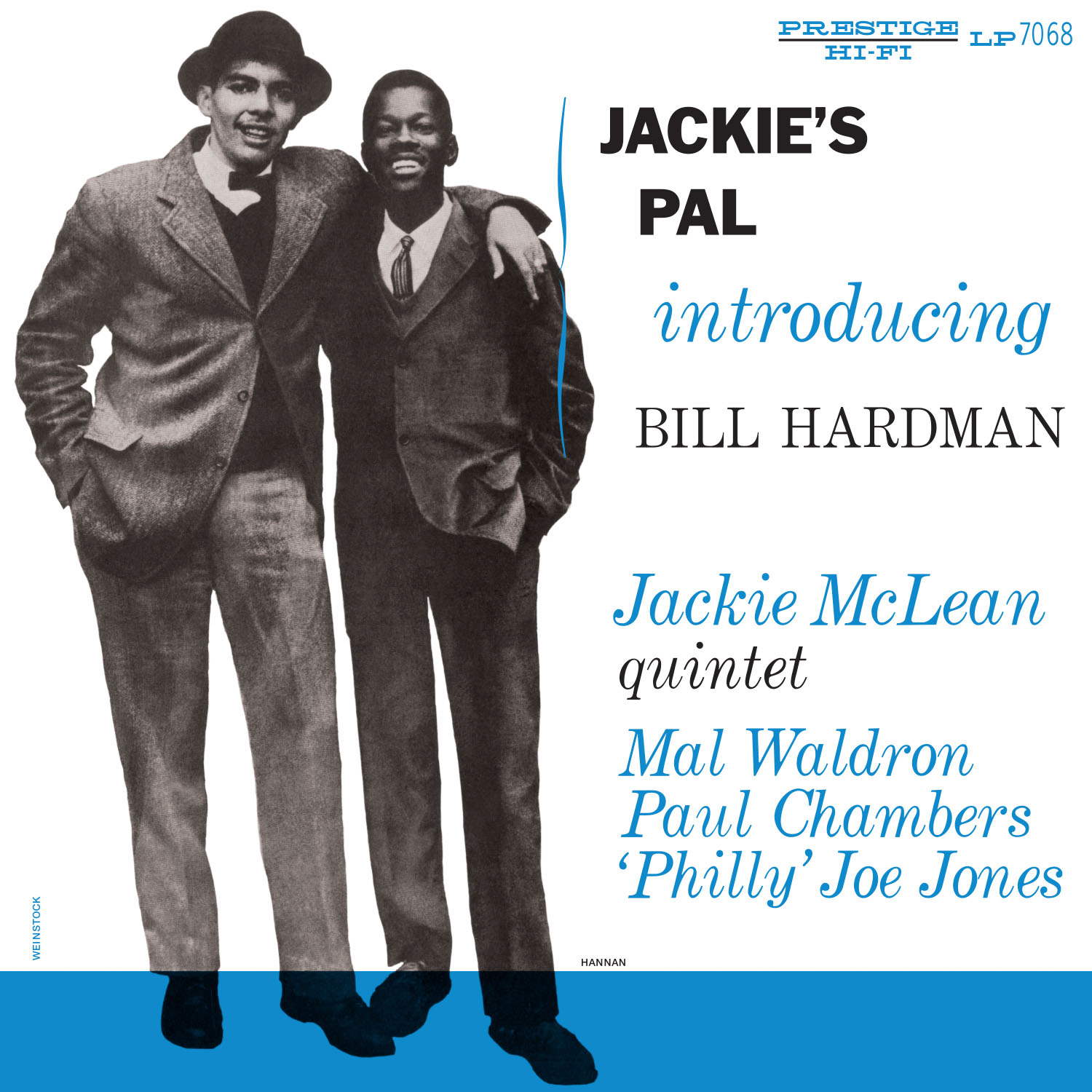
Jackie’s Pal is an unusually personal title for a jazz record. Rather than announcing an abstract programme, it points to a person: Bill Hardman. The original Prestige presentation explicitly reads Jackie McLean Quintet Introducing Bill Hardman. McLean uses his name to bring a young trumpeter forward. Recorded at Rudy Van Gelder’s Hackensack studio on August 31, 1956, the session belongs to that generous tradition in which an established musician creates a particularly visible opening for a colleague.
Hardman was twenty-three. This session marks the beginning of his documented recording career, and the programme shows that McLean gives him more than a place in the horn section. Hardman wrote two of the six pieces, and the final performance features him as the only horn player. The friendship named on the cover thus has a musical expression. McLean does not simply place another musician beside him: he provides several different opportunities to discover Hardman’s sound, his ideas and his treatment of a melody.
The association between the two also leads to Charles Mingus and Art Blakey. The label places the recording after their work with Mingus and before their shared involvement with the Jazz Messengers. This helps locate the session historically, among young musicians gaining experience in influential bands while finding possibilities of their own. Yet Jackie’s Pal deserves to be heard as more than a preliminary chapter in later careers. It has a specific repertoire, a formidable rhythm section and an intelligible musical purpose that extends through the final track. The invitation offered by its title is fulfilled by the construction of the record itself.

Bill Hardman alongside Jackie McLean
McLean’s alto and Hardman’s trumpet share the front line on five of the six selections. Their different instruments make the quintet immediately easy to follow. A saxophone shapes the tension within a note differently from a trumpet, giving a common phrase two distinct edges. One rewarding approach is to listen first to the way the horns meet in a theme, and then to the individual identities that emerge in their solos. Friendship provides the album’s premise, but its musical interest depends on the fact that these are two recognisable voices rather than interchangeable players.
Hardman contributes Just for Marty and Sublues. He is not merely a young performer receiving a few choruses from a more experienced colleague: his compositions account for a third of the programme. McLean adds Sweet Doll, while Mal Waldron supplies Dee’s Dilemma. Four of the six pieces therefore come from inside the band. This matters to the session’s character. Its members are doing more than exploring an inherited repertoire together; they are offering one another their own themes as material for collective work.
Waldron on piano, Paul Chambers on double bass and Philly Joe Jones on drums form the rhythm section. In 1956, Chambers and Jones were also members of Miles Davis’ first great quintet. Here they work with Waldron, whose compositional contribution further emphasises his part in the album. Reducing the record to an encounter between alto and trumpet would consequently miss much of its appeal. The accompaniment connects melodic movement, harmonic direction and rhythmic responses. With two contrasting horns, it is especially worthwhile to follow the piano’s place between their lines and the way bass and drums carry changes in the foreground.

Four originals, a Parker theme and Hardman’s final word
Side one opens with McLean’s Sweet Doll. Hardman’s Just for Marty and Waldron’s Dee’s Dilemma follow, introducing three members of the quintet as composers in succession. This offers an engaging listening perspective: the themes can be heard as different proposals made to the same band, with the common personnel creating continuity between them. There is no need to treat every original composition as a literal portrait of its writer. The fact that three musicians share their material with one another is already a meaningful part of the session’s identity.
Hardman’s Sublues begins the second side. Charlie Parker’s Steeplechase then introduces a point of reference of particular importance to McLean’s generation. Parker’s name here is a precise compositional credit, rather than a general label for the style. Keeping the theme in focus makes it possible to distinguish a shared bebop foundation from the individual players’ treatment of it. Collectors may enjoy placing this performance beside 4, 5, and 6, where McLean had recorded another Parker piece, Confirmation, a few weeks earlier, in that case using a sextet.
The final word belongs to Bill Hardman. Jimmy Van Heusen and Johnny Burke’s It Could Happen to You is performed by trumpet, piano, bass and drums. McLean sits out. The quintet becomes a quartet, giving the introduction of the young trumpeter its clearest expression: Hardman no longer shares the melodic foreground with the named leader. Waldron, Chambers and Jones remain alongside him. This change alters the responsibilities within the group while preserving a direct connection with the preceding music. The same rhythm section now supports a single horn voice, inviting closer attention to the trumpeter’s phrasing and to the spaces around it.
That conclusion makes Jackie’s Pal particularly rewarding as a complete album. The session listing places the song fourth, but the LP moves it to the end, giving Hardman’s feature a distinctive position in the published programme. The same music later appeared on New Jazz as Steeplechase; the original title, however, conveys the human and musical idea especially well. For collectors it is an important early document of Hardman, and for curious listeners it offers an introduction to a less frequently celebrated trumpet voice in the company of McLean and an exceptional rhythm section.
Analogue Productions: mono at 33⅓ RPM
The edition offered here is Analogue Productions’ mono LP APRJ 7068. Kevin Gray handled the mastering and lacquer cutting at Cohearent Audio, with the label specifying the analogue masters as the source. Quality Record Pressings manufactures the version currently listed at 180 grams. A high-gloss Stoughton tip-on jacket completes the presentation, retaining the familiar appearance of this Prestige recording while identifying the later mastering and manufacturing work clearly.
Earlier 200-gram editions were issued under the same catalogue number. The currently documented 180-gram repress should be distinguished from those versions. Numbering on early copies, and particular edge or label features recorded for earlier pressings, are not automatically promises about every copy offered today. The relevant identifiers here are the mono programme, Gray’s mastering, QRP manufacture and the current weight specification. Keeping those details together allows the edition to be described accurately without merging several generations of the release into one.
The single 33⅓ RPM LP preserves the programme in two groups of three tracks. Side one places the three composers from the band alongside each other; side two moves through Hardman and Parker to the closing trumpet quartet. That sequence can unfold without additional interruptions within either side. Approached in this way, the album becomes a rounded introduction to a musician, supported by a band that gives him meaningful space. You order from Michael 45 in Germany. We arrange the US import and dispatch from Hilden.
More by Jackie McLean: Lights Out!
Customer question: Buying Analogue Productions records in Europe
Series: Analogue Productions Prestige – all 50 records, musicians and session paths
Musicians
Participants and documented credit status. Track references correspond to the tracklist.
- Jackie McLeanalto saxophoneParticipation: A1, A2, A3, B1, B2
- Paul Chambersdouble bassParticipation: A1, A2, A3, B1, B2, B3
- Philly Joe JonesdrumsParticipation: A1, A2, A3, B1, B2, B3
- Mal WaldronpianoParticipation: A1, A2, A3, B1, B2, B3
- Bill HardmantrumpetParticipation: A1, A2, A3, B1, B2, B3


Jackie McLean sits out B3 (It Could Happen to You): Bill Hardman with piano, bass and drums. All other tracks: quintet. August 31, 1956, Hackensack.

Reviews
There are no reviews yet.