



Giving a ballad time to unfold
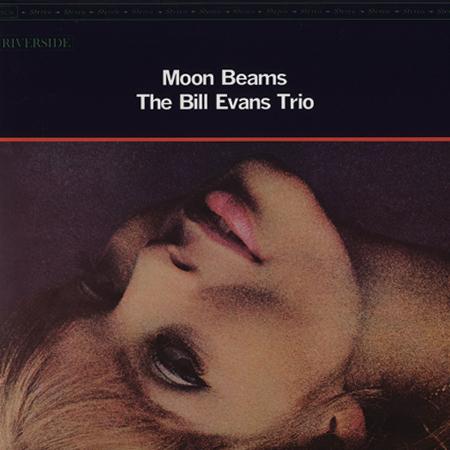
Moon Beams does not need a grand gesture to hold attention. Bill Evans takes up a melody, preserves its recognisable shape and changes the way we move through it. A harmonic turn receives more space; a slight delay makes a familiar phrase feel like a question. The music’s calm should not be confused with inactivity. Because new events are not continually demanding the foreground, decisions within a single line become unusually clear.
The recordings were made in New York during May and June 1962, with Chuck Israels on bass and Paul Motian on drums. Following Scott LaFaro’s death, this was a new configuration for Evans. Israels was not required to reproduce his predecessor’s approach. His own way of connecting notes and supporting harmonic movement helps define the trio, and distinguishes Moon Beams from the recordings made in 1961.

Two albums within one body of work
The sessions also provided material for How My Heart Sings! Producer Orrin Keepnews separated the more ballad-oriented performances from the faster pieces. Moon Beams therefore owes its character not only to the mood of individual takes, but also to a deliberate editorial decision. The slower performances relate to one another, creating a sustained musical narrative across the original album programme.
That history makes it too simple to describe the entire record exclusively as an expression of grief. The biographical context is important, but these musicians were also working with repertoire, structures and contrasting kinds of expression. The livelier companion album from the same sessions makes that especially clear. Moon Beams is a thoughtfully selected aspect of their work, not a complete account of one emotional condition.

Two Evans compositions frame the programme
“Re: Person I Knew” opens the record. Its unusual title is an anagram of Orrin Keepnews, a quiet acknowledgement of the producer that does not require explanation for the music to communicate. The composition became a recurring part of Evans’s repertoire. Here it introduces an album in which personal melodic ideas and well-established songs belong naturally beside one another.
“Very Early” is also by Evans and dates back to his student years. Between these original pieces sit such songs as “Polka Dots and Moonbeams”, “I Fall in Love Too Easily” and “If You Could See Me Now”. The gap between a composition’s age and the freshness of its performance is revealing. An early original and a standard played for years can both sound fully present when the ensemble approaches them as active musical possibilities.
Melody, bass and the art of leaving room
On a ballad record, listening beyond the soloist brings particular rewards. Israels connects the harmonic landmarks while Motian makes time perceptible through small movements. Neither has to occupy the foreground continuously in order to shape the performance. Their restrained contributions determine how freely Evans can stretch a phrase without losing contact with the group.
“It Might as Well Be Spring” and “Stairway to the Stars” can first be enjoyed simply as songs. Returning to them reveals further layers: the distance between melody and accompaniment, the weight of a bass note, the duration of a piano decay. Moon Beams is consequently more than music for a late evening. It also rewards concentrated listening to the way three players support a form together, finding expression not by making every gesture larger, but by understanding how much a seemingly modest turn can convey.
More from Analogue Productions
More by Bill Evans Trio: At Shelly’s Manne-Hole · Everybody Digs Bill Evans
Artist page: All titles by Bill Evans
Customer question: Buying Analogue Productions records in Europe
Musicians
Personnel checked against album sources.
- Bill EvansPiano
- Chuck IsraelsBass
- Paul MotianDrums


🎧 Review video: 4 New Analogue Productions Reissues: America, Benson & Bill Evans Shootout
This video is hosted by YouTube (Google). It only loads once you switch on “Functional” in the cookie settings.

Reviews
There are no reviews yet.