

A saxophonist exploring the ideas of other saxophonists
Smack Up has a straightforward but rewarding programme concept: Art Pepper plays compositions by saxophonists. Harold Land, Buddy Collette, Benny Carter, Duane Tatro and Ornette Coleman each contribute a piece, while Pepper supplies Las Cuevas de Mario. The instrument shared by the writers does not imply a single musical outlook. Different personalities provide the material from which one quintet shapes its sequence. The record can therefore be approached as an encounter between a compositional idea and an individual performance. What one musician writes and what another makes of it remain connected without having to become identical.
The music was recorded at Contemporary Records in Los Angeles on October 24 and 25, 1960. Lester Koenig produced the session, with Roy DuNann responsible for the sound. Pepper plays alto saxophone, Jack Sheldon trumpet, Pete Jolly piano, Jimmy Bond double bass and Frank Butler drums. These five names identify the performing ensemble. The other saxophonists are present through their compositions, rather than participating in the recording date. That distinction clarifies the concept: a consistent group encounters different musical starting points and builds them into an album with a common identity, established through the musicians doing the playing.
For listeners already familiar with Pepper, the selection offers a particular route towards his personality. The question concerns not only his treatment of a theme he wrote himself, but how his musical language responds to someone else’s ideas. New listeners also gain a manageable connection to several other jazz composers. Six selections cannot provide a comprehensive history of the saxophone, and that is not their purpose. They form a particular choice realised across two recording days with the same partners. Different material meets a shared musical present, a relationship that can be followed from one piece to the next.

Six compositions and six points of departure
The title track, Smack Up, was written by Harold Land and opens side A. Pepper’s own Las Cuevas de Mario follows, with its 5/4 metre providing a distinctive point of orientation. Five beats to a bar may initially seem unfamiliar, but listening need not become an exercise in arithmetic. The useful question is how a melody and its accompaniment find movement inside that organisation. A returning pulse gives the players something they can emphasise in different ways. Pepper’s contribution consequently takes its place among his colleagues’ compositions while adding a particular rhythmic characteristic to the overall selection.
A Bit of Basie, by Buddy Collette, closes the first side. Its title invokes another musical personality who is neither a performer nor the writer of this piece: Count Basie is the reference within the name. Side B begins with How Can You Lose, written by Benny Carter, followed by Maybe Next Year from Duane Tatro. The succession of writers places different ideas alongside one another. Rather than hearing the tunes only as settings for solos, try attending to their themes and transitions as the material from which each performance begins. That makes the musicians’ responses easier to consider in context.
Ornette Coleman’s Tears Inside concludes the LP. Its position is especially interesting within this concept: a Coleman composition appears in a quintet with piano, alongside work by the other saxophonists. It encourages a distinction between an individual piece and familiar assumptions about its composer. Music can enter another setting and establish different relationships there. The six tracks are divided evenly between the two sides. Solid Citizens and its alternative take, included on expanded CD editions, are absent from this LP. The original selection retains its compact identity, allowing the six compositions to be heard as a deliberately bounded sequence.

Art Pepper, Jack Sheldon and the rhythm section’s three voices
Alto saxophone and trumpet give the quintet two clearly differentiated horn voices. Pepper and Jack Sheldon share an ensemble working with material from several writers. One useful approach is to follow the relationship between the theme and an individual line. Which features of the melody remain a point of reference? When does attention move towards the beginning of a note or the ending of a phrase? The pairing of two instruments also makes clear that musical identity involves more than what is written. Different voices can give another shape to a shared task, drawing attention to expression as well as to the composition.
Pete Jolly contributes piano, Jimmy Bond double bass and Frank Butler drums. Their responsibilities overlap while remaining distinct. The piano can clarify harmonic movement and respond to a horn phrase; the bass connects the lower register with the continuing direction of the music; the drums shape its rhythmic activity. On another listening, choose one of these players as your starting point. A seemingly familiar quintet then becomes a network of specific decisions. The accompaniment receives attention as part of the interpretation, rather than simply the surface beneath the foreground. That shift can reveal another route through material you have already heard.
Leonard Feather’s sleeve notes also belong to the album’s historical setting. They direct attention towards Pepper’s understanding of individuality, particularly the personal treatment of sound and time. That perspective suits a record expressly assembled from different writers’ material. Someone else’s composition need not obscure a player’s own voice; it can bring that voice into another revealing relationship. Within a collection, Smack Up consequently offers more than another title in a substantial discography. Its understandable concept, consistent personnel and six distinct points of departure establish an identity that can be explored from several directions over repeated visits.
Contemporary, Craft and Bernie Grundman’s analogue mastering
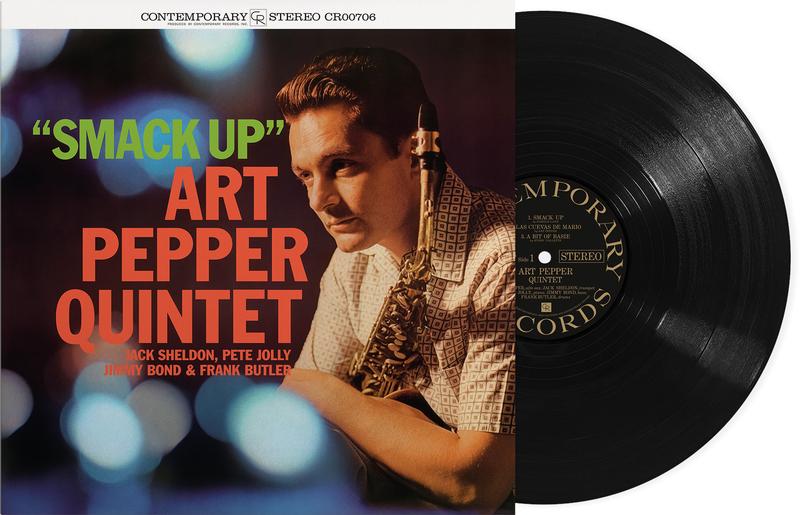
The edition offered here carries the shop code ACONC 706, while the release catalogue number is CR00706. It belongs to Craft Recordings’ Contemporary Records Acoustic Sounds Series. This identifies the publisher precisely: although Acoustic Sounds participates in the series, the release is not an Analogue Productions issue. According to the publisher, Bernie Grundman cut the lacquers AAA from the original analogue master tapes. That is an explicitly documented production claim for this reissue, rather than an assumption inferred simply because the original recording was made on analogue tape. Keeping the attribution specific helps distinguish editions carrying the same album title.
The 180-gram stereo LP is pressed at Quality Record Pressings and plays at 33⅓ RPM. It is presented in a Stoughton tip-on jacket, with the documented QRP inner sleeve. The historical cover photograph is by William Claxton, with cover design credited to Robert Guidi and George Kershaw. Recording and presentation history meet here at different stages: Koenig and DuNann belong to the 1960 session, while Grundman and QRP identify the later vinyl manufacture. Keeping those stages distinct makes the release easier to understand. A carefully specified reissue gains its identity from these particular contributions, without requiring unsupported claims about every other version.
Three selections on each side preserve the programme’s concentrated progression. The single side change follows A Bit of Basie, and the second half eventually leads to Coleman. The format allows the six compositions to be experienced as one considered selection while leaving their differences intact. Pepper collectors and listeners curious about small jazz ensembles have a clear subject here: five performers, six composers and several ways of discovering personality within familiar or borrowed material. The record’s concept provides an accessible beginning, while the individual musicians offer reasons to listen again from another perspective. You order from Michael 45 in Germany. We arrange the US import and dispatch from Hilden.
Series: Contemporary – all 24 records: sunny jazz from Los Angeles
Musicians
Participants and documented credit status. Track references correspond to the tracklist.
- Art PepperPortrait circa 1960alto saxophoneParticipation: Quintet on the six original tracks
- Jack SheldonExisting portrait; not a session depictiontrumpetParticipation: Quintet on the six original tracks
- Pete JollypianoParticipation: Quintet on the six original tracks
- Jimmy Bonddouble bassParticipation: Quintet on the six original tracks
- Frank ButlerExisting portrait reference 1956drumsParticipation: Quintet on the six original tracks


Contemporary Records, Los Angeles, October 24–25, 1960. Lester Koenig: producer; Roy DuNann: engineer; Leonard Feather: liner notes; William Claxton: photography; Guidi/Kershaw: cover design. Six original tracks. Composers in running order: Harold Land, Art Pepper, Buddy Collette, Benny Carter, Duane Tatro and Ornette Coleman. No Solid Citizens bonus tracks. Sources disagree on the original release year (1960/©1962); the recording dates are secure. Craft/Contemporary reissue, not Analogue Productions.

Reviews
There are no reviews yet.