

Twelve classics between soloist and ensemble
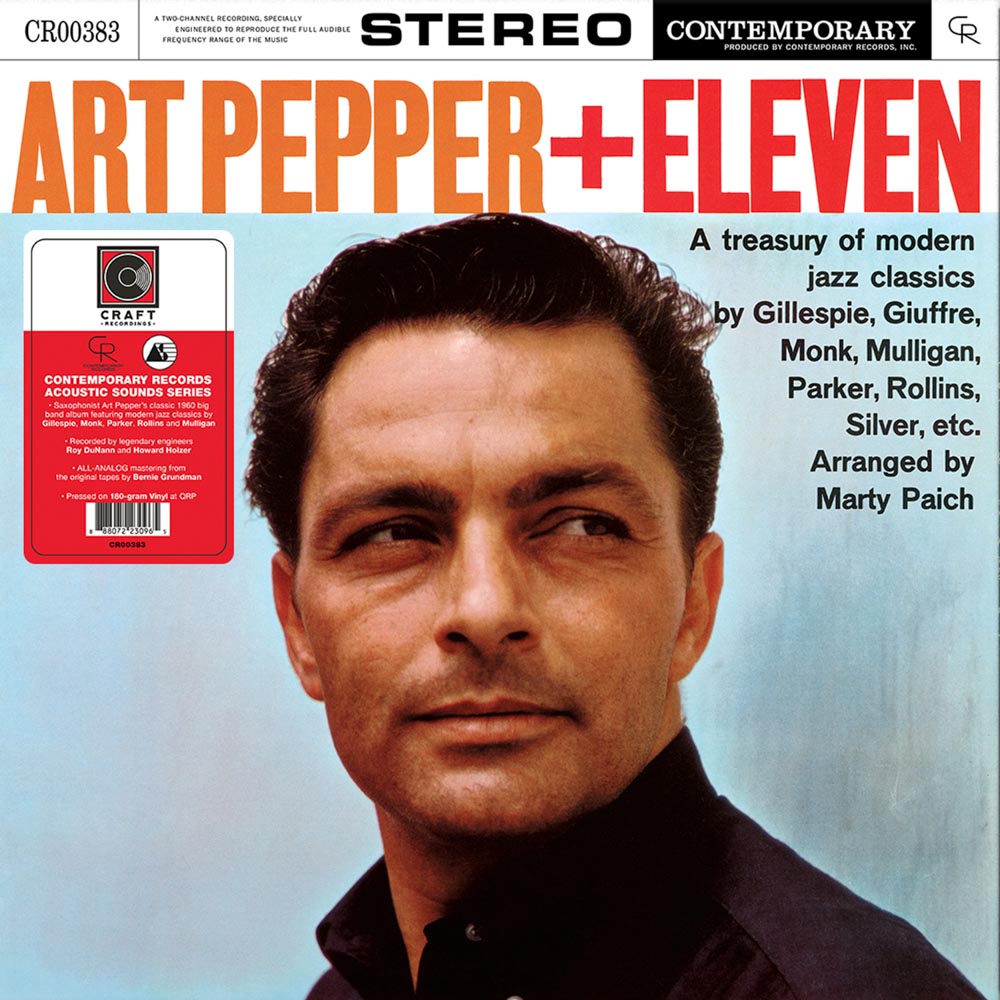
The album title specifies an unusually precise scale: Art Pepper plus eleven. This is neither a conventional quartet nor simply a larger backing group. Art Pepper + Eleven: Modern Jazz Classics places Pepper’s individual voice within a carefully arranged ensemble. Marty Paich wrote the arrangements and directed the musicians. Twelve pieces drawn from the repertoire of modern jazz make up the programme, recorded over three dates in the spring of 1959 at Contemporary’s studio in Los Angeles.
The selection reads like a personal map of jazz since the 1940s. Charlie Parker and Dizzy Gillespie appear alongside Thelonious Monk, Horace Silver, Gerry Mulligan, Jimmy Giuffre and Sonny Rollins. “Classics” therefore refers to music that, when this record was made, was still a relatively recent part of the jazz landscape. Paich and Pepper treat it as living repertoire. The pieces receive fresh ensemble settings without needing to surrender their distinctive melodic identities in the process.
The distance between an individual solo voice and a scored ensemble is central to the album’s appeal. A theme can take on another outline when carried by several horns rather than a small combo. The soloist, meanwhile, responds to prepared colours, answers and transitions as well as to the rhythm section. The listener can follow two connected levels: Pepper’s personality and the structures Paich develops around the compositions and their improvisations. Neither level needs to be reduced to a mere frame for the other.
Lester Koenig produced the sessions, with Roy DuNann and Howard Holzer credited for the recording. Contemporary issued the original mono and stereo editions as M3568 and S7568 respectively; this reissue presents the stereo album. For listeners who know Pepper chiefly in smaller groups, it offers a valuable alternative perspective. The difference lies less in headcount than in the relationship between individual flexibility and written parts. The music remains approachable on a first encounter while offering a wealth of instrumental and personnel details to explore over repeated plays.

Eleven accompanists, a changing personnel list
The recording dates were March 14, March 28 and May 12, 1959. Across those sessions, the full list of names becomes longer than the album title might suggest, because some horn positions were filled by different players. “Plus Eleven” does not mean that everyone named in the combined credits performed simultaneously. That distinction matters when collecting the record, comparing performances or simply learning more about its ensemble. The musicians section assigns the changing contributions to the relevant tracks rather than presenting one undifferentiated list.
Jack Sheldon plays trumpet, while Pete Candoli appears on “Opus de Funk,” “’Round Midnight,” “Walkin’ Shoes” and “Airegin.” Al Porcino occupies the corresponding trumpet position on the remaining eight selections. Dick Nash is credited on trombone, Bob Enevoldsen on valve trombone and tenor saxophone, and Vincent DeRosa on French horn. These instruments already suggest the range of colours available to Paich beyond a basic trumpet-and-saxophone group. The horn and the different middle and lower voices broaden the ensemble’s possibilities.
The saxophone personnel changes too. Herb Geller, Bud Shank and Charlie Kennedy belong to different dates, as do Bill Perkins and Richie Kamuca. Med Flory plays baritone saxophone. At the piano is Russ Freeman, the jazz pianist, rather than the later guitarist with the same name. Joe Mondragon plays double bass and Mel Lewis drums. Paich’s own credit is for arranging and conducting; the piano part should therefore not be assigned to him merely because he led the sessions.
Pepper is credited with alto and tenor saxophones and clarinet. Clarinet is specifically documented on “Anthropology,” but a multiple-instrument album credit does not establish that every listed instrument occurs on every track. A record like this rewards careful attention to such details. Credits do not explain the music in place of listening, but they reveal distinctions that can disappear behind a famous name on the front cover. What might otherwise look like a uniform backing ensemble becomes a group of individual musicians with particular contributions.

A compact history of modern jazz repertoire
Denzil Best’s “Move” opens the programme, followed by Gillespie’s “Groovin’ High” and Horace Silver’s “Opus de Funk.” These three different melodic and rhythmic identities immediately demonstrate the breadth of modern jazz represented here. The record is not confined to repeating one musical stance. A useful listening approach is to follow the relationship between thematic statements, ensemble writing and the space made for improvisation. Where is a melody carried collectively, and where does an individual voice give it a different emphasis?
“’Round Midnight” brings Monk’s distinctive song into the sequence. “Four Brothers” points towards Jimmy Giuffre and the history of saxophone-section writing, while “Shaw ’Nuff” returns to Parker and Gillespie. Side A therefore brings together compositions whose original contexts were far from identical. Paich’s arrangements supply their shared setting. For collectors, one pleasure is hearing these interpretations with other familiar recordings of the same pieces in mind, while allowing this ensemble to establish its own character rather than expecting a reproduction.
Side B begins with “Bernie’s Tune” and Gerry Mulligan’s “Walkin’ Shoes.” “Anthropology,” “Airegin,” “Walkin’” and “Donna Lee” complete the dozen. Rollins’ “Airegin” belongs as naturally to the programme as the bebop themes associated with Parker. The subtitle becomes concrete through this selection: the emphasis is on a chosen working repertoire rather than a chronological classroom survey. Each composition retains an identity, yet also becomes part of an album conceived as a whole through its arrangements, personnel and sequence.
With twelve relatively compact performances, it is easy to change listening priorities from one play to another. Pepper’s line may lead the first encounter, followed by the rhythm section or the changing combinations of horn colour. The ensemble format offers abundant detail without depending on exceptionally long solo features. Much of the interest lies in how material is distributed and how prepared passages relate to improvised contributions. That relationship makes the record a distinct encounter with familiar compositions, rather than simply an anthology of recognisable titles.
Contemporary, Bernie Grundman and this edition
The record offered here carries the order number ACONC 383 and belongs to Craft Recordings’ Contemporary Records Acoustic Sounds Series. It should be distinguished from the Verve/UMe series with a related name. This is one 180-gram stereo LP at 33⅓ RPM, pressed at Quality Record Pressings. Bernie Grundman handled the all-analogue mastering from the original tapes. A Stoughton tip-on jacket is part of the edition’s presentation; that description does not, by itself, imply a gatefold sleeve.
These specific production details are particularly useful for a Contemporary recording, since the label’s name often carries considerable expectations before a record is played. DuNann and Holzer belong to the original recording process, Grundman to the mastering of this reissue, and QRP to its manufacture. Those are separate stages. Together, they describe the path from the three Los Angeles sessions to this LP. For a collection of Contemporary titles, that distinction is useful: the original recording team remains identifiable, while the mastering and manufacture of the particular reissue are clearly named.
A single 33⅓ RPM LP preserves the original division into six pieces per side. For an album of twelve compact arrangements, that offers a practical musical benefit: several different ensemble ideas can be heard in succession before the record needs turning. The relationships within the sequence remain intact. Listeners wishing to follow one horn player or concentrate on Mel Lewis during another play also have a clear track list with identifiable positions. Album continuity and closer examination therefore fit comfortably together in this format.
One historical credit complication deserves attention. A documented sleeve annotation gives a contradictory assignment for a March session, listing one track twice while omitting another. The assignments used here have therefore been checked against the session discography. Unresolved details are not converted into false precision. The result remains an invitation to an exceptional combination: Pepper as the principal solo voice, Paich as arranger and a group filled with distinctive musical personalities. You order from Michael 45 in Germany. We arrange the US import and dispatch from Hilden.
More by Art Pepper: Gettin’ Together! · Intensity
Series: Contemporary – all 24 records: sunny jazz from Los Angeles
Musicians
Participants and documented credit status. Track references correspond to the tracklist.
- Art PepperPortrait: circa 1960alto saxophone, tenor saxophone, clarinet (including B3)Participation: All tracks
- Marty Paicharrangements, conductingParticipation: All tracks
- Jack SheldonPortrait: existing portraittrumpetParticipation: All tracks
- Pete CandoliPortrait: 1950strumpetParticipation: A3, A4, B2, B4
- Al PorcinotrumpetParticipation: A1, A2, A5, A6, B1, B3, B5, B6
- Dick NashtromboneParticipation: All tracks
- Bob Enevoldsenvalve trombone, tenor saxophoneParticipation: All tracks
- Vincent DeRosaFrench hornParticipation: All tracks
- Herb GellerPortrait: 1971 · later portrait referencealto saxophoneParticipation: A3, A4, B2, B4
- Bud Shankalto saxophoneParticipation: A2, A6, B3, B6
- Charlie Kennedyalto saxophoneParticipation: A1, A5, B1, B5
- Bill Perkinstenor saxophoneParticipation: A2–A4, A6, B2–B4, B6
- Richie KamucaPortrait: 1965tenor saxophoneParticipation: A1, A5, B1, B5
- Med Florybaritone saxophoneParticipation: All tracks
- Russ FreemanpianoParticipation: All tracks
- Joe Mondragondouble bassParticipation: All tracks
- Mel LewisPortrait: 1959drumsParticipation: All tracks


Three 1959 sessions; track assignments follow the reconciled discography. Multiple instruments are album credits, not claims that every instrument appears on every track. Marty Paich arranges and conducts; Russ Freeman plays piano.

Reviews
There are no reviews yet.