


West Side Story: Broadway becomes a conversation for three
A piano, a double bass and a drum kit: André Previn needs no larger ensemble to open up the world of West Side Story. Leonard Bernstein’s melodies already contain dramatic tension, but here they have to work without scenery, dialogue or a theatre orchestra. That reduction is central to the album’s appeal. Previn, Red Mitchell and Shelly Manne approach the material as a flexible jazz trio. Listeners familiar with the musical encounter recognisable ideas in different light. Those coming to the record without that background get eight individual pieces whose musical appeal does not depend on knowing the plot.
The album was recorded on August 24 and 25, 1959, at Contemporary Records’ studio in Los Angeles. Those two days establish a clear setting: three musicians, a shared repertoire and enough contrasting material to sustain an entire LP. Bernstein wrote the music, while Stephen Sondheim supplied the original lyrics. No theatrical roles are sung on this instrumental recording. The words remain part of the songs’ background, while the trio develops its own conversation through touch, phrasing and rhythm. Recognition and transformation can therefore become equally rewarding parts of listening, without either approach having to exclude the other.
Previn’s piano occupies a central position, but a worthwhile trio recording cannot be understood through its leading melody alone. Mitchell’s bass and Manne’s drums also determine how much space a phrase receives and where the music can go next. The instrumentation makes clear that this is more than a small-scale orchestral transcription. The bass can connect lines, the drums can adjust the emphasis, and the piano need not occupy every available opening. A compelling question runs through both sides: how do three players reshape music whose original dramatic impact also depended on a much larger ensemble? Their interaction provides the answer.

Eight pieces moving between anticipation, dance and intimacy
Something’s Coming opens side A with a title that already suggests anticipation. It is followed by Jet Song, then Tonight and I Feel Pretty. The sequence brings together several kinds of energy: the prospect of something new, a group asserting its identity, a personal encounter and an exuberant sense of self. In the trio setting, these become musical characters that remain accessible without a sung text. Listen for what makes each melody immediately recognisable, and for the places where a change of rhythmic emphasis offers a different way of understanding a familiar phrase.
Side B begins with Gee, Officer Krupke! and continues through Cool to Maria and America. The contrast between these pieces gives three instruments plenty to work with. A pointed comic number, an exploration of tension and restraint, a name placed at the centre of a melody, and a closing piece associated with movement make an engaging sequence. There is no obligation to treat every performance as a direct illustration of a scene. The record also encourages you to separate these melodies from their theatrical setting and consider how strongly they stand as musical ideas in their own right.
The proportions add another dimension. The opening Something’s Coming lasts 2:35, whereas I Feel Pretty receives considerably more room at 6:45. Maria, at 5:29, sits between the shorter Cool and the closing America. Durations do not tell us what happens in every solo, but they show that the trio does not force each selection into a uniform shape. Some pieces are presented compactly; others are given longer to develop. Vinyl makes that balance easy to appreciate: four tracks before the turn, four afterwards, with a brief physical pause that allows the second chapter to begin deliberately.

Previn, Mitchell and Manne: three independent musical viewpoints
André Previn, Red Mitchell and Shelly Manne perform on all eight tracks. Their credits require no elaborate track-by-track qualification. The more interesting investigation happens while listening: how does attention move among the three voices? The piano can carry melody and harmony together. The double bass offers a different articulation and its own sense of time. The drums can support, comment on and open up the musical line. Those functions are distinct, yet they must be negotiated continuously. This is one reason a trio can feel so immediate: every decision changes the space available to the other two musicians.
Try following the melody of a familiar selection on one hearing, then listening primarily to its accompaniment on the next. Notice how a musical question can continue even when the piano briefly says less. Or concentrate on the way bass and drums create common ground without performing an identical function. These are invitations to discover more within a familiar tune, rather than requirements for enjoying the record. A programme drawn from a musical is particularly welcoming in that respect. The compositions provide orientation while leaving the players considerable freedom to shape their own responses to the material and to one another.
Lester Koenig produced the recording, and Roy DuNann engineered it. Both are essential to its history, but neither should be counted among the three performing musicians. Contemporary’s studio provides the practical and technical setting for this small ensemble. For collectors, the connection between label, producer and engineer offers a useful route towards other records from the same musical environment. The strongest reason to remain with this particular album, however, is the trio itself: three contrasting instruments taking on a shared task that extends beyond presenting well-known themes. The melodies establish the starting point; the communication between the players supplies the discovery.
The Contemporary edition on 180-gram vinyl
This reissue belongs to Craft Recordings’ Contemporary Records Acoustic Sounds Series. It presents the album on one 180-gram LP, running at 33⅓ RPM in stereo. Bernie Grundman handled the mastering and lacquer cutting, with the original tapes identified as the source. The record was pressed at Quality Record Pressings, with a jacket from Stoughton Printing. The edition number CR00390 and shop reference ACONC 390 help distinguish this version from other releases of the repertoire. It is Previn’s recording with Mitchell and Manne, rather than a theatrical cast recording or a different jazz interpretation of the same musical.
Those production details are useful when choosing an edition, but they should leave room for the music itself. A single LP maintains the programme’s clear proportions, and its two sides divide the eight selections into readily approachable groups. Piano-trio listeners will find a record on which the repertoire is inseparable from the ensemble’s character. Those arriving through Bernstein can explore how his themes live within a smaller instrumental setting. The album therefore works both as a self-contained listening experience and as a rewarding counterpart to a musical recording you already know, inviting comparison without depending on it.
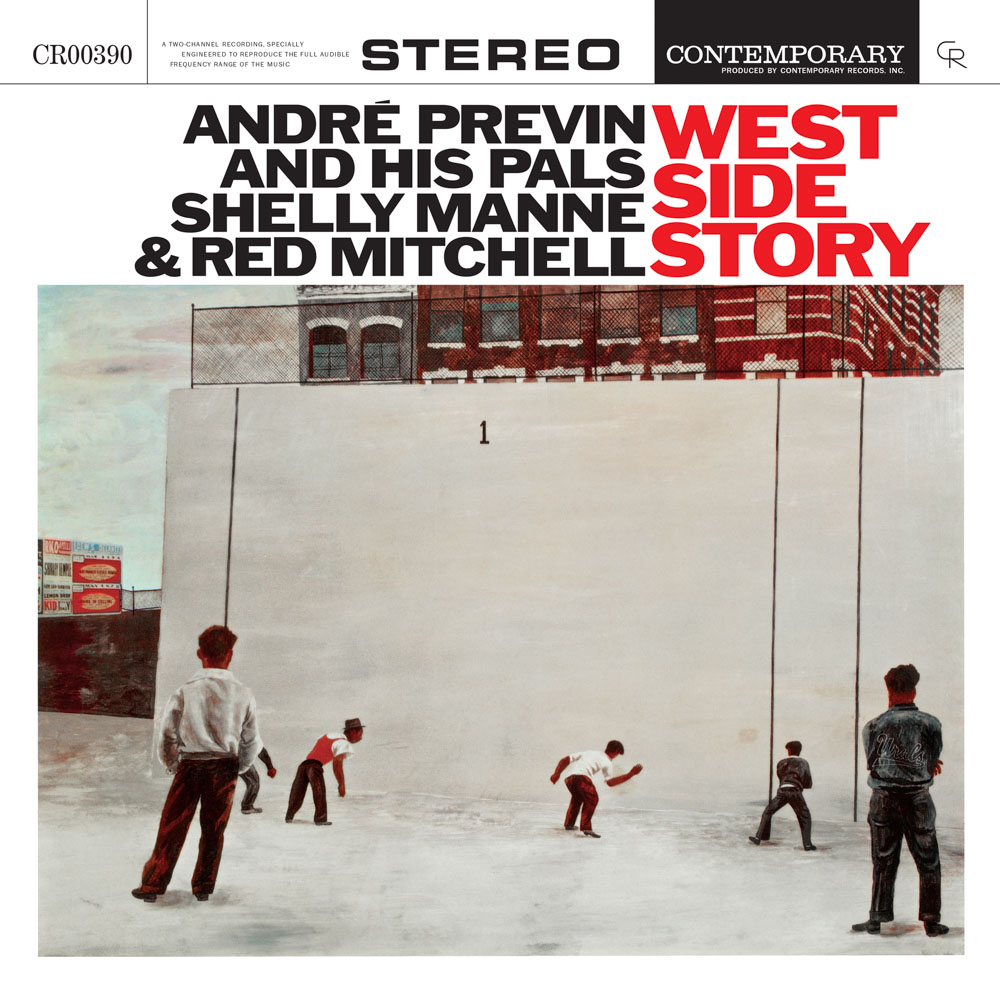
The original cover uses Ben Shahn’s 1939 painting Handball. That connection between visual art and music is an appealing part of the album’s design history; the illustrations on this page are independent works rather than copies of the painting. Michael 45 dispatches orders from Hilden in Germany, allowing customers in Germany and the EU to order without importing it themselves from the United States or waiting for customs clearance. If you want to buy André Previn’s West Side Story on vinyl, this Contemporary edition is presented here with the complete musician credits and eight-track running order to help place it in your collection.
Current availability and delivery information appear beside the purchase controls; this edition description is not a statement of stock availability.
Series: Contemporary – all 24 records: sunny jazz from Los Angeles
Musicians
Participants and documented credit status. Track references correspond to the tracklist.
- André PrevinPortrait reference: 2012pianoParticipation: all eight tracks
- Red MitchellExisting portrait; not a session depictiondouble bassParticipation: all eight tracks
- Shelly ManneExisting portrait; not a session depictiondrumsParticipation: all eight tracks


Production and liner notes: Lester Koenig. Recording: Roy DuNann. Cover painting: Ben Shahn, Handball (1939). Music: Leonard Bernstein; original lyrics: Stephen Sondheim. Mastering/lacquer cutting: Bernie Grundman. Pressing: QRP.

Reviews
There are no reviews yet.