Magazine · From the Listening Room · Pressing Comparison
The Who at 45 RPM:
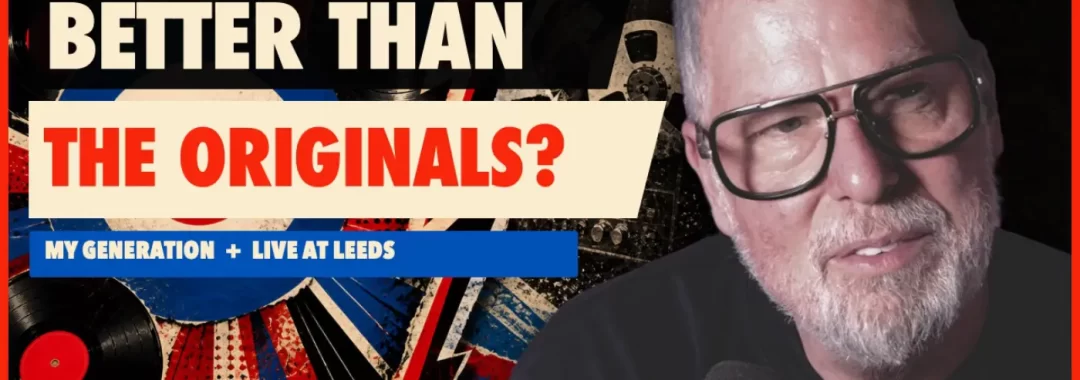
My Generation and Live at Leeds Compared
Two albums. Two entirely different kinds of gain.
Analogue Productions has cut My Generation and Live at Leeds at 45 RPM. With My Generation it feels as though a heavy curtain were torn out of the room. Live at Leeds changes less radically, but it audibly gains width, depth and the atmosphere of the concert hall.

Five years apart, The Who built two completely different sound worlds. My Generation arrives compact, mono and confrontational – a clenched blow from the centre. Live at Leeds lives from the stage, from air, depth and movement. That is exactly why the new 45 RPM cut changes the two albums in such different ways.
“Not just as if a curtain were drawn back. As if a huge, thick curtain were pulled away.”Michael on My Generation
A simple verdict like “better than the original” therefore falls short. One album gains above all in immediate impact – in pressure, contour and forward drive. The other gains the room around the band, and with it a stronger sense of the evening itself.
How two sound worlds came about
The difference begins long before the groove. My Generation was made in 1965 in three concentrated studio stints in London: a young quartet, tightly bundled in mono, with all its energy pointing forward. Five years later Live at Leeds captured an experienced band in a concert hall – not as a clean studio picture, but as an event with scale, air and physical movement.


Album one · 1965
My Generation: When mono lands the way it should

My Generation was released in the United Kingdom on 3 December 1965. It was the debut album by The Who, issued by Brunswick under the catalogue number LAT 8616, and it reached number five in the British charts. Shel Talmy produced, Glyn Johns was the engineer, Nicky Hopkins played piano.
The recordings did not come out of one continuous session. The band returned to IBC Studios in London in April, October and November 1965. Those three stints explain part of the album’s restless energy: it feels urgent rather than polished.
The format matters just as much. The songs did not appear in stereo until 2002. Mono is therefore not a nostalgic extra here, but the form in which this album was made. The later American edition The Who Sings My Generation also changed the cover and the running order. Analogue Productions follows the British album.
The new 45 RPM cut was made by Chris Bellman at Bernie Grundman Mastering. His task was not to turn a 1965 recording into a modern high-gloss production, but to release its energy without smoothing the raw mono core.
What I heard with My Generation
I compared the 45 RPM edition of My Generation with a German first pressing and an early German reissue from 1981. I do not own a British first pressing – an important limitation, because the new pressing is based on that edition.
Despite that limitation the result was astonishing. The German first pressing sounded as though heavy fabric lay between the band and the listener. The 45 RPM cut pulls that fabric away. The mono image stays closed, but it now steps out of the centre with greater contour and force. Dynamic accents shoot forward more directly; the music feels less restrained, more physical and more determined.

The title track shows particularly well what this is about. John Entwistle’s bass solo has the attack it needs and a clearer contour; it does not sit softly in the room, it asserts itself. And yet the recording remains unmistakably rock and rhythm & blues from 1965. This is not “audiophile” in the sense of a spacious old jazz recording – and it is not meant to be. The achievement of the new cut is to give the original recording more breath and more power without smoothing its raw core.
The same comparison also exists as a video on my channel 45 RPM Audiophile: The Who at 45 RPM: My Generation and Live at Leeds compared on video. What follows here stays with the second album.


Album two · 1970
Live at Leeds: Further into the room

Live at Leeds was recorded on 14 February 1970 in the Refectory of the University of Leeds and released in May. The original LP condensed a far longer concert into six tracks: Young Man Blues, Substitute, Summertime Blues, Shakin’ All Over, My Generation and Magic Bus.
The packaging was meant to look like a bootleg. The plain cardboard sleeve carried block lettering; inside lay twelve facsimiles – among them photographs, lyrics, a receipt for a smoke bomb, a rejection letter from EMI and the Woodstock contract.
That was exactly my first question after the Analogue Productions edition was announced: would a regular reissue really include all those inserts? It does. The documents come together in a small bag. That matters, because they are not decoration but part of this album’s identity.
What I heard with Live at Leeds
This comparison was harder. I put the 45 RPM edition of Live at Leeds against a British and a German first pressing. The British original already sounds better and more coherent than the German one – so the new edition faced strong competition.
“The difference is smaller than with My Generation. In soundstage and depth it stays clear all the same.”Michael on Live at Leeds
Here the improvement feels less like a curtain suddenly pulled away. Instead the room becomes more believable. The band does not simply stand larger in front of the listener; it gains depth behind it. Air opens up between the concentrated energy of the musicians and the hall. The stage layers itself from front to back, the dynamics let the performance breathe more freely, and a very good live recording turns more strongly into the feeling of actually sitting in the room. My personal highlight is the 14-minute-46-second My Generation, which now gets a side of its own.

Why Leeds became the album
Leeds was not the first choice. The band also recorded a concert in Hull, and Hull was the one meant for release. But John Entwistle’s bass was missing from the first reel. The problem could not be repaired at the time, so the safety recording from Leeds became the album. Hull was finally issued in 2012; the missing bass was patched in from the Leeds tapes.
The open question about Tommy can be answered.
That evening the band played the whole of Tommy, although none of it appeared on the original six-track LP. The complete Tommy performance was released in 2001 on the two-disc deluxe edition, where it fills the second disc.
Which reissue changes the listening more?
My Generation delivers the far more dramatic transformation. Against the German pressings available to me, the new cut changes the physical effect of the record: clearer, more direct and considerably more powerful. The music remains a compact mono block – only now that block stands in the room without a veil.
Live at Leeds starts from an already strong British first pressing, so the gain in sound is less spectacular. Small it is not. Its value lies in scale, in depth and in the feeling of stepping into the concert. One 45 RPM edition frees the energy of a studio recording, the other opens the room of a stage – which is exactly why both belong in one comparison.
The records discussed
The editions from this comparison
If you would like to follow the comparison yourself, here are the two editions discussed.
The Who – My Generation
Analogue Productions · APP 249-45 · 45 RPM · Mono · in stock
The Who – Live at Leeds
Analogue Productions · APP 253-45 · 45 RPM · in stock
Which The Who edition from Analogue Productions is right for you – including Tommy and Who’s Next as limited UHQR editions – is covered in our customer question The Who on Analogue Productions: which edition?
