
The route leads back as well
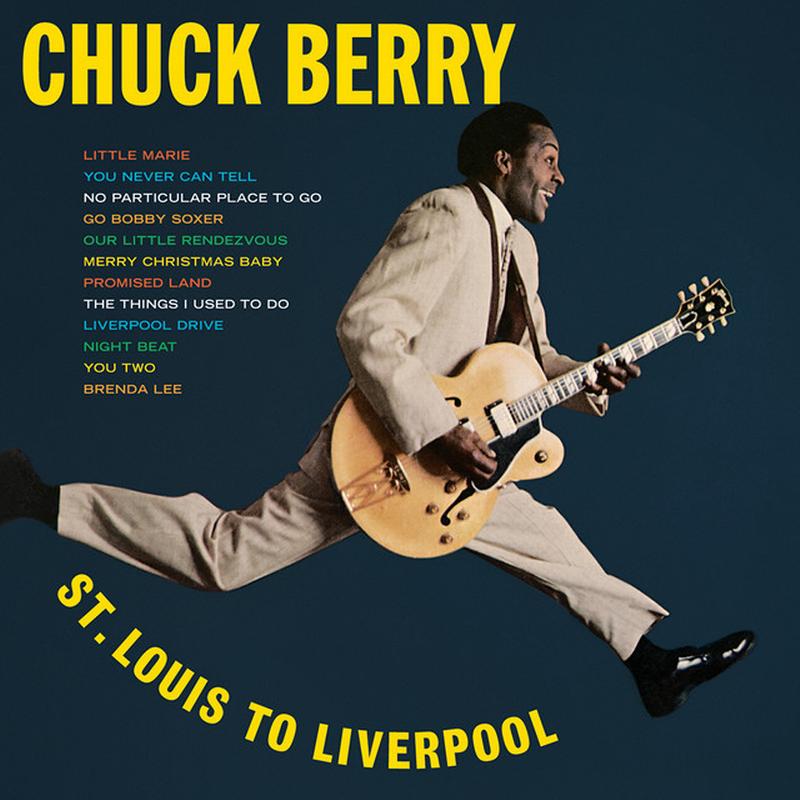
The title connects two cities between which rock ’n’ roll travelled with particular energy in the 1960s. St Louis stands for Chuck Berry; Liverpool evokes a British generation that had absorbed his songs and guitar vocabulary. Released in 1964, St. Louis to Liverpool belongs to that exchange. It presents a songwriter with new, immediately graspable stories, not simply a musician looking back at earlier achievements.
“No Particular Place to Go”, “You Never Can Tell”, “Promised Land” and “Little Marie” appear together here. That company is remarkable in itself. Berry can establish movement, characters and a situation with a small musical toolkit. The guitar matters, but so do the voice, the piano and the precisely timed turn within a song.

Several years, not a single session
The album gathers recordings made across different years between 1957 and 1964. It should not be understood as the document of one continuous session with an unchanged band. That background explains part of its variety and makes the credits more significant than they might first appear. A general list of accompanying musicians cannot automatically be applied to every track.
The programming also reflects this origin. Alongside the celebrated songs are the instrumental “Liverpool Drive” and “Merry Christmas Baby”. Unity comes from Berry’s musical personality rather than a single subject. Listeners arriving for the major hits encounter other views of the same artist between them.

Small resources, complete stories
“No Particular Place to Go” draws on the musical framework of Berry’s earlier “School Days” while telling a different story. That is an important part of his craft. A familiar structure does not lose its value when it can accommodate a new situation. Rhythm, pauses and the positioning of the voice can redirect what we recognise.
“Promised Land” sets an entire journey in motion. Its geographical route is part of the narrative construction, not incidental decoration. Berry used an atlas when writing the song. The practical detail suits his work: accuracy on a small scale creates a world that can become surprisingly expansive within a few minutes. The song moves because its individual stages have been thought through.
Listen for the piano too
Many listeners also know “You Never Can Tell” through the dance scene in Pulp Fiction. Here, the song returns to its original musical company. Give the piano as much attention as the guitar. The effect depends on their interplay and on the space the voice finds between instrumental gestures, rather than on one celebrated element in isolation.
Berry can be heard as a source for the rock music that followed him. This album reminds us that he is not merely a chapter in other bands’ histories. His songs work as complete small scenes: concentrated, mobile and observant. The most rewarding route to Liverpool therefore brings us back to Chuck Berry himself, and to the question of how much a short song can contain when its gestures are placed so well.
More from the series: Chess Records (Acoustic Sounds Series)
More by Chuck Berry: Berry Is On Top
Series: Chess Records – all 10 records: singles that became albums
Musicians
Credits for the twelve LP tracks, excluding additional CD bonus tracks. Drums on “Our Little Rendezvous” are variously attributed to Ebby Hardy or Jaspar Thomas; the player remains unresolved.
- Chuck BerryVocals, Guitar
- Johnnie JohnsonPiano
- Lafayette LeakePiano
- Willie DixonDouble bass
- Odie PayneDrums
- Matt “Guitar” MurphyElectric guitar on “Our Little Rendezvous”
- Paul WilliamsPiano
- Fred BelowDrums
- Leroy C. DavisTenor saxophone
- James RobinsonTenor saxophone
- Louis SatterfieldBass


How Michael hears this edition
Listening impression · paraphrased from the video
Michael describes this Acoustic Sounds Chess Series edition as powerful and particularly highlights Chuck Berry’s guitar playing. He points to “You Never Can Tell” as a track to explore. He does not make a direct sonic comparison with an original pressing of this album in the video.
🎧 Review video: 5 Legendary Reissues: Before Van Halen, Pulp Fiction & Rolling Stones Name
This video is hosted by YouTube (Google). It only loads once you switch on “Functional” in the cookie settings.

Reviews
There are no reviews yet.