A concert album with a clear position
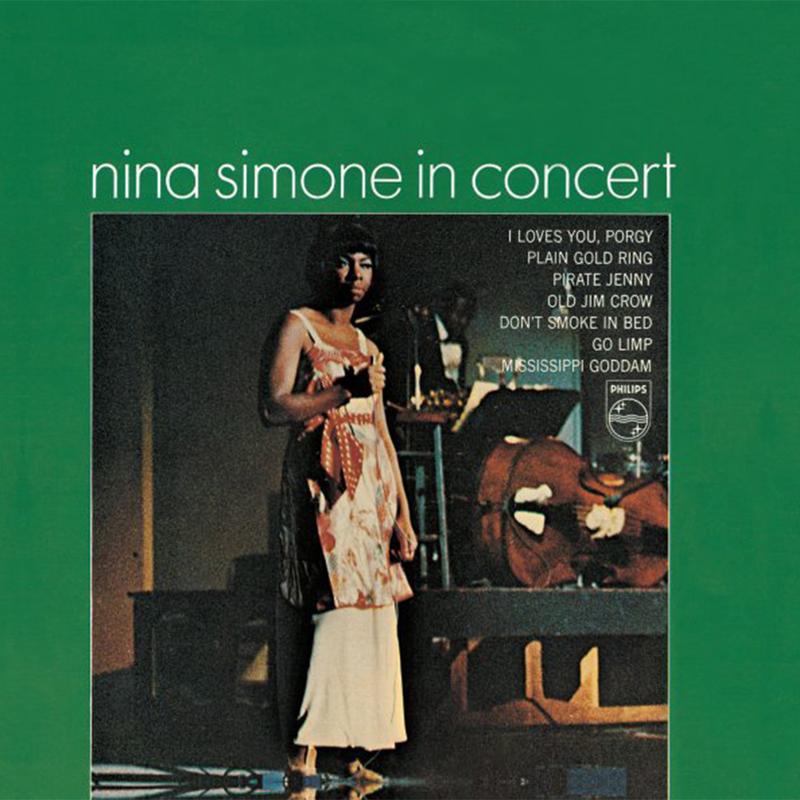
Nina Simone’s In Concert connects familiar songs, theatrical storytelling and political protest. Its seven selections come from Carnegie Hall appearances in the spring of 1964. The audience belongs to the situation: Simone addresses it, responds to its presence and changes the distance between performer and room. The album title is understated, but the repertoire ranges from “I Loves You, Porgy” to “Mississippi Goddam”, with different forms of narrative between them. The record can therefore be followed as more than a collection of individual songs. It is an assembled programme whose position becomes increasingly clear as its sequence unfolds.
The release began Simone’s period with Philips following her years at Colpix. Hal Mooney produced, while Simone sings, plays piano and shapes the arrangements. Rudy Stevenson on guitar, Lisle Atkinson on bass and Bobby Hamilton on drums are documented as accompanying musicians, although their contributions are not securely assigned to every selection. The precise recording dates also differ between sources. The supported setting is several Carnegie Hall performances in March and April 1964. Retaining that boundary does not weaken the musical connection; it avoids supplying a degree of chronological precision that the available documentation cannot consistently sustain.

Familiar material in a changed setting
Simone had already recorded “I Loves You, Porgy”, “Plain Gold Ring” and “Don’t Smoke In Bed” for her debut, Little Girl Blue. Their return connects the new album with an earlier phase of her work. In concert, however, they occupy a different environment and sit beside different material. That makes their functions within the programme worth considering: a familiar song can establish an entrance, recall an earlier experience or prepare the way for a sharper statement. The earlier recording is not rendered obsolete. The changed situation extends the context in which the same composition can be understood and heard.
“Pirate Jenny” leads to Kurt Weill and Bertolt Brecht, through Marc Blitzstein’s English adaptation. Simone brings musical theatre into her concert repertoire. The narrative cannot be reduced to another jazz selection; it introduces characters, changes of perspective and a threatening vision of power. Beside the other songs, that theatrical tradition acquires a new political tension. The handling of the narrative is central to listening: how does Simone alter her position and distance, and what role does the piano take? Its effect need not be explained by reproducing the lyrics. It can be followed through the form of the piece and the decisions made in performance.

Different ways of making a public statement
“Old Jim Crow” confronts racial segregation. “Go Limp”, by contrast, adapts a song by Alex Comfort associated with Britain’s anti-nuclear movement, placing it in a different political setting. Humour, audience participation and direct address are part of the performance. The album therefore does not rely on a single way of taking a public position. Its tone and methods change between selections. That variation gives particular significance to the ending with “Mississippi Goddam”. The statement grows from a programme that has already explored different possibilities of memory, theatre and collective response, rather than arriving as an isolated message unrelated to the preceding music.
Simone wrote “Mississippi Goddam” in response to racist violence, particularly the murder of Medgar Evers and the bombing of Birmingham’s 16th Street Baptist Church in 1963, which killed four Black girls. The song became a central expression of her involvement in the civil-rights movement. On In Concert, it closes the second side and thus has a definite place within the larger sequence. Reducing the entire record to this one song would be limiting; treating it as merely another addition would be equally inadequate. The journey through the six preceding performances forms part of its context on this particular album.
The Philips Acoustic Sounds Series reissue
APHI 512473 identifies this single 180-gram LP running at 33⅓ RPM, part of the Verve/UMe Acoustic Sounds Series. The associated original label is Philips. This is not an Analogue Productions release, even though Acoustic Sounds participates in the reissue programme. Ryan K. Smith at Sterling Sound is named for mastering, and the publisher identifies original analogue tapes as the source. The available sources name neither a separate lacquer-cutting credit nor a runout inscription for this edition. Recording, reissue mastering and physical manufacture remain distinct stages with separately supported information.
The publisher specifies Quality Record Pressings and a Stoughton tip-on gatefold jacket. The stereo edition preserves the original seven selections and their side order. It does not add the shortened single version of “Mississippi Goddam” or material from other concerts. The focus remains a historically identifiable concert programme whose significance arises from music, stage presence and social context. Simone’s voice and piano are the starting point; her relationship with the audience and her repertoire decisions open a wider view of an artist articulating her public role with particular clarity in 1964. That combination gives the record its continuing interest as an album, beyond any single celebrated performance. Michael 45 dispatches orders from Hilden, Germany, so you do not need to arrange your own US import. Please refer to the stated availability and delivery time for this item.
You order from Michael 45 in Germany. We arrange the US import and dispatch from Hilden.
More by Nina Simone: Pastel Blues · Wild Is The Wind
Series: Nina Simone on Philips – three records, 1964 and 1965
Musicians
Documented participants in this recording. Track references correspond to the tracklist.
- Nina Simonevocals, piano, arrangements, bandleaderParticipation: Album personnel
- Rudy StevensonguitarParticipation: Track assignments unconfirmed
- Lisle Atkinsondouble bassParticipation: Track assignments unconfirmed
- Bobby HamiltondrumsParticipation: Track assignments unconfirmed

Accompanists are documented for the album, but their participation is not assigned track by track. Some March/April 1964 recording dates remain disputed.
How Michael hears this edition
Listening impression · paraphrased from the video
Michael highlights the intimacy and precision of the live recording. The immediate impact of Nina Simone’s voice makes him wish he had been in the concert audience.
🎧 Review video: New Amazing Records From Smith, Simone and Webster
This video is hosted by YouTube (Google). It only loads once you switch on “Functional” in the cookie settings.

Reviews
There are no reviews yet.