Texas blues in Englewood Cliffs
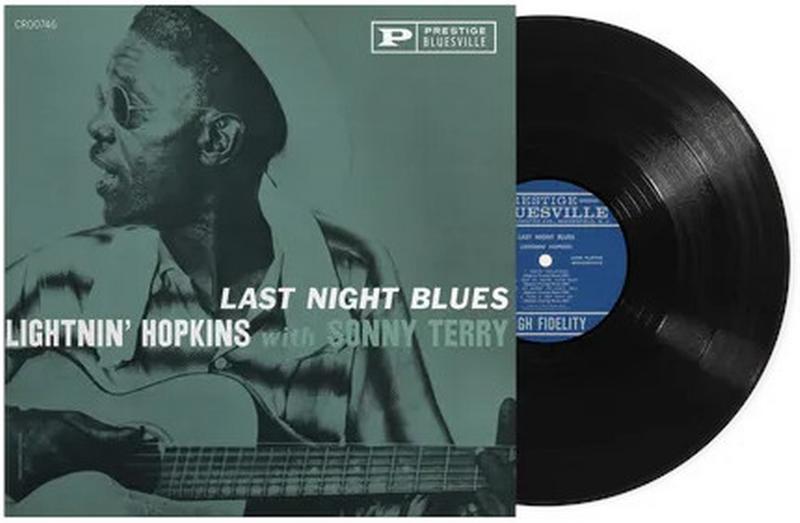
On October 26, 1960, Lightnin’ Hopkins and Sonny Terry meet at the Van Gelder Studio in Englewood Cliffs. Hopkins brings guitar and vocals, Terry his harmonica. Joined by Leonard Gaskin on bass and Belton Evans on drums, they record Last Night Blues, an album generally dated to 1961 for its original release. Two distinctive blues personalities share a common setting. Rudy Van Gelder handles the recording: a name most readily associated with jazz, heard here in the story of a different musical encounter.
Hopkins’ language depends on the immediate relationship between a sung line and a guitar figure. Terry adds an instrument that moves between melody, breath and an almost vocal expressiveness. The album’s title directs attention towards experience and storytelling. What matters is the individual way a musician turns a story into music. The small band provides enough support while leaving space for the personal inflections that an overly smooth or rigid arrangement could easily remove. Those differences are central to the record’s character.

Four voices in conversation
The lineup is simple, but its possibilities are varied. Hopkins can begin a thought with his voice and continue it on guitar; Terry can respond or place an accent of his own. Gaskin and Evans give the encounter a rhythmic foundation. The balance between freedom and accompaniment is particularly rewarding to follow. Blues depends on recognisable forms, yet personality often emerges where a player reshapes an expected turn in his own way. Shared ground makes the individual departure meaningful.
That is why the most prominent instrument need not command all of the listener’s attention. How does a harmonica phrase fit around the singing? Where does the accompaniment hold the music together while a voice takes its time? Terry is also documented as a singer on “Conversation Blues.” The title gives a name to an idea that extends across the album: address and response are fundamental to this music. The players share a form without surrendering their individual accents within it.

Eight paths through the blues
“Rocky Mountain” opens the first side, followed by “Got To Move You Baby,” “So Sorry To Leave You” and “Take A Trip With Me.” Side two contains the title track, “Lightnin’s Stroke,” “Hard To Love A Woman” and “Conversation Blues.” The titles suggest movement, departure and relationships. Among them, the instrumental “Lightnin’s Stroke” gives Hopkins’ guitar an explicitly independent storytelling role. The programme allows the relationship between voice and instrument to change as the record progresses.
The pleasure of Last Night Blues comes less from searching for a single peak than from gradually becoming familiar with its players. A brief instrumental comment can become as significant as a sung passage. Each return offers another relationship to follow. Hopkins may command the first hearing, Terry the next, with bass and drums becoming more apparent later. These changing perspectives reward attention without compromising the album’s directness. It remains blues built around musicians finding something to say to one another.
The Craft Bluesville vinyl edition
This is the Craft Recordings Bluesville reissue produced in collaboration with Acoustic Sounds, carrying catalogue number CR00746 and distributor reference ACONC 746. It is presented on one 180-gram LP at 33⅓ RPM. Matthew Lutthans handled mastering and lacquer cutting at The Mastering Lab. Craft identifies the original master tapes as the source and describes the edition as AAA. Pressing is by Quality Record Pressings. These details place this specific release firmly within the Bluesville programme.
A Stoughton Printing tip-on jacket and blue obi with notes by Scott Billington complete the package. Documented mastering and considered presentation suit a recording whose individuality lies in the interaction of its musicians. For listeners who value the human dimension of blues, this is an inviting opportunity to listen closely. Two unmistakable storytellers meet a small rhythm section. From that modest framework comes enough musical life to hold attention well beyond a first encounter, and enough individual detail to make repeated listening feel worthwhile.
You order from Michael 45 in Germany. We arrange the US import and dispatch from Hilden. Editions not currently in stock are dispatched after the goods arrive.
Musicians
Participants and documented credit status. Track references correspond to the tracklist.
- Lightnin’ Hopkinsvocals, guitarParticipation: Album personnel
- Sonny Terryharmonica, vocals (B4)Participation: Album personnel
- Leonard GaskinbassParticipation: Album personnel
- Belton EvansdrumsParticipation: Album personnel


Personnel: Lightnin’ Hopkins – vocals, guitar; Sonny Terry – harmonica, vocals (B4 “Conversation Blues”); Leonard Gaskin – bass; Belton Evans – drums. Recorded October 26, 1960, at Van Gelder Studio, Englewood Cliffs, New Jersey. Recording engineer: Rudy Van Gelder. Liner notes: Mack McCormick. Producer credit on the original sleeve: The Sound Of America. This edition (2024): mastering and lacquer cutting by Matthew Lutthans (The Mastering Lab); obi notes by Scott Billington; pressed at QRP.
🎧 Review video: 12 Amazing New Reissues!
This video is hosted by YouTube (Google). It only loads once you switch on “Functional” in the cookie settings.

Reviews
There are no reviews yet.