
A church, a voice and the courage to leave space
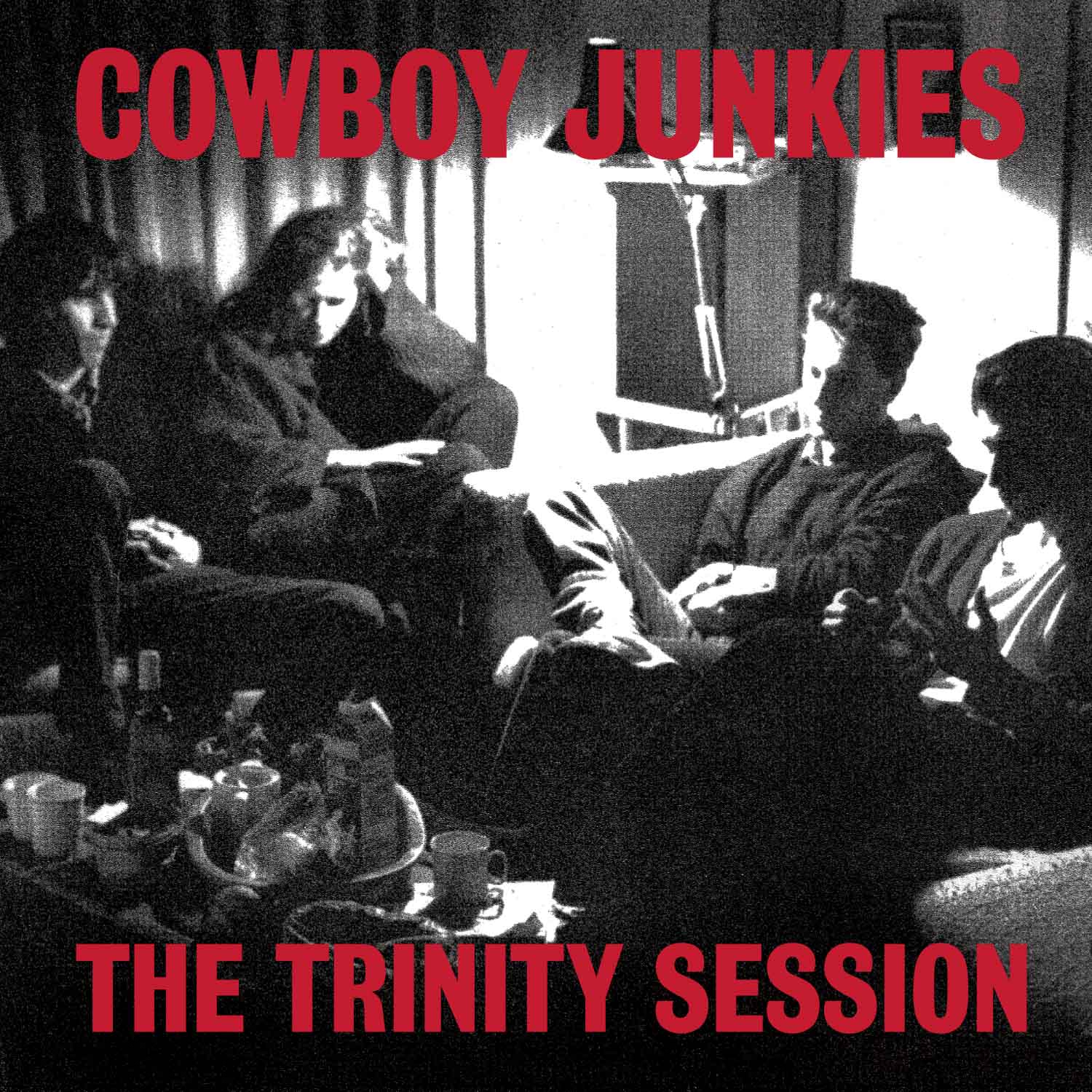
Some records derive their strength from what they choose not to cover up. The Trinity Session is one of them: a voice that does not have to bridge distance through volume, a band listening closely to itself, and a room whose reverberation becomes part of the musical language. The Cowboy Junkies were not looking for a neutral studio sound. On November 27, 1987, they recorded in Toronto’s Church of the Holy Trinity. The building became a shared resonating space. These songs reveal their weight through the relationships between the singer, the accompaniment and the notes allowed to fade away.
Margo Timmins stands at the centre. Her singing holds the music together without insisting that everything else retreat into the background. Guitarist Michael Timmins, bassist Alan Anton and drummer Peter Timmins form the band’s instrumental core. This relationship explains more about the record than any single genre label. Country, blues, folk and rock are not presented as separate traditions to be demonstrated in turn. They enter the same patient storytelling space. A familiar song is treated as something that can acquire meaning again in the present, rather than as an object that must be preserved behind glass.
One small distinction matters to the recording’s history: not everything on the album was recorded on that same day. “Mining for Gold”, the unaccompanied opening song, was captured a few days later. Its exposed voice makes the commitment to simplicity particularly clear. Before an instrumental ensemble enters, the singer establishes a scale of attention without any supporting arrangement. The album appeared in 1988; accounts do not always distinguish consistently between the early Latent release and its wider international circulation. The essential musical discovery remains the same. A remarkably quiet record could travel a very considerable distance.

Margo Timmins and an ensemble with open edges
The quartet is only the beginning of the album’s personnel. John Timmins contributes guitar and backing vocals, while Kim Deschamps adds pedal steel, Dobro and slide guitar. Jeff Bird brings violin, harmonica and mandolin; Steve Shearer also contributes harmonica, and Jaro Czerwinec plays accordion. These are album credits, not a claim that all nine musicians perform on every track. In particular, the a-cappella “Mining for Gold” should never acquire an imaginary backing band in a rewritten description. Where the remaining track-by-track assignments cannot be securely established, those details are left open in the accompanying credits.
The expanded instrumentation nevertheless helps explain the music’s variety of shading. A bowed string, a sliding guitar note or the breath of an accordion can connect voice and room without turning the arrangement into a dense surface. Michael Timmins’ guitar is more than a harmonic platform for a singer. It belongs to an ensemble approach in which notes retain their own space and an answering phrase need not arrive immediately. Margo sings within that relationship, rather than across its surface. It is an invitation to hear accompaniment as a form of storytelling with a presence of its own.
Peter Moore recorded the music with a Calrec Ambisonic microphone. A spatial recording method of this kind makes the musicians’ placement and balance particularly significant. The church acoustic is consequently more than an atmosphere added later. It belongs to the recording’s original identity. That history should not, however, be turned into a legend about an all-analogue single-microphone tape session. The original recording is digital, at 44.1 kHz and 16 bits. Sources disagree about the precise recording equipment. Acknowledging that digital origin makes this edition’s story more accurate, without diminishing the musical or technical interest of the achievement.

Twelve songs between folk tradition, country and “Sweet Jane”
The programme is fundamental to the album’s identity. The unaccompanied “Mining for Gold” leads into “Misguided Angel” and “Blue Moon Revisited (Song for Elvis)”. That sequence already suggests how personal songwriting and musical memory can inhabit the same record. “Blue Moon Revisited” does not function simply as an isolated quotation from a familiar standard. Its title announces an act of returning. Something recognisable is placed in new surroundings. Instead of announcing each stylistic turn with a change of temperature, the album maintains its own atmosphere and allows the different histories of the songs to remain within it.
“I’m So Lonesome I Could Cry” and “Dreaming My Dreams with You” bring the programme’s country lineage into focus. “Working on a Building” opens another channel into older musical traditions. Alongside them, “I Don’t Get It”, “To Love Is to Bury” and “200 More Miles” do not feel like unrelated contemporary additions. The attraction lies in that equality of treatment. Listening need not become an exercise in constantly switching between the band’s own writing and inherited repertoire. Interpretation creates a connection while leaving the individual songs, their words and their melodic identities intact.
“Sweet Jane” connects the record to Lou Reed’s songwriting before “Postcard Blues” and “Walkin’ After Midnight” complete the final section. This Analogue Productions edition places twelve tracks across four sides, with three songs on each side. It therefore includes “Blue Moon Revisited” and “Working on a Building”, both absent from the first Latent vinyl edition. For collectors, that is a meaningful distinction. The complete twelve-song programme familiar from subsequent versions can be followed here on vinyl. Both records run at 33⅓ rpm: this is a two-LP edition, and the four sides should not be mistaken for a 45-rpm configuration.
Analogue Productions: respecting the digital source
Peter Moore and the band worked on the remastering for this reissue. Ryan K. Smith cut the lacquers at Sterling Sound, Gary Salstrom is credited for plating, and Quality Record Pressings manufactured the records. These are distinct stages of production. A new vinyl cut does not change the origin of a recording, but it can provide a carefully considered transfer of the available master to the record. The accurate collector’s description is therefore a closely supervised vinyl reissue of a digital original. For an album so closely associated with the sound of a room, that distinction deserves to remain explicit.
The presentation includes a Stoughton gatefold jacket, revised cover artwork requested by the artists, new notes by Jason Schneider and additional photographs. Those elements give the edition documentary interest even for listeners who already know the album well. Older listings describe a 200-gram pressing, while the current product is specified at 180 grams. These refer to different production periods and should not be combined into a supposedly certain claim about every copy in circulation. The current article specification matters for the offered product; the weight of an earlier collector’s edition is a separate historical detail.
This edition will appeal to listeners who follow the small relationships inside a recording: the transition between songs, the contribution of an acoustic space, and the way a restrained voice interacts with its accompaniment. It offers neither a new performance nor an invented analogue past. Its particular attraction is the opportunity to encounter the complete programme, with its unusual internal coherence, across two carefully produced records. The Trinity Session remains an album that draws attention through concentration. Its quietness is not an absence of musical activity, but an invitation to notice how much can happen when the musicians leave room for one another.
You order from Michael 45 in Germany. We arrange the US import and ship from Hilden.
Customer question: Buying Analogue Productions records in Europe
Musicians
Participants and documented credit status. Track references correspond to the tracklist.
- Margo TimminsPortrait: Reference published 2008; photograph date unknownvocalsParticipation: Vocals; A1 a cappella
- Michael TimminsguitarParticipation: Album credit; not A1; other track assignments unconfirmed
- Alan AntonbassParticipation: Album credit; not A1; other track assignments unconfirmed
- Peter TimminsdrumsParticipation: Album credit; not A1; other track assignments unconfirmed
- John Timminsguitar, backing vocalsParticipation: Album credit; not A1; other track assignments unconfirmed
- Kim Deschampspedal steel, Dobro, bottleneck slide guitarParticipation: Album credit; not A1; other track assignments unconfirmed
- Jeff Birdviolin, harmonica, mandolinParticipation: Album credit; not A1; other track assignments unconfirmed
- Steve ShearerharmonicaParticipation: Album credit; not A1; other track assignments unconfirmed
- Jaro CzerwinecaccordionParticipation: Album credit; not A1; other track assignments unconfirmed

Album credits; “Mining for Gold” features Margo Timmins a cappella, not the full band. Other individual-track instrumental assignments are unconfirmed. Timings follow the documented AP release.

Reviews
There are no reviews yet.