Returning to a song as a new encounter
Recording a familiar composition again can reveal more about a musician than a constant search for new titles. Bill Evans’ Trio ’65 is a particularly rewarding example. The pianist had previously recorded seven of its eight pieces; only “Who Can I Turn To” was new to his recorded repertoire. The album therefore raises a natural question: what changes when a known song meets a different moment, another ensemble and the particular shared circumstances of a new recording date?
The session took place on February 3, 1965, at Rudy Van Gelder’s studio in Englewood Cliffs. Evans is joined by Chuck Israels on double bass and Larry Bunker on drums. This is a different rhythm section from Trio ’64, which featured Gary Peacock and Paul Motian. The adjacent years in the titles should not obscure the distinction. Considered together, the albums offer an especially clear picture of how Evans continually developed the small trio format through particular musical partnerships rather than a single interchangeable backing group.
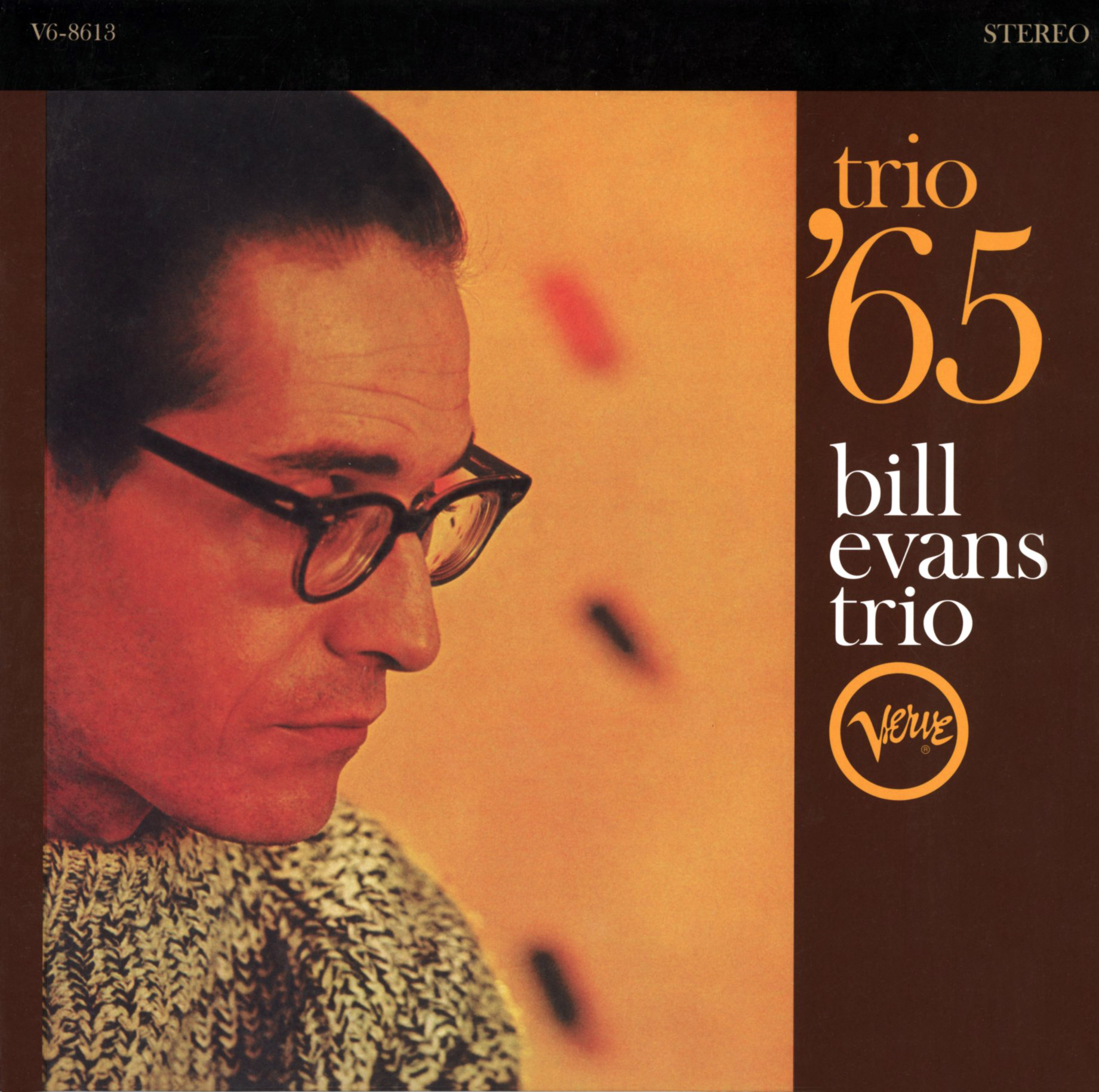
Creed Taylor produced the record and Van Gelder engineered it. Verve released the album in June 1965 as V6-8613. Don Nelsen supplied the liner notes and Fred Seligo the cover photograph. Eight tracks occupy two sides, including compositions by John Carisi, Earl Zindars, Thelonious Monk, George and Ira Gershwin, Harold Arlen and Johnny Mercer, and Tadd Dameron with Carl Sigman. Their different backgrounds give the programme variety without turning it into a demonstration of how many contrasting styles a trio can accommodate.
For an Evans collector, the return of particular titles is part of the attraction. A composition has a history within his work, and another recording adds a further perspective to that history. Knowledge of the earlier versions is not required to enjoy Trio ’65. Listeners who do know them can, however, pay particular attention to things that a list of notes cannot capture: the balance between the three instruments, the time allowed for tension to develop and the weight of a musical reply.

Israels and Bunker within the conversation
Chuck Israels does more than fill the bass position. In a piano trio, the bass helps determine how harmonic movement and melodic independence coexist. A note can establish a foundation, a line can lead onwards, and a pause can make room for another idea. It is therefore worth following the double bass before an obvious solo feature arrives. Beneath a piano phrase, a second melodic thought can already be influencing the direction of the whole performance.
Larry Bunker completes that relationship at the drums. His role here should be distinguished from a general list of the other instruments he played during his career: on this record, he is documented as the drummer. That keeps the picture of the ensemble precise. The instrumentation is acoustic piano, double bass and drums, without an additional vibraphone part or an assumed rotation of instruments. The variety comes from decisions made within a deliberately small set of musical resources.
One useful listening approach is to follow the transitions between roles. When does the piano carry the melody prominently, when does its line become part of a closer exchange, and how do bass and drums answer a change in phrasing? It is unnecessary to assign a conscious intention to every reaction. Hearing the relationships shift is rewarding in itself. The trio format makes those movements relatively easy to follow while leaving their musical complexity intact; clarity of ensemble does not mean simplicity of interaction.
All eight pieces were made at the same session, giving the album a clearly defined scope. It is not a retrospective assembled from several years, nor a programme of changing accompanists. Israels and Bunker participate throughout. That continuity lets the listener relate the differences between tracks to the material and its treatment, rather than constantly having to identify another group. Across the two sides, the musicians’ shared approach can become familiar enough for a small adjustment to carry considerable significance.

From “Israel” to “If You Could See Me Now”
John Carisi’s “Israel” opens side A. The similarity of the title to the bassist’s surname should not lead to a mistaken writing credit: Chuck Israels performs, while Carisi composed the piece. Earl Zindars’ “Elsa” follows, introducing a writer represented twice on this album. That double presence offers an appealing glimpse of Evans’ relationship with repertoire. A composer is not reduced to one identifying tune; two pieces allow different aspects of his melodic and formal imagination to contribute to the programme.
“’Round Midnight” and “Our Love Is Here to Stay” complete the first side. Monk’s composition and the Gershwin song each arrive with a strong identity. Listen for the relationship between their recognisable melodies and the harmonic surroundings Evans and his partners create. Familiar standards are especially rewarding in this respect. Recognition provides orientation, while a modest change in emphasis may become more noticeable than it would in an entirely unfamiliar theme. The tune’s history becomes a resource rather than a restriction.
Side B begins with the second Zindars piece, “How My Heart Sings.” It is followed by “Who Can I Turn To,” written by Leslie Bricusse and Anthony Newley. This selection has a particular place in the programme because it is the only one without an earlier Evans recording behind it. That does not automatically make it the album’s central performance. It does change the perspective: alongside returns to established material, there is a new encounter within the same day’s work and the same instrumental partnership.
Harold Arlen and Johnny Mercer’s “Come Rain or Come Shine,” followed by Tadd Dameron and Carl Sigman’s “If You Could See Me Now,” bring the album to its conclusion. Both recall the close connection between instrumental jazz and American song. A melody does not entirely lose its verbal origins when nobody sings. Its arc, breathing places and implied vocal phrasing can still provide a route into the performance. The trio develops those possibilities through instrumental means, allowing their expression to remain open rather than fixed by a sung text.
A single LP preserving the session’s shape
This edition carries the order number AVER 12401 and belongs to the Verve/UMe Acoustic Sounds Series. It presents the stereo album on one 180-gram LP at 33⅓ RPM. Ryan K. Smith at Sterling Sound handled the mastering from analogue tapes. The record is pressed at Quality Record Pressings and housed in a Stoughton gatefold jacket. These are the principal documented features of this particular reissue, rather than specifications borrowed from another Evans release with a similar presentation.
One LP is a sensible format for the programme. Four tracks occupy each side, with a single side change dividing the two halves. That allows the session to be heard as a sustained album sequence rather than repeatedly interrupted after only a few minutes. The combination of revisited compositions and the newly recorded “Who Can I Turn To” can be followed as a whole. The sequence travels from Carisi’s “Israel” to Dameron’s “If You Could See Me Now,” giving the two Zindars compositions separate places within the two halves of the album.
Clear identification also helps when comparing records within a collection. Trio ’64 means Evans, Peacock and Motian in New York in December 1963; Trio ’65 means Evans, Israels and Bunker in Englewood Cliffs in February 1965. Both belong to his Verve years and both explore the small ensemble, but neither the personnel nor the recording date is interchangeable. These reissues allow that relationship to be followed in a familiar LP format while retaining the identity of each album as a separate musical event.
The musical reason to return to this record is the meeting of three voices with eight compositions whose familiarity opens further possibilities. The two Zindars pieces, the Monk classic and the songs by Gershwin, Arlen and Dameron bring several aspects of Evans’ repertoire into view beside one another. In that light, a second or third Evans recording of the same song can be a meaningful addition rather than unnecessary duplication. You order from Michael 45 in Germany. We arrange the US import and dispatch from Hilden.
More by Bill Evans: At The Montreux Jazz Festival · Interplay
Artist page: All titles by Bill Evans
Series: Verve – all 34 records: voices, organ and bossa nova
Musicians
Participants and documented credit status. Track references correspond to the tracklist.
- Bill EvansPortrait: 1964pianoParticipation: All tracks
- Chuck Israelsdouble bassParticipation: All tracks
- Larry BunkerPortrait: 1957drumsParticipation: All tracks
- Creed TaylorproductionParticipation: Recording production
- Rudy Van Gelderrecording engineerParticipation: Recording production


All eight tracks: Bill Evans, Chuck Israels and Larry Bunker. February 3, 1965, Englewood Cliffs.
How Michael hears this edition
Listening impression · paraphrased from the video
Michael hears pleasing dynamics and abundant detail without the presentation becoming harsh or excessively analytical. He finds the Acoustic Sounds edition well balanced and on the same high level as Trio ’64.
🎧 Review video: Bill Evans Trio – Trio '65 - The Acoustic Sound Series
This video is hosted by YouTube (Google). It only loads once you switch on “Functional” in the cookie settings.

Reviews
There are no reviews yet.