Three voices opening a wider window
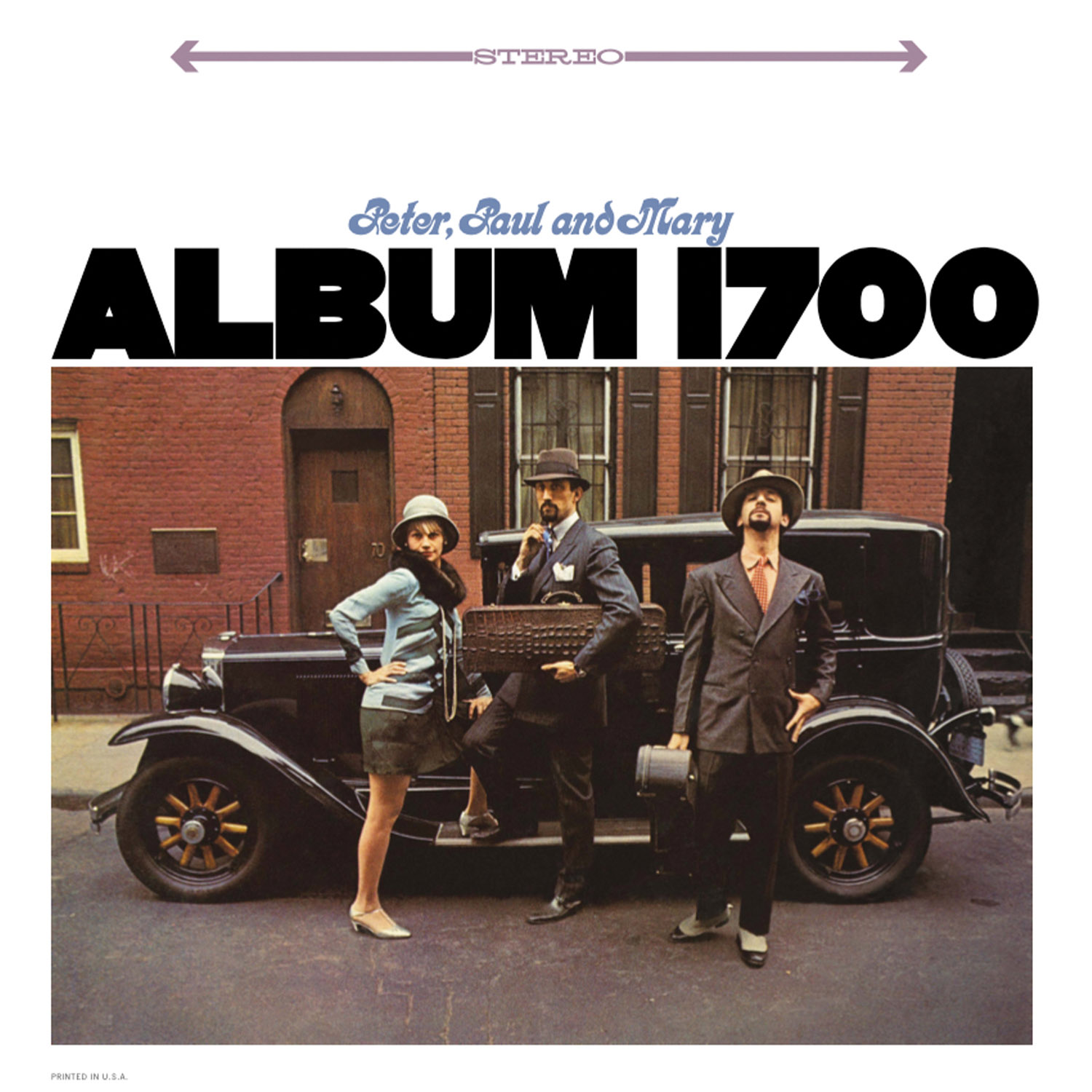
The title Album 1700 sounds almost deliberately matter-of-fact. Its number refers to the original catalogue designation, WS 1700; the programme behind that plain label is considerably more varied than it suggests. Peter, Paul & Mary released the album on August 4, 1967. Their three voices remain its centre, but a broader instrumental range surrounds them. Folk meets rock, individual wind colours and a chamber ensemble. The trio does not have to surrender its identity to make these encounters possible. Because that identity remains recognisable, the album’s different outward views can still be understood as parts of the same musical world.
Recording took place during 1966 and 1967 at A&R in New York. Albert Grossman and Milton Okun are the producers, Phil Ramone the recording engineer and Don Hahn the assistant. That studio setting provides a concrete background for a record whose personnel extends well beyond three singers with guitars. At the same time, the individual contributions of the three members remain clear. Peter Yarrow, Noel Paul Stookey and Mary Travers are more than interchangeable components in a unified vocal sound. The programme gives them separate space: Mary in No Other Name, Peter in If I Had Wings and Paul in Whatshername.
The result is an appealing alternation between a shared identity and individual storytelling. Listeners who know the trio mainly through a few familiar songs can use Album 1700 to explore several ways of sustaining a common programme. A solo voice need not interrupt that continuity; it can illuminate it from another direction. An additional instrument need not displace the folk foundation either. Expansion becomes part of the same musical language. The twelve songs do not submit to one stylistic test. They allow intimacy, social questions, humour and curiosity about other forms of music to exist alongside one another within a single album.

An unusually large circle behind the trio
The House Song reveals the particular breadth of the personnel. The Paul Winter Consort appears with seven individually documented members: Gene Bertoncini and Karl Herreshoff on guitars, John Beal on double bass, Gene Murrow on English horn, Paul Winter on saxophone, Virgil Scott on alto flute and Richard Bock on cello. These are not vaguely acknowledged additional musicians, but identifiable participants in a credited track ensemble. The mixture of strings and winds provides a different setting from the simple image of a folk trio. This song is therefore an especially rewarding reason to consult the complete credits and follow the instrumental contribution closely.
Elsewhere, further guests can be placed precisely. Paul Butterfield’s harmonica is credited on Rolling Home, and Paul Griffin’s organ on Weep For Jamie. Richard Kniss is documented on double bass, including a solo in Whatshername. Howard Collins contributes guitar, Morris Wechslier piano, and Harvey Brooks and Russ Savakus electric bass. Four members of the Paupers also appear in the credits: guitarists Chuck Beale and Adam Mitchell, bassist Denny Gerrard and drummer Skip Prokop. Where the sources do not supply secure individual song assignments, those assignments remain open. Sharing an album credit is not turned into a claim about a particular recording.
This level of detail changes the view of the album. Its three principal voices remain the identifiable reference point, but the accompaniment is not anonymous scenery. Different musical experiences meet inside the recordings. Twelve-string guitar is also specifically assigned to the two male members on selected tracks. There are several rewarding listening routes: following the movement between solo and ensemble singing, noticing changes of instrumental colour, or hearing individual songs as encounters with guests. None replaces the complete programme. Together, however, they help explain why the apparently modest title Album 1700 covers such a varied collection of musical situations and individual contributions.

From “Leaving On A Jet Plane” to “The Song Is Love”
Rolling Home, Leaving On A Jet Plane and Weep For Jamie make up the first side of this double LP. John Denver’s Leaving On A Jet Plane will be the immediate point of recognition for many listeners. Here it sits between two other songs, receiving its album position from that sequence. Side two moves through Mary Travers’ solo vocal in No Other Name to The House Song and The Great Mandella (The Wheel Of Life). Even the juxtaposition of those titles shows how little the programme depends on a single occasion or mood. A famous song exists inside a broader act of selection.
The second record begins with I Dig Rock And Roll Music, followed by If I Had Wings and I’m In Love With A Big Blue Frog. Moving between musical self-observation, an individual voice and a playful title is part of the album’s character. The seriousness of particular songs does not create an expectation that the whole record must carry the same emotional weight. Its final side brings together Whatshername, Bob Dylan’s Dream and The Song Is Love. The sequence reaches another important songwriter before closing with a title that explicitly returns attention to the shared, communicative possibilities of singing.
The twelve pieces can be heard as a conversation between different possibilities within folk-pop. A song can tell a story, take a position, smile, remember or respond to the music surrounding it. The trio holds those possibilities together without forcing every title into an identical instrumental setting. That is part of the album’s appeal beyond its most familiar single. Album 1700 documents a moment when an established group identity could admit new neighbours. Hearing the whole record is more revealing than waiting for one highlight. The contrasting songs and guest ensembles explain one another as the programme develops, giving the collection a flexibility of its own.
Four sides for the complete 1967 programme
This edition carries catalogue number AAPF 1700-45. Analogue Productions released it in 2022 as a stereo double LP, with two 180-gram records playing at 45 RPM. Kevin Gray handled mastering from the original analogue tapes. The records were pressed at Quality Record Pressings, with Gary Salstrom documented for the metalwork, and the release uses a Stoughton jacket. These details describe a particular reissue and form part of its identity. They should not be transferred automatically to another pressing simply because it shares a familiar sleeve design or the same album title. The edition matters as well as the repertoire.
The programme is divided evenly across four sides of three tracks each. That makes its groupings particularly easy to follow: the first record ends with The Great Mandella, and the second begins with I Dig Rock And Roll Music. Additional side changes are part of this format and deserve consideration alongside the named analogue source and mastering credit. Rotational speed alone cannot predict an individual listening experience. What can be established is the documented production of this version and the order in which its twelve songs occupy four sides. That precise identification is useful when distinguishing among the different available histories of a familiar album.
You order from Michael 45 in Germany. We arrange the US import and dispatch from Hilden.
For anyone looking to buy this album on vinyl, these details identify the edition described here. For a collection spanning folk, vocal groups and 1960s pop, Album 1700 offers several rewarding points of entry. The familiar trio remains visible while solo voices, rock musicians and chamber players widen the picture. The complete personnel section below makes those contributions traceable without inventing missing track assignments. This 45 RPM edition can therefore be approached through its recognisable songs or through less obvious connections among its players and arrangements. The unassuming album title promises little. The actual programme provides considerably more to follow, returning attention to the variety that becomes apparent when the entire record is allowed to unfold.
Customer question: Buying Analogue Productions records in Europe
Musicians
Participants and documented credit status. Track references correspond to the tracklist.
- Peter YarrowPortrait reference: circa 1968vocals, guitar, twelve-string guitarParticipation: Vocals/guitar: album credits · solo C2 · twelve-string guitar A2, A3
- Noel Paul StookeyPortrait reference: circa 1968vocals, guitar, twelve-string guitarParticipation: Vocals/guitar: album credits · solo D1 · twelve-string guitar A1, B2, D3
- Mary TraversPortrait reference: circa 1968vocalsParticipation: Album credits · solo vocal B1
- Howard CollinsguitarParticipation: Album credits · track assignment unconfirmed
- Paul GriffinorganParticipation: A3
- Morris WechslierpianoParticipation: Album credits · track assignment unconfirmed
- Harvey BrooksLater portrait: 1972electric bassParticipation: Album credits · track assignment unconfirmed
- Richard Knissdouble bassParticipation: Album credits · double bass solo D1
- Russ Savakuselectric bassParticipation: Album credits · track assignment unconfirmed
- Paul ButterfieldharmonicaParticipation: A1
- Chuck BealeguitarParticipation: The Paupers · track assignment unconfirmed
- Adam MitchellguitarParticipation: The Paupers · track assignment unconfirmed
- Denny Gerrardelectric bassParticipation: The Paupers · track assignment unconfirmed
- Skip ProkopdrumsParticipation: The Paupers · track assignment unconfirmed
- Gene BertonciniguitarParticipation: B2 · Paul Winter Consort
- Karl HerreshoffguitarParticipation: B2 · Paul Winter Consort
- John Bealdouble bassParticipation: B2 · Paul Winter Consort
- Gene MurrowEnglish hornParticipation: B2 · Paul Winter Consort
- Paul WintersaxophoneParticipation: B2 · Paul Winter Consort
- Virgil Scottalto fluteParticipation: B2 · Paul Winter Consort
- Richard BockcelloParticipation: B2 · Paul Winter Consort


Produced by Albert B. Grossman and Milton Okun. Recording: Phil Ramone; assistant: Don Hahn. This edition mastered by Kevin Gray (2022). Metalwork: Gary Salstrom.
🎧 Review video: The 20 Best Audiophile Analogue Production Editions (Still in Print 2021)
This video is hosted by YouTube (Google). It only loads once you switch on “Functional” in the cookie settings.

Reviews
There are no reviews yet.