

Four musicians and more than one recording location
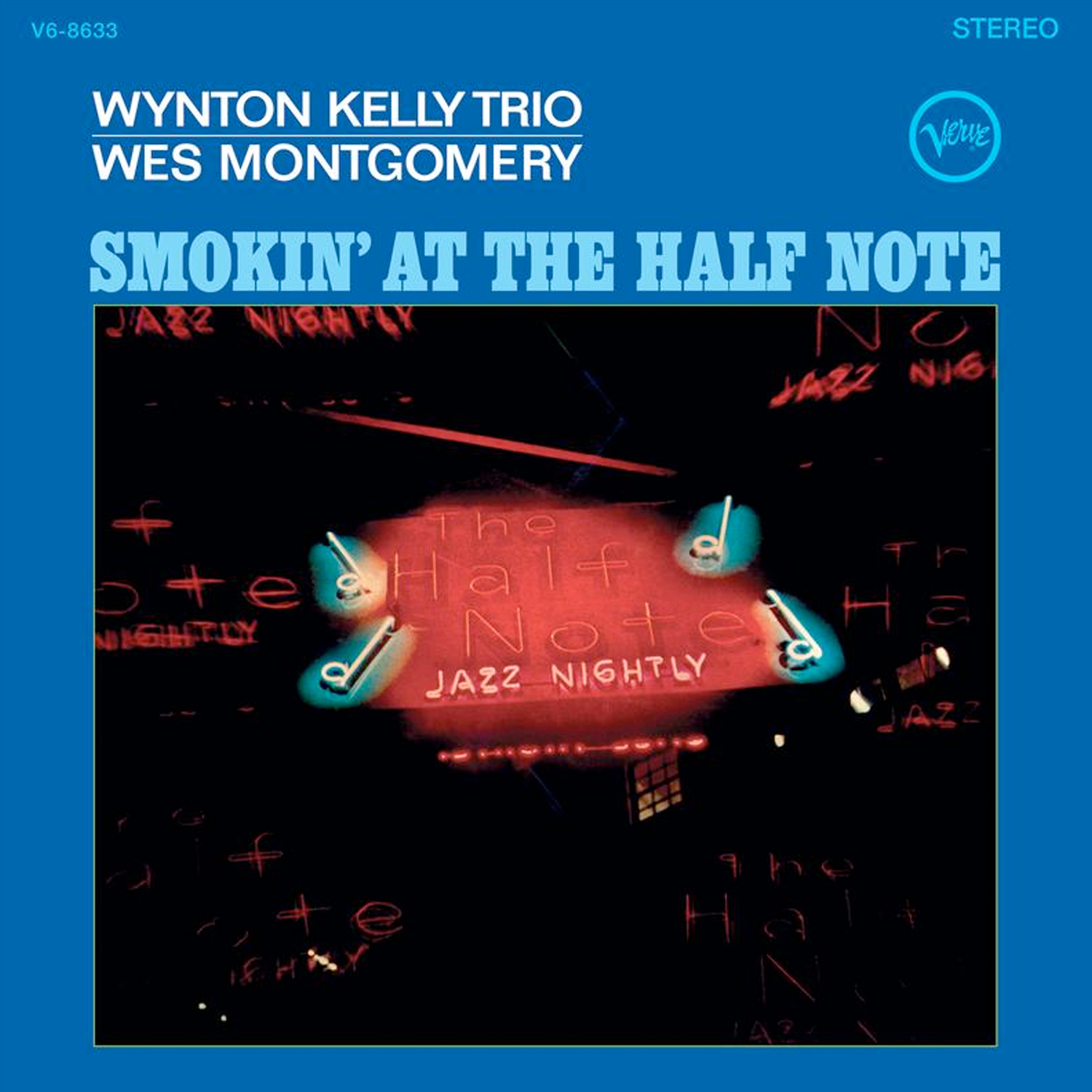
Smokin’ At The Half Note brings Wes Montgomery together with Wynton Kelly, Paul Chambers and Jimmy Cobb. Guitar, piano, double bass and drums form a quartet whose billing already expresses a musical relationship: the Wynton Kelly Trio and Wes Montgomery. If you want to buy Smokin’ At The Half Note on vinyl, this Acoustic Sounds Series edition presents five tracks on one 180-gram stereo LP. It plays at 33⅓ RPM and retains the concentrated programme of the original album.
The title names a New York club, but the recording history includes two locations. Part was recorded live at the Half Note in June 1965, with further material recorded on September 22 that year at Van Gelder Studio in Englewood Cliffs, New Jersey. The documentation for this edition lists both occasions without assigning each of the five tracks individually. The record should therefore be understood as a combination of live and studio recordings. Describing it as one uninterrupted evening captured entirely in the club would make a different claim.
Across those origins, the musical centre remains clear: four instruments and the same four players. Montgomery is not a guitar soloist in front of an anonymous backing orchestra. Kelly’s trio has an identity of its own, recognisable through the musicians’ shared work in other settings. Listeners who know Paul Chambers and Jimmy Cobb from Miles Davis recordings encounter them again here, in a conversation where guitar and piano share the melodic and harmonic foreground.
This compact personnel offers a useful starting point for listening. You can follow the guitar and later attend to how the piano responds to a phrase or supports a harmonic movement. Bass and drums do more than occupy the background; they are the other voices in this quartet. Five extended pieces allow time to notice such relationships developing over the course of a performance. A large ensemble is not necessary for the record to offer variety and an evolving musical conversation.

No Blues and the space of a long first side
No Blues opens the programme and was written by Miles Davis. Its documented thirteen-minute duration occupies most of the first side. That length immediately establishes a different scale from a brief opening number: the group has time to develop a setting and accommodate several contributions within it. Rather than waiting only for one conspicuous moment, a listener can follow the movement from phrase to phrase and consider how the performance holds together over a longer span.
The composer’s name connects the piece to a familiar musical circle without adding Davis to the performing personnel. Montgomery, Kelly, Chambers and Cobb remain the players on this recording. Separating writer from performer is particularly useful with jazz repertoire. A composition can travel between groups and instrumental combinations without losing its origin. The attraction of a particular record lies in the musicians who are actually working together on that version, and in the relationship they bring to the material.
If You Could See Me Now follows as the second track on side one. Tadd Dameron and Carl Sigman’s composition supplies a different melodic starting point after No Blues. The first side is consequently not simply a succession of similar numbers. Two pieces are enough to give the quartet contrasting material to work with. At more than six minutes, the second performance is also sufficiently extended for its melody to become more than a passing introduction before the record moves on.
Guitar and piano can both offer single-note lines and harmonic structures within this kind of group. Their proximity is therefore interesting: two instruments have related possibilities but express them in different ways. Montgomery’s contribution and Kelly’s playing can be followed as separate voices and as parts of the same ensemble. Chambers and Cobb provide the rhythmic foundation for that relationship. On a later playing, attention can move naturally from the leading line to the musicians working around it.

Three pieces on the reverse side
Unit 7 begins side two. It was written by bassist and composer Sam Jones, who does not perform on this album; Paul Chambers occupies the bass position. The piece illustrates how a writer’s name can broaden the connections around an album without changing its personnel. Between Miles Davis on side one and Jones on side two, the repertoire draws on compositions by working jazz musicians, complemented by songs from a different writing tradition.
Four On Six is Montgomery’s own composition, bringing his role as a writer into focus. It sits among pieces by other composers rather than defining the entire record through original material alone. That makes the selection particularly useful: the guitarist appears both with a composition of his own and in response to other writers’ ideas. An album can express a musician’s personality without consisting exclusively of self-written pieces. The players bring their identities to melodies that existed before this particular recording occasion.
What’s New?, by Bob Haggart and Johnny Burke, closes the programme. Its documented six-minute duration gives the final performance space without extending the LP through additional material. Unit 7, Four On Six and What’s New? provide three clearly identified stages on the reverse side. Together with the opening pair, they create a five-part sequence whose proportions are apparent from the tracklist. The album offers time within each performance rather than relying on a large number of short selections.
Creed Taylor produced the record. Rudy Van Gelder is credited with recording, and Val Valentin with engineering direction. Their names belong to the release’s history, alongside Chuck Taylor’s liner notes, Acy Lehman’s design and Jon Henry’s cover photography. The musician section, by contrast, lists the four players. Keeping those responsibilities distinct makes the information easier to use and prevents a familiar producer or engineer from being mistaken for an additional instrumentalist on the session.
The Acoustic Sounds Series LP
This particular reissue carries catalogue number AVER 82901 and was released in 2023. Ryan K. Smith handled mastering at Sterling Sound from the original analogue tapes. Quality Record Pressings manufactured the single 180-gram LP, while Stoughton Printing supplied the tip-on gatefold jacket. It belongs to the Verve/UMe Acoustic Sounds Series. These technical details describe the offered reissue and should remain separate from the production of the recordings in 1965.
The 33⅓-RPM format keeps the five tracks together across two sides. With an opening performance as long as No Blues, the sequence contributes to how the album unfolds: two extended pieces carry the first side, followed by three on the second. This is not a selection assembled from several albums or a running order enlarged with later CD bonus tracks. The record presents a clearly defined programme in its documented single-LP configuration.
For a collection focused on jazz guitar, the quartet provides a particularly intelligible setting. It places Montgomery beside a pianist with an individual voice and an established partnership on bass and drums. The album also offers a useful next step for listeners who mainly know Kelly, Chambers and Cobb supporting horn players. With guitar in the foreground, the instrumental relationships shift; familiar musicians work around a different focal point while retaining their own importance within the group.
Smokin’ At The Half Note remains rewarding to consider even when the famous guitarist is not the only focus. You can return to a piece for Kelly’s piano or concentrate on how Chambers and Cobb support an extended performance. The title provides an initial route through a club; the complete information leads further, to two recording locations, five compositions and four named musicians. Those connections make the record a distinct part of a jazz collection rather than simply another entry under a celebrated name.
You order from Michael 45 in Germany. We arrange the US import and dispatch from Hilden.
Series: Verve – all 34 records: voices, organ and bossa nova
Musicians
Participants and documented credit status. Track references correspond to the tracklist.
- Wes MontgomeryPortrait reference: 1959guitarParticipation: Album personnel; individual scope unspecified
- Wynton KellyPortrait reference: 1962pianoParticipation: Album personnel; individual scope unspecified
- Paul ChambersPortrait reference: 1958double bassParticipation: Album personnel; individual scope unspecified
- Jimmy CobbExisting portrait; not a session depictiondrumsParticipation: Album personnel; individual scope unspecified


Quartet according to album credits. June1965 Half Note and September22,1965 Van Gelder Studio: live/studio origins distinguished, without unsupported track assignments. Creed Taylor: producer; Rudy Van Gelder: recording; Val Valentin: engineering director. Miles Davis/Sam Jones are composers, not additional performers. Ryan K. Smith / Sterling Sound: mastering from original analogue tapes; QRP: pressing; Stoughton: jacket.
How Michael hears this edition
Listening impression · paraphrased from the video
Michael hears audience conversation and orders quietly in the background. This audible club atmosphere makes him feel as though he is sitting in the Half Note himself. He could not compare the Acoustic Sounds edition discussed with the older AP 45 RPM he was looking for.
🎧 Review video: Acoustic Sound Series: Wynton Kelly Trio / Wes Montgomery – Smokin' At The Half Note
This video is hosted by YouTube (Google). It only loads once you switch on “Functional” in the cookie settings.

Reviews
There are no reviews yet.