

Four tenors with no reason to sound alike
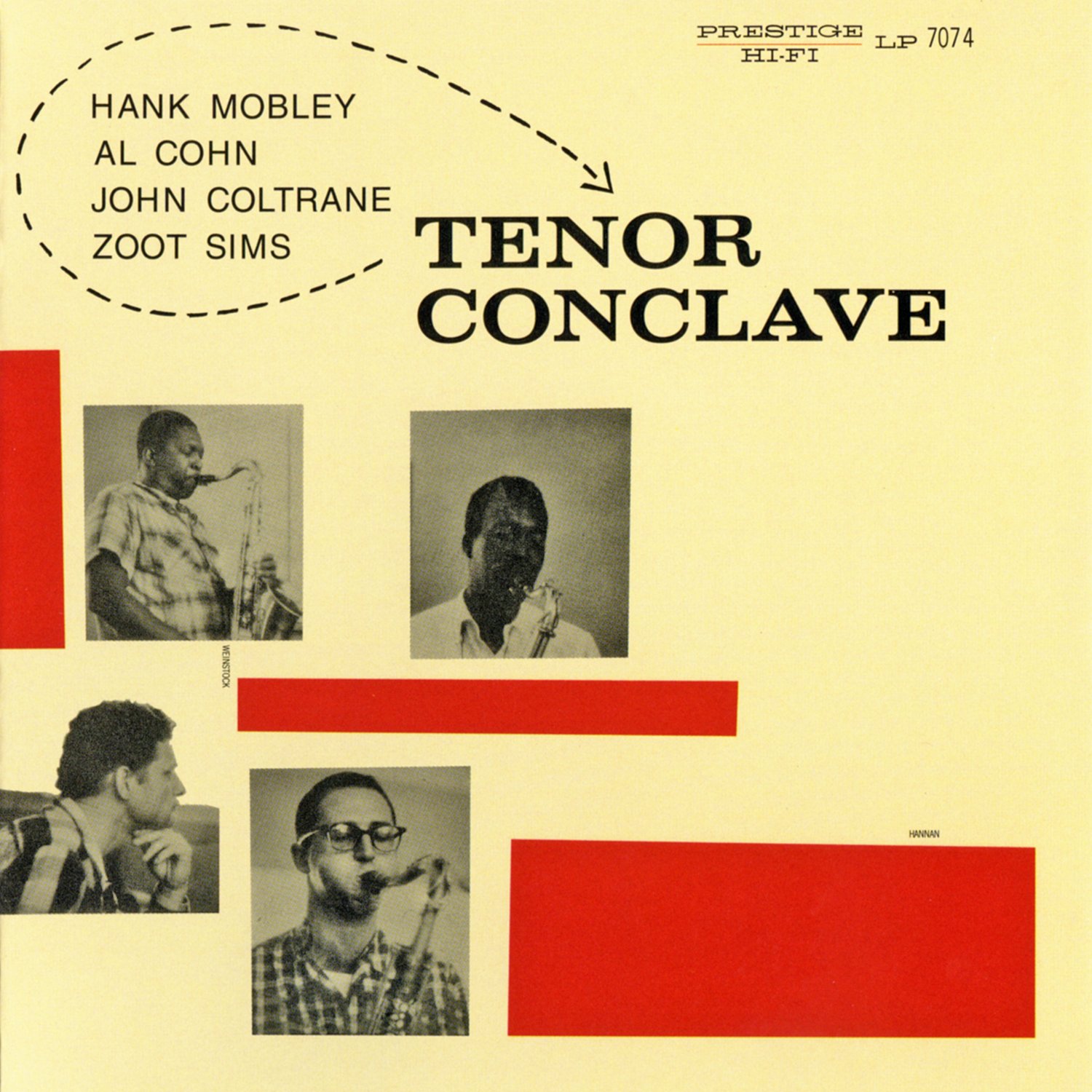
Four tenor saxophones in front of a rhythm section: the personnel of Tenor Conclave immediately promise an unusual encounter. Hank Mobley, Al Cohn, John Coltrane and Zoot Sims meet at Rudy Van Gelder’s studio in Hackensack on September 7, 1956. Red Garland plays piano, Paul Chambers double bass and Art Taylor drums, with Bob Weinstock producing for Prestige. The resulting album appears in 1957 under the collective name The Prestige All Stars. It gives several distinctive musical personalities the same starting point without requiring them to surrender their differences.
The publisher places the session within Prestige’s series of Friday-afternoon gatherings. A familiar working framework could provide room for something unexpected. This is neither a collection of four different wind instruments nor the usual combination of trumpet and saxophone. All four soloists inhabit the tenor’s register. Differences consequently emerge particularly clearly through tone, phrasing, rhythmic placement and the construction of a line. Sharing an instrument does not make their voices interchangeable; it directs attention towards the individual language each player brings to the music.
Mobley’s contribution extends beyond his playing. Two of the four compositions are his: the blues Bob’s Boys and the title piece, built on the harmonic framework of I Got Rhythm. Two standards complete the programme. This material supplies common ground without requiring the musicians to explain an elaborate unfamiliar structure before they can explore it. At the same time, the selection is more purposeful than the idea of an arbitrary jam session might suggest. Blues, familiar chord changes and established melodies offer different ways of developing a musical thought. The variety comes from what the players do with those forms.

Mobley’s compositions and two familiar standards
On this Analogue Productions LP, side A begins with Bob’s Boys. The blues form provides a recurring framework for the soloists. That repetition creates an inviting way to listen: which small motives continue beyond a single chorus, where does a phrase become shorter, and when does a pause alter the tension? There is no need to treat every entrance as a race to identify the player. The documented personnel establish all four tenorists, but that is not the same as a securely documented solo order for every track. The changing voices remain rewarding to follow even without attaching a name to each moment.
Just You, Just Me, by Jesse Greer and Raymond Klages, adds a standard to the first side. Familiar material permits a different relationship between theme and improvisation from that offered by a newly introduced original. A melodic turn can become a starting point, an accent can pull against the accompaniment, and a known form can take an unexpected direction. For collectors who enjoy comparing interpretations of jazz standards, this is more than another occurrence of a familiar title. The unusual personnel place the same composition under different conditions and create a worthwhile comparison of their own.
Side B opens with Tenor Conclave. Mobley’s theme rests on the harmonic foundation of I Got Rhythm, a familiar structure for jazz musicians. That shared framework allows freedom while still demanding a sense of direction. Irving Berlin’s How Deep Is the Ocean then receives the greatest span in the programme, at approximately fifteen minutes. The four performances vary considerably in length, from a little over eight minutes to around fifteen. These proportions allow developments that a compact single performance might not accommodate. A theme can establish the point of departure while the larger story unfolds across successive solos.

Garland, Chambers and Taylor keep the conversation open
Beneath the four tenors is a rhythm section whose names deserve equal attention. Red Garland, Paul Chambers and Art Taylor form the Red Garland Trio of this period. Their task is to respond to changing articulations and energies rather than accompany just one soloist. Garland can outline the harmony economically, Chambers support the course of a phrase through a bass movement, and Taylor alter the weight of the pulse. These are useful starting points for your own listening without turning a single accompanying figure into a rule for an entire performance.
A rewarding second visit can therefore begin with the piano, bass or drums. What remains constant when another tenor takes over? Where does the accompaniment answer, and where does it leave space? Those questions do not diminish the importance of the horns. Instead, they show how a shared setting can make the differences between the soloists more apparent. In a seven-piece group, not every musician needs to occupy the foreground at every moment. Much of the interest can lie in one player pursuing a clear line while the others give that line the room it requires.
For a collection, Tenor Conclave also offers the attraction of a precisely dated musical snapshot. Coltrane appears here as one of four equally named tenorists; knowledge of his subsequent development should not obscure the other participants. Mobley’s compositions, Cohn’s and Sims’ involvement, and the work of the trio are central to the album. A listener arriving through one famous name may find several other musical paths opening from the same session. The collective title can be taken quite literally: the meeting itself, with its distinct voices and shared forms, is the record’s principal subject.
Four extended performances on one Prestige mono LP
This edition carries catalogue number APRJ 7074 and belongs to the Analogue Productions Prestige Mono Series. It is a single LP playing at 33⅓ RPM. Kevin Gray cut the record at Cohearent Audio; the publisher identifies analogue masters as the source and Quality Record Pressings as the pressing plant. The programme is mono. The four tenors are therefore not separated by an artificially expanded stereo panorama. Catalogue number, mono presentation and mastering together establish the identity of this particular edition.
The side allocation suits the programme: Bob’s Boys and Just You, Just Me occupy side A, followed by the title composition and How Deep Is the Ocean on side B. The extended performances remain intact within their respective sides. A glossy tip-on jacket completes the presentation. Documentation for the first pressing of this reissue, released in 2013, describes 200-gram vinyl, deep-groove labels and a flat edge; the publisher now lists 180-gram editions under the same catalogue number. A particular early pressing or numbered copy is consequently not promised here without qualification.
The first attraction for a collector is the music and its clearly defined assembly: four pieces, seven identified musicians and one Hackensack session. The 33 RPM LP gives that programme a straightforward shape with a single side change. It invites you to let each piece take its time and to redistribute your attention on every return, both between the tenors and between the horns and the trio. You order from Michael 45 in Germany. We arrange the US import and dispatch from Hilden.
More by The Prestige All Stars: Wheelin’ & Dealin’ · All Night Long
Artist page: All titles with John Coltrane
Customer question: Buying Analogue Productions records in Europe
Series: Analogue Productions Prestige – all 50 records, musicians and session paths
Musicians
Participants and documented credit status. Track references correspond to the tracklist.
- Hank Mobleytenor saxophoneParticipation: All 4
- Al Cohntenor saxophoneParticipation: All 4
- John Coltranetenor saxophoneParticipation: All 4
- Zoot Simstenor saxophoneParticipation: All 4
- Red GarlandpianoParticipation: All 4
- Paul Chambersdouble bassParticipation: All 4
- Art TaylordrumsParticipation: All 4


All seven musicians appear on all four tracks. The order of tenor solos is not securely documented.

Reviews
There are no reviews yet.