

Karma: a large form sustained by many voices
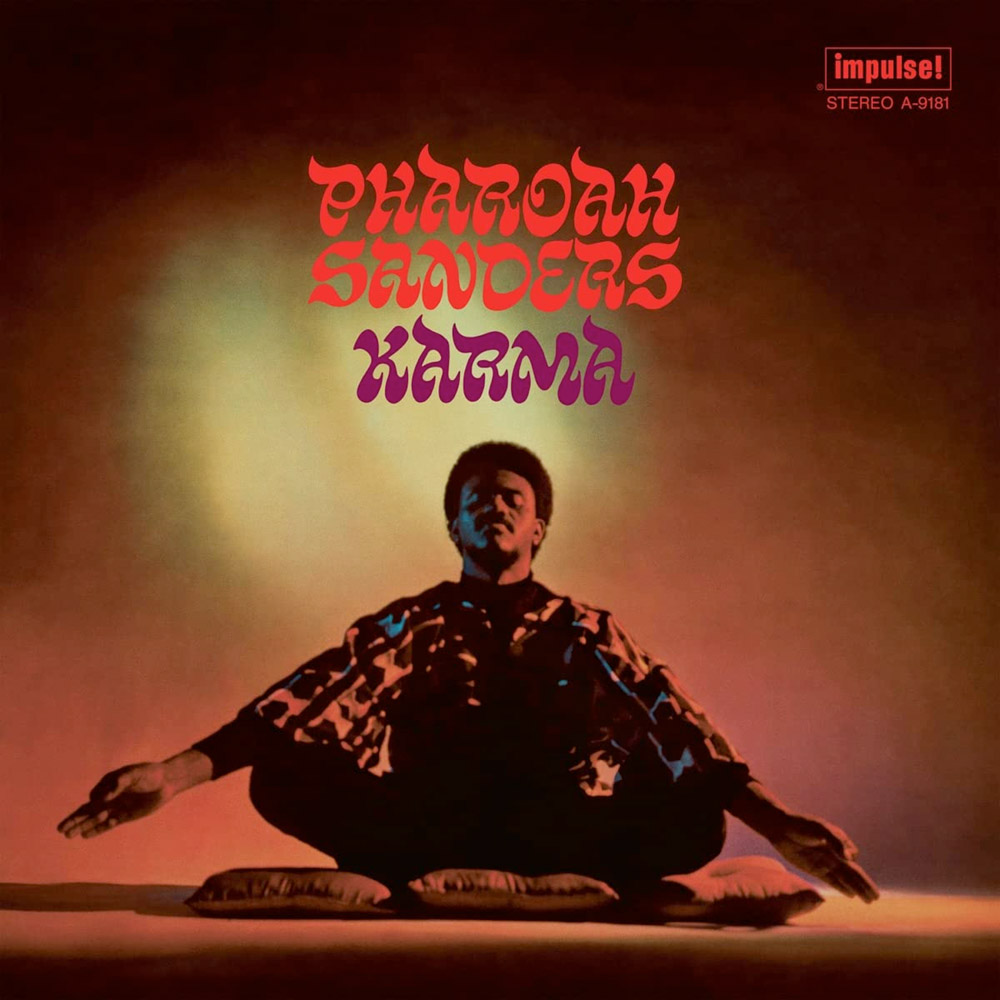
Karma asks for a different kind of attention from an album made up of numerous short selections. Pharoah Sanders places the extended The Creator Has a Master Plan at its centre, with a development spanning both sides of the record. That establishes a distinctive scale: a recurring figure can become a point of orientation while the music surrounding it changes. There is no need to classify every detail immediately. Begin by noticing relationships between voice and saxophone, the bass foundation and different rhythmic layers, or a recognisable idea and its continuing development. The larger shape gives those relationships time to register.
The recording belongs to the Impulse! catalogue and is identified in the session discography as an album from 1969. The Creator Has a Master Plan is documented on February 14, 1969, at RCA Studios in New York. Colors was recorded there on February 19, using a different personnel configuration. The album therefore draws on two sessions. Bob Thiele produced the record and Bob Simpson handled engineering. Those names locate the project concretely. They cannot replace the musical experience, but they provide a reliable historical frame within which to approach it.
Sanders plays tenor saxophone here. Leon Thomas, credited with vocals and percussion, gives the album an identifiable human voice alongside the wind instrument. That relationship provides an entrance even for listeners unfamiliar with extended jazz forms. Singing can establish a point of reference while the ensemble expands the surrounding context. Different expectations can coexist: follow the broad trajectory or concentrate on one participating musician. The album title does not dictate how the music must make you feel. Its effect grows from the interaction of the voices involved, and from the attention brought to those encounters.

The Creator Has a Master Plan and the passage into Colors
The first side contains part one of The Creator Has a Master Plan. The piece continues on side two before Colors follows. That division is particularly important for this edition because abbreviated listings describe the whole second side simply as Colors. Such a listing misrepresents the album’s form. The LP contains two compositions, with the extended main work divided into two parts across the sides. Turning the record interrupts playback; it does not establish that an entirely new composition has begun. Keeping that distinction clear helps listeners understand what is actually included.
The relationship can be carried consciously into listening. At the end of the first side, remember the direction of the music rather than only an isolated effect. When the stylus returns on side two, the continuation belongs to the same remembered development. This is a particular experience of the LP format: a large musical shape must remain connected across a short practical pause. Listeners accustomed to a digital version without a side change encounter a different organisation of time here. Neither needs to be declared universally correct. This specific edition requires its own way of handling the programme, and that handling becomes part of an attentive hearing.
Colors then provides a shorter conclusion. The frequently repeated figure 19:17 is not a verified running time for that composition; it is a problematic side-duration entry. The documented edition note gives 5:43 for Colors, while the precise duration of the second Creator part remains unconfirmed. That matters to collectors, because an incorrect tracklist creates expectations of a different programme. The tab below therefore lists part one on side A, its continuation as B1 and Colors as B2. The overview remains concise without shortening the actual sequence or turning an unsupported subtraction into an apparently exact track time.

Eleven participants, two bass pairings and a changing rhythm section
Nine musicians are documented for The Creator Has a Master Plan. Alongside Pharoah Sanders and Leon Thomas are Lonnie Liston Smith on piano, James Spaulding on flute and Julius Watkins on French horn. Reggie Workman and Richard Davis form the bass pairing, with Billy Hart on drums and Nat Bettis on percussion. This configuration explains why attention beyond the tenor saxophone is worthwhile. Flute and horn offer contrasting possibilities of line and colour, while two bassists establish a different starting point from the single bass of a conventional quartet.
For Colors, Sanders, Thomas, Smith, Watkins and Workman remain. Ron Carter takes the second bass role and Freddie Waits plays drums. Spaulding, Davis, Hart and Bettis belong to the other session. Across the two recordings there are therefore eleven distinct musicians, rather than sixteen separate people obtained by copying two lists without reconciling their names. The personnel section explicitly preserves these assignments. Anyone following an individual bassist or drummer can begin with the appropriate selection. For an album with changing personnel, a brief and accurate participation note is more useful than an extended undifferentiated list.
One rewarding listening approach is to follow the colours surrounding Sanders first. Where does the flute emerge as an independent line? How does the horn alter the impression of a collective entry? What orientation do piano and bass provide when attention moves towards the voice? These are invitations to personal listening, not claims arising from a pressing comparison conducted by us. They leave room for individual perception while giving the music a clearer outline. Part of the record’s scale resides in the participants’ different responsibilities and in the patience with which their relationships can be followed over time. Returning to a passage with another instrument in mind can reveal a different balance.
Karma on vinyl: the Impulse! reissue AIMP 57201
The edition offered here carries catalogue number AIMP 57201 and belongs to the Acoustic Sounds Series. It presents Karma as a stereo LP on 180-gram vinyl, playing at 33⅓ RPM. The publisher credits Ryan K. Smith at Sterling Sound with mastering from the original analogue tapes. Pressing is by Quality Record Pressings, with a Stoughton tip-on gatefold jacket. These identify the particular reissue and provide a useful basis for comparing offers that share the same album title. Recording history and manufacturing details should remain connected without being treated as interchangeable information.
The publisher describes the series in terms of an analogue production approach. That is not presented here as an independently performed technical measurement or a universal sonic promise. Clear identification of the recording, edition and format is what matters. Historical dating also requires care: an edition note gives 1970 and mentions only one recording date, whereas the session discography documents both February sessions and lists the Impulse! release under 1969. The full source correction remains in the accompanying research dossier. For musical orientation, the relationship between the two sessions and the two compositions is the essential point to retain.
If you want to buy Karma on vinyl, this LP offers an album whose extended form deserves time and attention. The single record makes the side change within Creator a tangible part of playback, with Colors preserved afterwards as its own conclusion. The specified reissue provides a considered physical setting for that experience. Its strongest argument remains the musicians: Sanders and Thomas at the centre, surrounded by independent partners whose contributions become more distinguishable with repeated listening. The record leaves considerable room for discovering those connections at your own pace. You order from Michael 45 in Germany. We arrange the US import and dispatch from Hilden.
Series: Impulse! – all 19 records: the house that Trane built
Musicians
Participants and documented credit status. Track references correspond to the tracklist.
- Reggie WorkmanExisting portrait; not a session depictionBassParticipation: Creator (both parts); Colors
- Richard DavisExisting portrait; not a session depictionBassParticipation: Creator (both parts)
- Billy HartExisting portrait; not a session depictionDrumsParticipation: Creator (both parts)
- James SpauldingFluteParticipation: Creator (both parts)
- Julius WatkinsExisting portrait; not a session depictionFrench HornParticipation: Creator (both parts); Colors
- Nat BettisPercussionParticipation: Creator (both parts)
- Lonnie Liston SmithPianoParticipation: Creator (both parts); Colors
- Pharoah SandersPortrait reference: 2006Tenor SaxophoneParticipation: Creator (both parts); Colors
- Leon Thomasvocals, PercussionParticipation: Creator (both parts); Colors
- Ron CarterExisting portrait; not a session depictionBassParticipation: Colors
- Freddie WaitsDrumsParticipation: Colors


The Creator Has a Master Plan: February 14, 1969, nine musicians. Colors: February 19, 1969, seven musicians. Both at RCA Studios, New York. Side B includes the continuation of Creator and Colors; 19:17 is not a verified duration for Colors. Reissue: Ryan K. Smith / Sterling Sound, original analogue tapes; QRP, 180 g; Stoughton gatefold (publisher specifications).
How Michael hears this edition
Listening impression · paraphrased from the video
Michael praises the space, dynamics and instrument separation, explicitly applying his comments to both Karma and Journey in Satchidananda. Despite Chad Kassem’s reservations about recording quality mentioned in the video, Michael finds both editions excellent sounding.
🎧 Review video: Acoustic Sounds Series: Alice Coltrane Journey In Satchidananda
This video is hosted by YouTube (Google). It only loads once you switch on “Functional” in the cookie settings.

Reviews
There are no reviews yet.