

A small ensemble, a full album
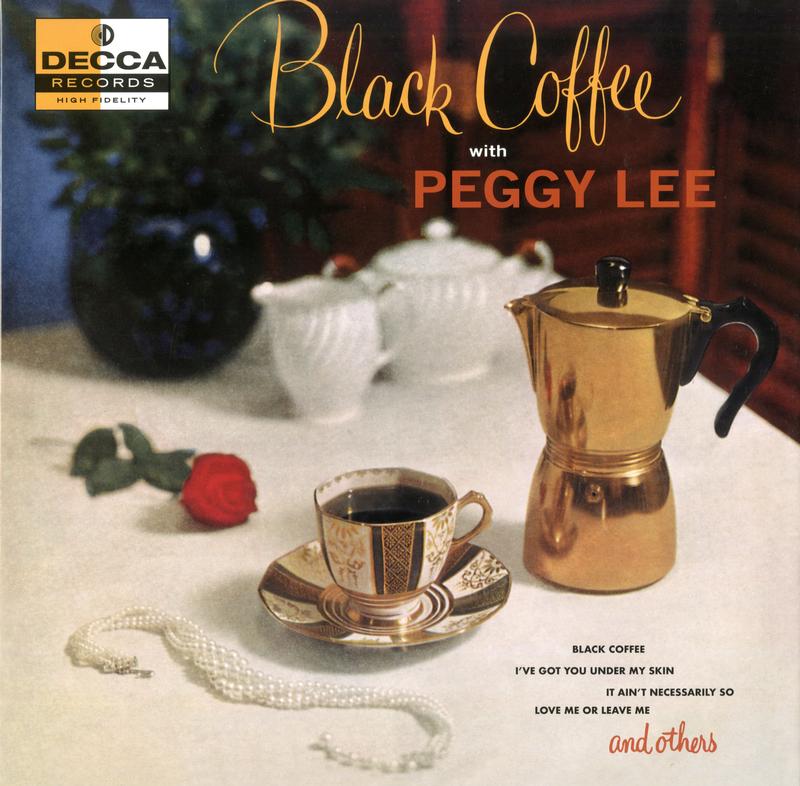
Peggy Lee’s original Black Coffee sessions use a compact group: trumpet, piano, bass and drums around the singer. Recorded for Decca in 1953, they belong to an earlier phase than her celebrated version of “Fever”, which followed in 1958. This album offers a different starting point, built around a programme of songs rather than a single signature recording.
Sonny Burke and Paul Francis Webster’s title song sits alongside “I've Got You Under My Skin” and “My Heart Belongs to Daddy”. The selection leaves room for more than one mood. Follow the movement between a restrained passage and a song with a more explicit rhythmic lift. With so few players, a change in the accompaniment can alter the setting without the intervention of a large orchestra.

From eight tracks to twelve
The first edition was a ten-inch LP containing eight songs. Four additional recordings were made in 1956 to create the expanded twelve-inch version. That is the programme included here. The album therefore carries a small piece of format history within its running order: a shorter release extended through new recording sessions.
The personnel changed too. Pete Candoli, Jimmy Rowles, Max Wayne and Ed Shaughnessy form the 1953 group on trumpet, piano, double bass and drums. The later sessions introduce Stella Castellucci on harp, Lou Levy on piano, Bill Pitman on guitar, Buddy Clark on bass and Larry Bunker on drums and vibraphone. The sleeve brings together two periods of work with different instrumental possibilities.

Listen for the harp
Castellucci’s presence provides an especially useful reason to listen beyond the familiar songs. Follow the instrumental colours across the programme. Which sound answers the singer, and which supports a phrase from behind? When does an instrument take on a melodic role rather than simply maintaining the accompaniment? The changing line-up makes these questions part of the album’s story.
Its writers also reach across several strands of popular songwriting, from Cole Porter and Rodgers & Hart to the Gershwins. Decca’s A&R figure Milt Gabler helped initiate the project. He had earlier recorded Billie Holiday’s “Strange Fruit” for Commodore. That connection is a practical one: a person who created opportunities for two individual singers. It need not imply that their musical approaches were alike. Lee’s phrasing and the specific musicians around her remain the focus here.
The expanded programme on vinyl
This Decca Acoustic Sounds Series edition contains twelve tracks on one 180-gram LP playing at 33⅓ RPM. Ryan K. Smith at Sterling Sound is credited with mastering from the original analogue tapes. The record was pressed at Quality Record Pressings and comes in a tip-on gatefold jacket. Catalogue number ADEC 83401 identifies this release, including the four recordings added for the expanded 1956 programme.
Michael 45 holds the record in Germany and dispatches it from Hilden, so customers can avoid arranging a personal US import or waiting for customs clearance.
Musicians
Documented selection of participating musicians. Personnel may vary by track; this list does not claim to be complete.
| Name | Instrument / role |
|---|---|
| Peggy Lee | Vocals |
| Pete Candoli | Trumpet |
| Jimmy Rowles | Piano |
| Ed Shaughnessy | Drums |
| Stella Castellucci | Harp |
| Lou Levy | Piano |
| Bill Pitman | Guitar |
| Buddy Clark | Bass |
| Larry Bunker | Percussion, Vibraphone, Drums |
The LP combines personnel from 1953 and 1956. Conflicting evidence for the 1953 bassist remains unresolved.
How Michael hears this edition
Listening impression · paraphrased from the video
Michael welcomes this reissue of Black Coffee but ranks the recording’s overall sound quality below a Billie Holiday album he mentions for comparison. He does not think the new mastering is responsible; the passage does not identify the Billie Holiday title.


Reviews
There are no reviews yet.