

A blues album with open doors
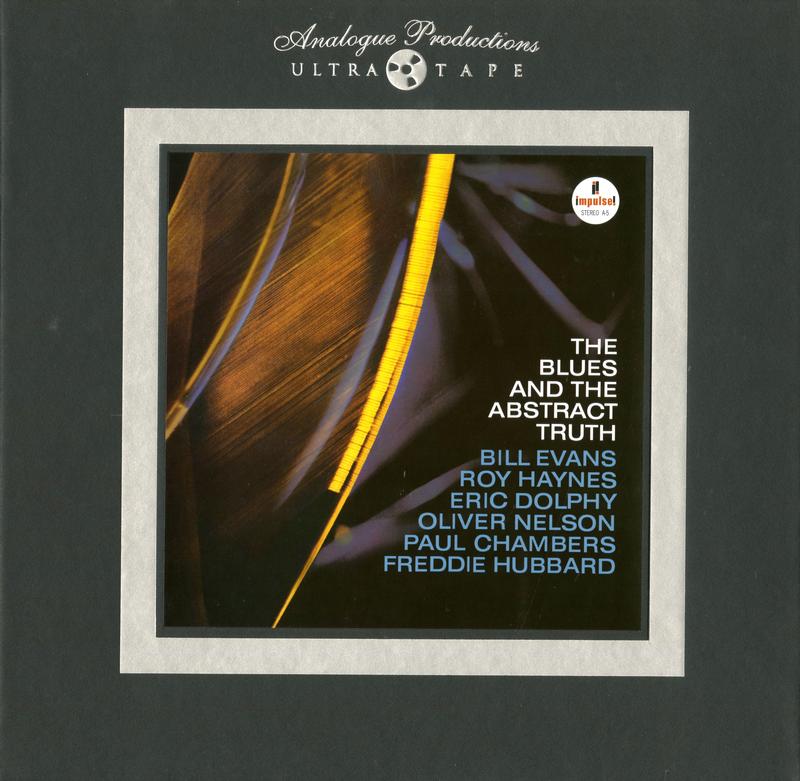
“Stolen Moments” offers the entrance to Oliver Nelson’s The Blues And The Abstract Truth. The composition has long since become part of the jazz repertoire, but here it belongs to a carefully shaped programme. Six originals explore how far familiar structures can be opened without losing their connection to the blues. Nelson thinks simultaneously as a saxophonist and an arranger. Individual voices emerge while the surrounding instruments do considerably more than provide support. Shift your attention from the melody to the lines underneath it and another dimension becomes apparent: the organisation of a small group with unusually varied resources.
The entire album was recorded on February 23, 1961, at Rudy Van Gelder’s studio in Englewood Cliffs. Creed Taylor produced the session for the young Impulse! label, which issued it as A-5. Behind that single recording date was a remarkable meeting of musical personalities. Freddie Hubbard was associated with Blue Note, Bill Evans with Riverside, and Nelson and Eric Dolphy with Prestige. The original sleeve explicitly acknowledged those relationships. These were established individual voices brought together for Nelson’s compositions, each arriving with experience and ideas developed elsewhere. The common purpose of the session did not require them to become anonymous members of an ensemble.

Seven musicians, one carefully shaped ensemble
The horn section combines Hubbard’s trumpet, Dolphy’s alto saxophone and flute, Nelson’s alto and tenor saxophones, and George Barrow’s baritone saxophone. Bill Evans, Paul Chambers and Roy Haynes supply piano, double bass and drums. Barrow’s contribution deserves particular attention: he has an important place in the written ensemble parts without taking a solo. That shifts the perspective beyond a succession of star improvisers. A low instrument can support an entire horn arrangement and change its outline without moving into the foreground. Nelson treats the differences between these instruments as part of the composition itself.
The horn line-up changes in the documentation for “Teenie’s Blues”. A published score prepared from Nelson’s original manuscripts describes an arrangement for two alto saxophones and rhythm section. Other discographical sources list the session personnel without making that track distinction. Hubbard’s and Barrow’s participation on the closing piece therefore cannot simply be assumed from the album credits. Chambers’ bass opening and Nelson’s alto saxophone are documented features. For the listener, this makes the final selection an opportunity to reconsider the number and function of the voices, rather than mentally carrying the instrumentation of the preceding pieces unchanged into the ending.

Familiar forms, newly assembled
“Stolen Moments” already had a history before this session. An earlier version, titled “The Stolen Moment”, appeared on Eddie “Lockjaw” Davis’s big-band album Trane Whistle, to which Nelson contributed compositions and arrangements. The smaller ensemble creates a different setting. The composed theme and the blues form used for improvisation are not simply identical structures. That relationship between planned shape and improvised movement helps explain the larger album. “Hoe Down” and “Cascades” extend familiar forms in different directions, while “Yearnin’”, “Butch And Butch” and “Teenie’s Blues” maintain a more immediate connection with the blues framework.
The word “abstract” need not turn listening into a theory exercise. Start with the transitions: where does a shared passage end, when does an individual line separate from the group, and how does the next instrument change the character of a phrase? Nelson’s writing provides concrete points of reference without imposing one repeated pattern. All six compositions are his, but their realisation depends on musicians with strongly differentiated approaches. The result connects an arranger’s identity with the possibilities of a particular ensemble. This tape edition preserves the original six-track sequence, without the additional performances that may accompany expanded editions on other formats.
Identifying the Ultra Tape
Catalogue number RRAP 0024 identifies the Analogue Productions tape edition. Its documented specification is two 10.5-inch reels containing quarter-inch tape at 15 ips, in two-track stereo, also described as half-track, with IEC equalisation. A playback machine must be configured accordingly. The NAB designation of the reel hub concerns the mechanical mounting and should not be confused with NAB equalisation. A compatible reel adaptor alone is therefore insufficient: tape speed, track configuration and playback equalisation must all match the stated format. These practical requirements are part of identifying the edition, rather than evidence of a particular listening result.
The available edition descriptions refer to real-time copying on an ATR-modified Ampex machine, using a copy of the original analogue master tape as the source. They do not establish a named mastering or transfer engineer for this particular release. Kevin Gray’s SACD credit and Ryan K. Smith’s work on the Acoustic Sounds Series LP belong to different products. Here, the original album programme is presented on the specified tape format; neither an exact tape generation nor a claim of sonic superiority follows automatically from that information. Michael 45 dispatches orders from Hilden, Germany, so you do not need to arrange your own US import. Please refer to the stated availability and delivery time for this item.
You order from Michael 45 in Germany. We arrange the US import and dispatch from Hilden. Editions not currently in stock are dispatched after the goods arrive.
Also in another edition: Blues And The Abstract Truth
More by Oliver Nelson: Screamin’ the Blues
Artist page: All titles with Bill Evans
Customer question: Buying Analogue Productions records in Europe
Musicians
Documented participants in this recording. Track references correspond to the tracklist.
- Oliver Nelsontenor saxophone, alto saxophone, arrangement, bandleaderParticipation: Album personnel
- Eric Dolphyalto saxophone, fluteParticipation: Album personnel
- Freddie HubbardtrumpetParticipation: A1, A2, A3, B1, B2
- George Barrowbaritone saxophoneParticipation: A1, A2, A3, B1, B2
- Bill EvanspianoParticipation: Album personnel
- Paul Chambersdouble bassParticipation: Album personnel
- Roy HaynesdrumsParticipation: Album personnel


Hubbard and Barrow are documented for A1–B2; participation on B3 is disputed. Nelson’s and Dolphy’s instrument changes are not confirmed for every track.

Reviews
There are no reviews yet.