

Two trombones open a new chapter
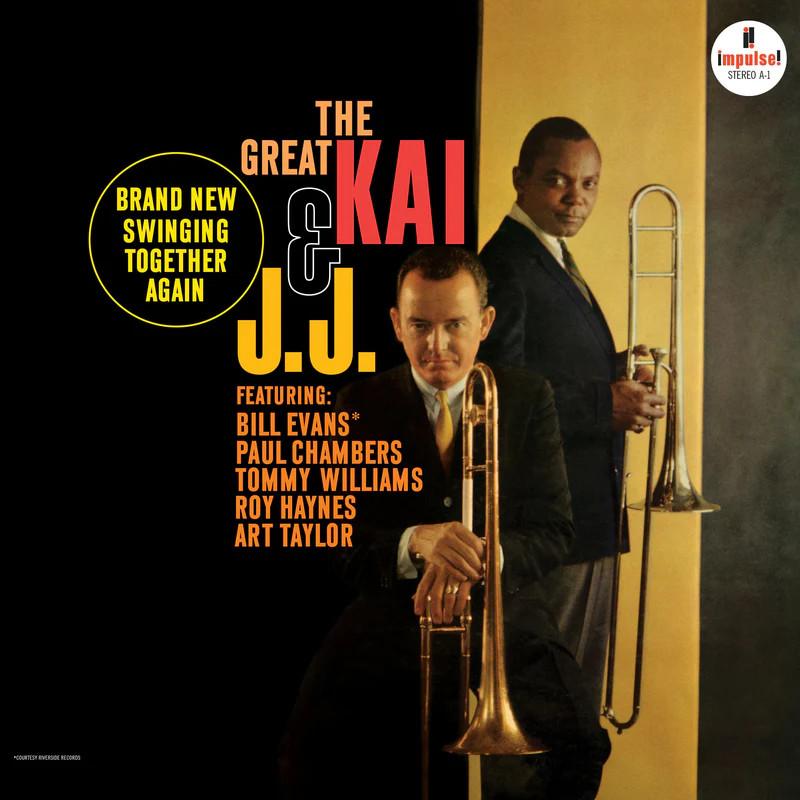
A small number carries considerable history here: The Great Kai & J.J. is catalogue number one in the Impulse! sequence. Released in 1961, it stands at the beginning of a label soon closely associated with John Coltrane. Its opening statement, however, belongs to J.J. Johnson and Kai Winding, two trombonists whose partnership already had a substantial history.
Producer Ozzie Cadena brought them together in 1954. After several years of collaboration they followed separate paths, returning to the studio together for this recording. Creed Taylor produced, with Rudy Van Gelder engineering the sessions in the autumn of 1960. The title announces a reunion. The personnel turn that reunion into something broader: an encounter with a rhythm section that contributes much more than a background for two featured soloists.

One instrument, two musical histories
Johnson was among the musicians who brought the trombone into the language of bebop. Winding, born in Aarhus and brought to America as a child, had worked with Benny Goodman and Stan Kenton. Both participated in the Miles Davis recordings later collected as Birth of the Cool, although on different selections. Their partnership draws on experience in small groups as well as larger ensembles.
“This Could Be the Start of Something Big” opens the programme. “Georgia on My Mind”, “Blue Monk” and “Alone Together” then move through different corners of the songbook. Listen for the way the instruments are combined: shared lines, responses, supporting parts and solos redistribute their roles. With two instruments of the same family, differences of phrasing and placement become especially rewarding to follow.

Bill Evans belongs to the conversation
Bill Evans plays piano on all eleven selections. Paul Chambers and Roy Haynes form the rhythm section on four tracks; Tommy Williams and Art Taylor take those roles on the others. The same two horns therefore work with different rhythmic partnerships. Evans is part of the album’s musical design, rather than simply a famous name in its credits. He would also appear on other important early Impulse! releases.
Original compositions sit beside the standards. “Judy” and “Trixie” are Johnson’s, while “Going, Going, Gong!” comes from Winding. Try one of those after “Blue Monk”. How much room do the horns leave for the piano, and how do bass and drums respond when the lead changes? On a return visit, following an accompanying part through the whole selection can reveal connections that disappear when attention moves only from solo to solo.
This edition of Impulse!’s first LP
AVER 64569 is an Acoustic Sounds Series release, presenting the eleven album selections on one stereo LP, pressed on 180-gram vinyl at 33⅓ RPM. The publisher credits Matthew Lutthans at The Mastering Lab with mastering from the original master tape. His lacquer-cutting work is supported by the documented TML runouts. Quality Record Pressings manufactures the record, with a Stoughton tip-on gatefold jacket.
The original album belongs to Impulse!, while the present series is administered through Verve and UMe. This is consequently not an Analogue Productions edition. Its presentation recalls the early Impulse! catalogue, in which Winding appeared more than once. At the centre remains the small group itself: two trombones, an independent piano voice and rhythm players who make the reunion a collective performance.
You order from Michael 45 in Germany. We arrange the US import and dispatch from Hilden. Editions not currently in stock are dispatched after the goods arrive.
Artist page: All titles with Bill Evans
Musicians
Documented selection of participating musicians. Personnel may vary by track; this list does not claim to be complete.
| Name | Instrument / role |
|---|---|
| J. J. Johnson | Trombone |
| Kai Winding | Trombone |
| Bill Evans | Piano |
| Paul Chambers | Bass |
| Tommy Williams | Bass |
| Roy Haynes | Drums |
| Art Taylor | Drums |

Reviews
There are no reviews yet.