



A message from Hackensack
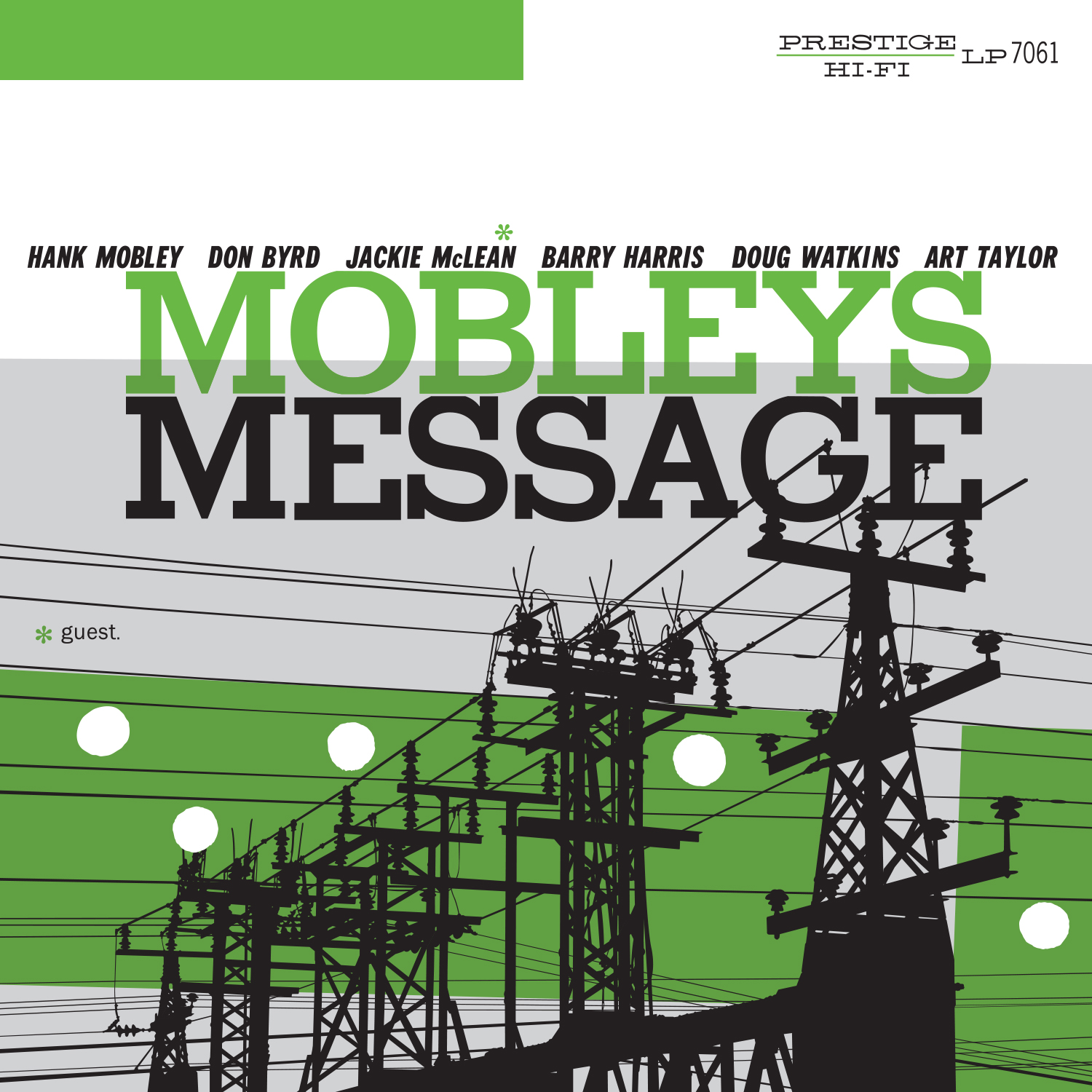
Mobley’s Message takes us into a particularly productive period of modern jazz: the summer of 1956, when small groups were continuing to shape the language of hard bop. Hank Mobley does not appear here as someone who needs grand gestures to explain his personality. His tenor saxophone stands at the centre of a recording whose appeal comes from melodic resourcefulness, carefully selected repertoire and changing instrumental combinations. The title’s “message” can be taken quite directly. A musician with an individual voice has brought together the right partners to let that voice be heard in several different settings.
The session took place on 20 July 1956 at Van Gelder Studio in Hackensack, New Jersey. Bob Weinstock supervised, Rudy Van Gelder engineered the recording and Ira Gitler supplied the liner notes. The original album bears the Prestige number PRLP 7061. Sources place its first release in either 1956 or early 1957; the documented recording date is the firm point of reference. A week later, Mobley recorded Mobley’s 2nd Message with a different horn line-up. That is a separate album, rather than simply the second half of this session.
Leonard Feather’s often repeated description of Mobley as the tenor saxophone’s “Middleweight Champion” is memorable, but it should not become a judgement of supposedly middling importance. It describes a position among different tonal ideals, rather than a league table. The specific work on this record is more illuminating than the label: Mobley plays compositions by Bud Powell, Thelonious Monk and Charlie Parker, places his own material beside them and gives a ballad a contrasting instrumental setting. Six tracks are enough to create a remarkably clear sequence of musical situations.

From quintet to sextet—and to a single horn
The core group consists of Hank Mobley on tenor saxophone, Donald Byrd on trumpet, Barry Harris on piano, Doug Watkins on double bass and Art Taylor on drums. This quintet appears on four selections: “Bouncing with Bud,” “52nd Street Theme,” “Minor Disturbance” and “Alternating Current.” Tenor and trumpet form the front line. It is an approachable combination for the listener, because the instrumental colours remain easy to identify while piano, bass and drums establish their shared field of movement.
On “Au Privave,” Jackie McLean joins on alto saxophone, expanding the group into a sextet. The distinction between instruments matters: Mobley plays tenor, McLean alto and Byrd trumpet. Three horns do not simply amount to three versions of the same voice; they alter the balance of register, colour and weight. In a Charlie Parker composition, an alto player also creates a particular connection with the tune’s history, without turning the performance into a reconstruction of an earlier model. McLean appears on this selection only, and his credit should not be extended automatically across the album.
“Little Girl Blue” reverses that expansion. Byrd sits out, McLean is absent, and Mobley remains the sole horn in a quartet with Harris, Watkins and Taylor. Following the larger ensemble of “Au Privave,” the same LP side opens into a very different setting. The Rodgers and Hart ballad gives the tenor an exposed melodic role. That sequence provides an excellent guide for a first listen: rather than waiting only for individual solos, follow the changing relationship between the principal voice and the group surrounding it.

Bebop memory and an individual hand
Side one opens with Bud Powell’s “Bouncing with Bud,” followed by Monk’s “52nd Street Theme.” Both place the session within repertoire central to the development of modern jazz. Parker’s “Au Privave” on the second side completes this set of reference points. Mobley does not have to stand outside a tradition in order to establish his independence. He works within a shared language, using themes, harmonic routes and rhythmic possibilities that give the players common ground from which to begin.
“Minor Disturbance” and “Alternating Current” bring Mobley’s own material into the programme; both are attributed to him in the documented track credits. That matters to the album’s identity. He is not only a tenor soloist selecting familiar pieces, but a composer supplying the band with music shaped by his own decisions. One useful approach is to place these two numbers beside the Powell, Monk and Parker selections. How is each theme introduced? What task is given to the front line? How much of a piece’s character becomes apparent before an extended solo begins?
Mobley and Doug Watkins also shared experience in the early Jazz Messengers setting around Horace Silver and Art Blakey. That connection belongs to the historical background, without making Mobley’s Message a recording by that band. This is Mobley leading his own Prestige date. For collectors, that perspective is especially appealing: a musician strongly associated with Blue Note can be heard through another label and a clearly defined session. Those familiar with later records such as Soul Station can consider an earlier stage of the same individual work without reducing this album to nothing more than preparation for what followed.
The personnel changes also make repeat listening rewarding in a very practical way. A first encounter can follow Mobley throughout; another can concentrate on Harris’s place in the different groups or on the way Watkins and Taylor support them. The album provides a stable enough framework for those shifts of attention to be meaningful. Its variety is not a collection of unrelated ideas, but a set of changes made within one coherent musical occasion.
APRJ 7061: mono, one LP and the original sequence
The edition offered here is Analogue Productions APRJ 7061, a mono LP at 33⅓ RPM from the Prestige Mono series. Kevin Gray handled the mastering and Quality Record Pressings pressed the record. According to the publisher, the series draws on the original analogue tapes, while a tip-on jacket retains the traditional form of presentation. The current publisher listing specifies 180-gram vinyl; the early AP edition from 2012 is documented as a 200-gram pressing. Numbering associated with early copies is not a promise that every copy available today belongs to that initial run.
The conventional 33⅓ RPM format is particularly appropriate to the album’s internal sequence. Side A contains three quintet performances. On side B, the sextet of “Au Privave” gives way to the quartet of “Little Girl Blue,” before “Alternating Current” returns to the quintet. That small drama of changing personnel can unfold across one uninterrupted side. It is a musical reason to value the original division, independent of blanket comparisons between playback speeds. Mono is part of this specific edition’s identity and should not be treated as interchangeable with another format or mastering.
Mobley’s Message is an inviting record for listeners who enjoy finding substantial musical differences in small changes. An additional alto, a resting trumpet, another composer or a ballad setting alters the perspective on the same tenor player. The recording has enough continuity to work as an album and enough variation to reveal new relationships on return visits. Its message resides not only in the leader’s name, but in the care with which his voice is placed among those of his colleagues.
You order from Michael 45 in Germany. We arrange the US import and dispatch from Hilden.
Customer question: Buying Analogue Productions records in Europe
Series: Analogue Productions Prestige – all 50 records, musicians and session paths
Musicians
Participants and documented credit status. Track references correspond to the tracklist.
- Hank MobleyPortrait: circa 1956tenor saxophoneParticipation: All tracks
- Donald ByrdPortrait: later referencetrumpetParticipation: A1–A3, B1, B3
- Jackie McLeanPortrait: existing portraitalto saxophoneParticipation: B1
- Barry HarrisPortrait: 1981pianoParticipation: All tracks
- Doug WatkinsPortrait: existing portraitdouble bassParticipation: All tracks
- Art TaylorPortrait: 1957drumsParticipation: All tracks


20 July 1956, Van Gelder Studio, Hackensack; supervision Bob Weinstock, engineer Rudy Van Gelder, notes Ira Gitler. Quintet on A1–A3/B3; sextet with McLean (alto) on B1; quartet without Byrd on B2. Mobley: tenor. Original release variously dated 1956/57.

Reviews
There are no reviews yet.