
Four musicians and an unusual world of sound
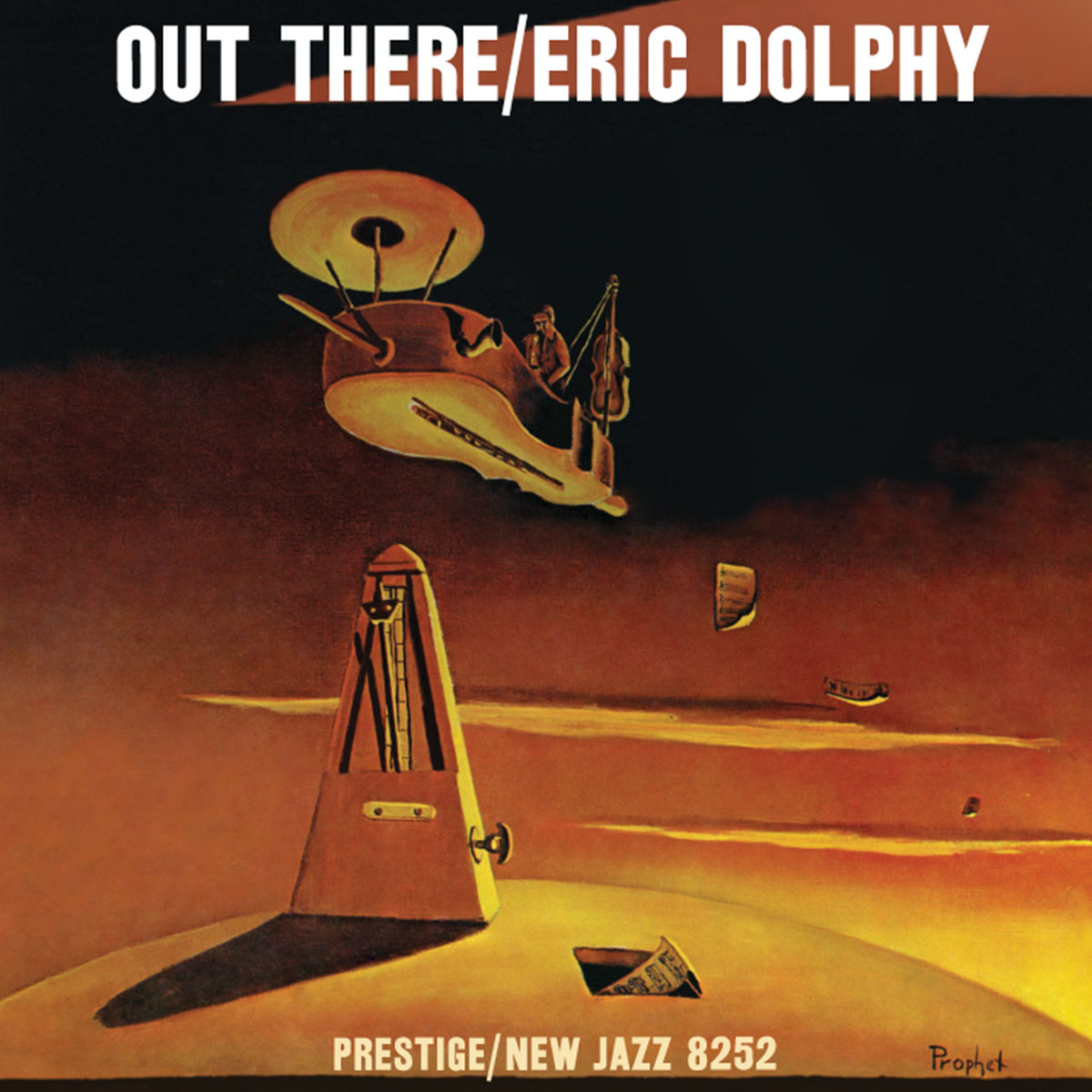
The instrumentation of Out There is an invitation in itself: Eric Dolphy with four different wind instruments, Ron Carter on cello, George Duvivier on double bass and Roy Haynes on drums. There is no piano. Instead, two string instruments occupy distinct places within a quartet whose relationships can change from moment to moment. The cello belongs to Carter; Duvivier plays the double bass. That distinction matters. Anyone who associates Carter primarily with his later position in Miles Davis’s quintet encounters a different part of his musical personality here.
The four musicians recorded at Rudy Van Gelder’s studio in Englewood Cliffs on August 15, 1960. Esmond Edwards produced the session, and the album appeared on the Prestige-affiliated New Jazz label in September 1961, under the original catalogue number NJLP 8252. Dolphy was developing his unmistakable musical language across a series of recordings as a leader. The title Out There suits that openness, although it would be limiting to regard the music only as an act of pushing boundaries. Its compact forms, choice of other composers’ material and attention to instrumental colour are equally important.
Four Dolphy compositions sit alongside pieces by Charles Mingus, Randy Weston and Hale Smith. Those names introduce different approaches to melody, harmonic thought and musical character. Dolphy brings them into contact with his own imagination rather than allowing the album to become a collection of unrelated features. A useful first question is therefore less about whether the music belongs to a particular category than about who is leading a passage and what changes when another voice responds. This is adventurous music built from specific relationships between people and instruments.

Cello, bass and drums with voices of their own
Ron Carter’s cello occupies a position that a more conventional jazz quartet might give to a piano or a second horn. Its register lies between the soloist’s upper lines and the foundation of the double bass. That arrangement allows counterlines, shared movement and changes in density without requiring one fixed pattern of accompaniment. On an album where Dolphy changes instruments repeatedly, the cello’s middle register becomes an especially interesting point of reference. It can draw close to the lead voice or establish a separate direction.
George Duvivier keeps the double bass present as an independent part. Cello and bass are consequently not interchangeable descriptions of the same role. Following their relationship offers a way into the quartet’s musical organisation: where do the lines meet, when do they move apart, and how does a low note change its meaning when Dolphy changes instruments above it? The small ensemble gives these questions room to develop. Considerable variety can arise from four musicians without the additional layers of a larger studio group.
Roy Haynes completes the setting. In a quartet without piano, accents, cymbal colours and the placement of rhythmic responses have particular significance. They help shape the music between the foreground phrases as well as beneath them. Listening for those spaces can reveal how much of the album’s character belongs to the ensemble. Dolphy’s striking melodic contours are one element in a conversation whose other participants continually influence its direction.
The precise distribution of Dolphy’s instruments is worth keeping in mind. He plays alto saxophone on the title track and “Feathers,” bass clarinet on “Serene” and “The Baron,” and conventional clarinet on “Eclipse.” “17 West” and “Sketch of Melba” feature his flute. These are four distinct instrumental voices, not different names for one general woodwind sound. Their sequence contributes to the shape of the album and can be followed as consciously as the changes of composer. The move from alto to bass clarinet, for example, establishes an immediate change of perspective within the first side.

Seven pieces with different ways of holding attention
The first side consists entirely of Dolphy compositions. “Out There” opens with alto saxophone before the bass clarinet takes over for “Serene” and the considerably shorter “The Baron.” This sequence keeps the quartet from settling into a single instrumental identity. The changes involve more than pitch: articulation, attack and the way a phrase enters the surrounding texture vary with the instrument. Two extended pieces followed by a concise third selection also give the side a clear internal balance.
The second side opens the programme towards other composers. Mingus’s “Eclipse” introduces the clarinet, followed by Dolphy’s “17 West” and Weston’s “Sketch of Melba,” both featuring flute. Hale Smith’s “Feathers” then returns to alto saxophone. The ending recalls a colour heard at the beginning while retaining the sense of a journey through contrasting settings. Seven pieces are enough to establish considerable variety, without requiring either an extended suite or a succession of different studio line-ups.
It can be rewarding to approach each composition as a manageable musical space. A returning melodic idea, the interval between two entries or the direction of an accompanying line may offer a more immediate point of contact than an attempt to explain every turn in theoretical terms. Dolphy’s music rewards attentive listening, but curiosity does not require specialist preparation. Alongside the wide intervals and unusual colours associated with his playing, this album offers opportunities to consider form, restraint and the give-and-take of a responsive ensemble.
That particular combination makes Out There valuable within a collection. It is not simply an interchangeable stop between better-known titles. Its instrumentation and the distribution of Dolphy’s four voices identify a specific session with a character of its own. Carter’s cello adds another reason to return: the recording preserves a musical relationship that cannot be inferred solely from the roles its participants later became famous for. Familiar names can still lead towards unexpected encounters when the details of a session receive proper attention.
Analogue Productions’ Prestige edition
The stereo edition offered here is APRJ 8252, part of the Analogue Productions Prestige series. Kevin Gray cut it from the original analogue tapes, with pressing at Quality Record Pressings. The single LP plays at 33⅓ RPM and comes in a tip-on jacket, with the deep-groove label presentation associated with this reissue programme. The publisher currently specifies 180 grams; earlier documented editions in the series were described as 200 grams. Those weights belong to their respective issues rather than identifying every pressing as physically identical.
The single-LP format retains the album’s two-sided design. Dolphy’s three compositions occupy the first side, while the second introduces the broader succession of pieces by Mingus, Weston and Smith alongside “17 West.” At 33⅓, that structure remains intact without additional record changes. It provides a satisfying way to become familiar with the programme: first the concentrated world of the opening side, then the changing perspectives of the second.
Van Gelder’s recording, Edwards’s production and Gray’s later cut refer to different stages in this edition’s history. Together they connect an unusual session from 1960 with a clearly identified reissue. At the centre remain four musicians whose instruments enter into a distinctive relationship. Out There invites the listener to give that relationship time, discovering how much detail and movement a small ensemble can contain. Its appeal lies both in the individual voices and in the space they create together.
You order from Michael 45 in Germany. We arrange the US import and dispatch from Hilden.
More by Eric Dolphy: Outward Bound · At The Five Spot, Vol. 1
Customer question: Buying Analogue Productions records in Europe
Series: Analogue Productions Prestige – all 50 records, musicians and session paths
Musicians
Participants and documented credit status. Track references correspond to the tracklist.
- Eric DolphyPortrait: 1960alto saxophoneParticipation: A1, B4
- Eric DolphyPortrait: 1960bass clarinetParticipation: A2, A3
- Eric DolphyPortrait: 1960clarinetParticipation: B1
- Eric DolphyPortrait: 1960fluteParticipation: B2, B3
- Ron CarterPortrait: existing portraitcelloParticipation: All tracks
- George DuvivierPortrait: existing verified portraitdouble bassParticipation: All tracks
- Roy HaynesPortrait: existing verified portraitdrumsParticipation: All tracks


Credits refer to the original LP programme listed here. Other formats and bonus tracks are not included.

Reviews
There are no reviews yet.