

A trio, an evening and an open conversation
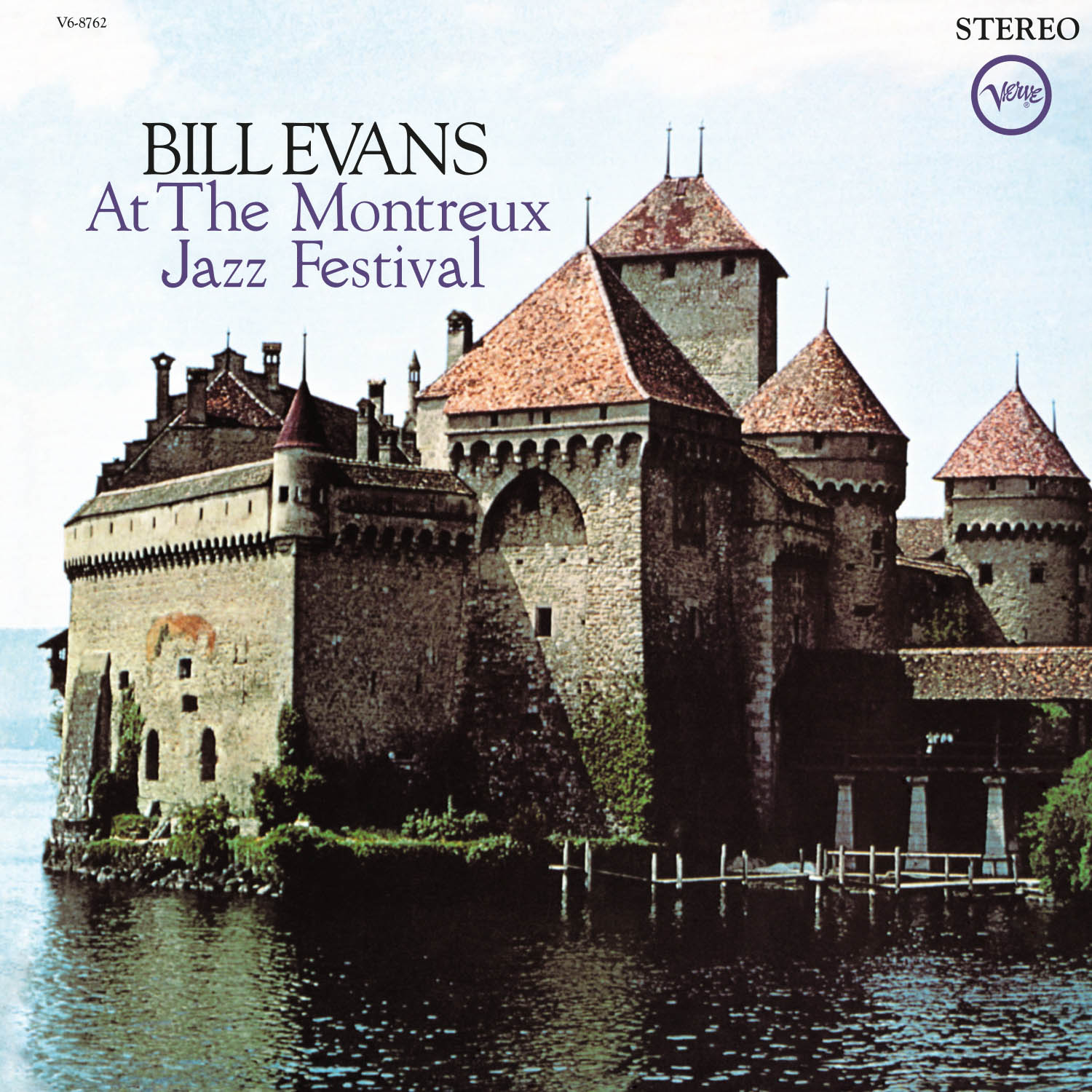
On 15 June 1968, Bill Evans, Eddie Gomez and Jack DeJohnette perform at the Casino in Montreux. That appearance becomes At The Montreux Jazz Festival, capturing the pianist in a particular trio configuration. Piano, double bass and drums provide a shared setting in which attention can move between three independent musicians. The LP’s nine selections combine original compositions with songs by other writers, giving the concert a varied and recognisable shape.
The opening One For Helen immediately places Evans the composer beside the interpreter of established melodies. Another of his pieces, Walkin’ Up, closes the record. Between them come Harold Arlen’s A Sleeping Bee, Earl Zindars’ Mother Of Earl, Nardis, attributed to Miles Davis, and several standards. The programme consequently draws on familiar material as well as the pianist’s individual musical world. Knowing a tune does not mean knowing how this particular performance will unfold.
A live recording supplies a distinctive context for such music. The pieces emerge during one evening, within the same acoustic and through an ongoing exchange between the same players. Decisions about duration, density and transitions belong to those performances. The attraction for a listener lies in following a developing musical argument as well as recognising an established form. A theme provides the starting point for the conversation rather than a complete script for it.
The album received a Grammy in 1969, but its interest extends beyond that subsequent recognition. Montreux preserves Evans with Gomez and DeJohnette at a specific moment. It makes a useful point of comparison within his discography: the same musical personality encountered in different settings, alongside a partnership whose character cannot be described by the pianist’s name alone. The other two musicians are essential to understanding what this recording documents.

Eddie Gomez and Jack DeJohnette as active partners
Eddie Gomez’s double bass provides more than the lowest voice beneath the piano. The instrument offers several responsibilities: harmonic orientation, rhythmic movement and melodic expression. As one or another comes forward, the pianist’s role changes too. Evans can fill a passage, leave it open or respond to a bass figure. A trio becomes a shifting relationship in which the importance of a voice is not determined simply by its volume.
Jack DeJohnette extends that relationship at the drums. A cymbal sound can sustain a temporal framework while other accents comment on it. Drumming need not choose between basic accompaniment and an explicitly announced solo. Even within a shared passage, opportunities for response and change remain available. In combination with an independently directed bass, this gives the listener reason to follow rhythmic motion through more than the piano part alone.
Two selections offer useful perspectives on those roles: Embraceable You gives the bass particular prominence, while Nardis makes room for a drum feature. These are emphases within the programme, not reasons to erase the remaining players from the personnel. A featured soloist still belongs to a specific performance whose continuity involves more than one musician. The distinction is between changing prominence within the trio and a change in the instrumentation itself.
The crucial exception is I Loves You, Porgy, which opens the second side with Bill Evans playing alone. Gomez and DeJohnette participate on the other eight LP tracks. That reduction changes the listener’s perspective on the entire programme. After a conversation between three instruments, responsibility for shaping the music rests with one pianist. Including such a moment within a trio album enriches its structure and gives additional significance to the ensemble’s return.

Nine selections with changing perspectives
The first side leads from One For Helen through A Sleeping Bee to Mother Of Earl. The writers’ names alone show Evans constructing a programme from his own music and the compositions of others. For a listener, that creates different kinds of familiarity. Some pieces carry a long history as songs, while others are more closely connected with the pianist’s repertoire. In concert they meet under shared conditions and become parts of one sequence.
Nardis ends side A at almost eight minutes, making it the longest selection on that side. Its room for development differs from the opening piece’s four-minute span. A longer performance can shift attention from the tune itself towards the distribution of tension, solo space and return. Its position matters too: the extended trio passage is followed by the record turn, before the second side begins with a quite different degree of concentration.
After the solo I Loves You, Porgy comes Ray Noble’s The Touch Of Your Lips. Embraceable You and Someday My Prince Will Come then move through further familiar song worlds. The triple-time motion of Someday My Prince Will Come provides a different rhythmic starting point from an even pulse. An established melody can offer orientation while leaving room for individual shaping. Recognition becomes the beginning of listening rather than its conclusion.
Walkin’ Up finishes the programme in a little over three minutes. Returning to an Evans composition frames the standards without interrupting or retrospectively explaining them. The LP is a specifically bounded nine-track album; later CD additions do not form part of this edition. Listening on vinyl preserves this particular succession of extended and compact forms, trio and solo, familiar melodies and performances whose unfolding remains open to the moment.
The Analogue Productions single 33⅓ RPM LP
The edition offered here is AAPJ 8762, a 180-gram LP running at 33⅓ RPM. Bernie Grundman cut from the original master tape, Quality Record Pressings manufactured the record, and the presentation includes a Stoughton jacket. Those details distinguish it from other vinyl editions of the same album. A single record retains the programme across two longer sides, including the striking change from Nardis to solo Porgy after the turn.
Helen Keane produced the original album. The recording involved Radio Suisse Romande, with Jean-Claude Martin and Pierre Grandjean credited as engineers. Bob Schwarz handled editing and mixing, with Val Valentin responsible for technical direction. Gene Lees contributed notes and photography, and Acy Lehman the cover design. These credits help explain how a concert became a released album, while keeping the musicians’ performance distinct from the subsequent production work.
Musically, this version invites the evening to be followed in its LP sequence. The original compositions frame the selection, bass and drums receive individual emphasis, and the solo piece creates another form of intimacy. Favourite tracks can provide an introduction, but further relationships emerge when both sides are heard in succession. The changing instrumentation is as important to that experience as the changing composers and the differing lengths of the performances.
For listeners seeking Bill Evans with Eddie Gomez and Jack DeJohnette on a clearly specified single vinyl record, this is the Analogue Productions edition of that Verve recording. Its defined programme and documented production route provide a straightforward basis for choosing this particular release. You order from Michael 45 in Germany. We arrange the US import and dispatch from Hilden.
Artist page: All titles by Bill Evans
Customer question: Buying Analogue Productions records in Europe
Musicians
Participants and documented credit status. Track references correspond to the tracklist.
- Bill EvansPortrait reference: 1964pianoParticipation: All nine tracks; B1 solo
- Eddie GomezLater portrait reference: 2010double bassParticipation: A1–A4, B2–B5 · absent from the piano solo B1
- Jack DeJohnetteLater portrait reference: 2006drumsParticipation: A1–A4, B2–B5 · absent from the piano solo B1


15 June 1968, Casino Montreux; Radio Suisse Romande. Helen Keane: producer; Jean-Claude Martin and Pierre Grandjean: engineers; Bob Schwarz: editing/mixing; Val Valentin: technical direction; Gene Lees: notes and photo; Acy Lehman: cover design. B1 I Loves You, Porgy: solo Bill Evans; Gomez and DeJohnette on the other eight tracks. Bernie Grundman: recut from the original tape; QRP: pressing. Nine LP tracks, without later CD bonuses.

Reviews
There are no reviews yet.