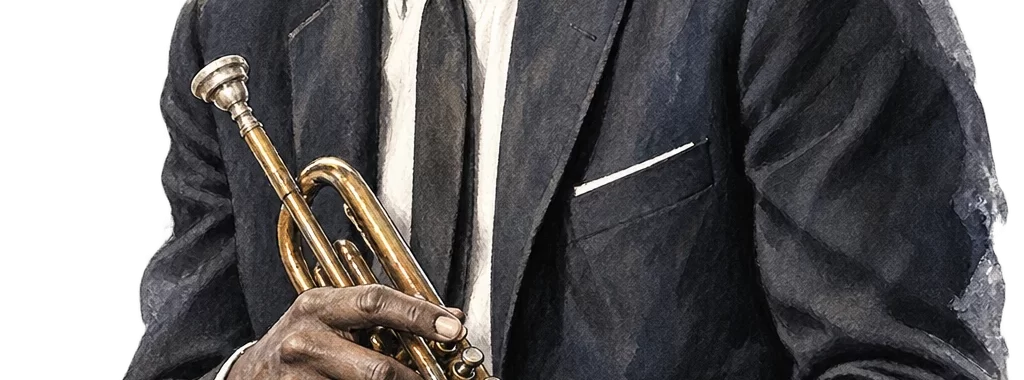
The artist dossier · Jazz
Miles Davis:
A History in Records
From the interplay of the first great quintet to the electric years: how Miles Davis kept rethinking his music, through the records and the musicians who made them.

I want to begin with the records. With a trumpet that does not need to spell out every detail of a melody. With a bass holding a band together while the music above it changes. The individual ideas of his fellow musicians help determine what a recording becomes.
The starting points are the Miles Davis editions in my shop. Bags’ Groove and the first quintet’s recordings on Cookin’, Relaxin’, Workin’ and Steamin’ were made for Prestige. The 1958 recordings collected on Birth of the Blue, along with Kind of Blue, Someday My Prince Will Come and Seven Steps to Heaven, come from his work for Columbia. The current shop editions discussed here are released by Analogue Productions. From there, the story reaches Gil Evans, the second great quintet and the electric music. These records illuminate one another. Knowing Kind of Blue means knowing a central moment in Miles’s career. It still leaves much of his musical imagination to discover.
01 · A sound finds its direction
From bebop to a musical vision of his own
Born in 1926, Miles Davis was recording with Charlie Parker in the 1940s, at the heart of bebop’s transformation of jazz. Angular themes, rapidly changing harmony and tightly packed musical situations demanded quick responses. Within that language, Miles developed his own way of placing tension: a phrase could end with a single carefully positioned note, leaving the silence after it to change the meaning of what had just been played.
The nonet recordings of 1949 and 1950, later collected as Birth of the Cool, extended that thinking from the solo to the sound of an ensemble. French horn and tuba were among the instruments that joined trumpet and saxophones. Arrangements by Gerry Mulligan, Gil Evans, John Lewis and John Carisi turned nine instruments into a flexible fabric of voices. Low instruments carried melodies; one timbre could merge into another. For Miles, Gil Evans became much more than an orchestral arranger he would work with later. He was a partner in imagining how an individual sound might belong within something larger.1
Those early recordings provide historical context here. The shop selection checked for this article begins elsewhere. One distinction is particularly important: Birth of the Cool and Birth of the Blue are entirely different projects.
02 · Recorded in 1954 / released in 1957
Bags’ Groove: two groups, two kinds of tension

Bags’ Groove makes a good case for keeping recording dates separate from release dates. The Prestige LP appeared in 1957, but its music comes from two sessions in 1954. Rudy Van Gelder recorded both at his original studio in Hackensack. The title piece was recorded on December 24 by Miles, vibraphonist Milt Jackson, Thelonious Monk, Percy Heath and Kenny Clarke. The other pieces date from June 29, with Sonny Rollins and Horace Silver in place of Jackson and Monk.2
The vibraphone alone changes the texture. Jackson’s notes begin with a defined attack and continue to ring, while Miles shapes his lines through breath and silence. The blues does not need an elaborate structure to contain a great deal of musical activity. What matters is how long an idea is allowed to stand, and how the next musician answers it. Monk’s own solo introduces a different, more angular sense of time.
Elsewhere, Rollins’s “Airegin,” “Oleo” and “Doxy” put a tenor saxophone beside the trumpet. The two horns can sharpen a line together, then pursue quite different paths in their solos. Silver’s approach to the harmonic foundation differs from Monk’s. Heath and Clarke connect the two sessions. The album therefore documents several ways of working with the blues and the contemporary jazz repertoire, rather than one settled band on a single afternoon.
For AP edition APRJ 7109, the manufacturer credits Kevin Gray with mastering and Quality Record Pressings with manufacture. The mono recording retains a shared sound field: instruments are distinguished by timbre, articulation and musical placement, rather than an invented left-to-right stereo layout. Van Gelder’s original recording and Gray’s later work for the reissue are separate stages of production.29

In the shop: Bags’ Groove, Analogue Productions, mono LP.
03 · The first great quintet · 1955–1956
Five musicians making room for one another
John Coltrane, Red Garland, Paul Chambers and Philly Joe Jones formed the band whose interplay runs through the Prestige albums. Individuality here did not require everyone to remain in the foreground. Garland’s chords could provide a supple, springing foundation. Chambers kept the direction of movement clear in his bass lines. Philly Joe Jones punctuated phrases, answered them and drove the group forward. Above that rhythm section, Miles’s concise trumpet lines and Coltrane’s denser tenor playing were immediately distinct.

On May 11 and October 26, 1956, the quintet recorded enough material at Van Gelder’s studio for four albums released over the following years: Cookin’, Relaxin’, Workin’ and Steamin’. Miles’s move from Prestige to Columbia was part of the reason. His remaining commitments to Bob Weinstock’s label were fulfilled with a repertoire the musicians knew through their work together. That business context explains the concentrated recording schedule; it does not reduce the performances to contractual routine.3
Cookin’: the ballad and the fast-moving band
Cookin’, released in 1957, comes entirely from the October session. “My Funny Valentine” opens with Miles and the rhythm section; Coltrane sits out. That changes the focus. The trumpet’s breath, Garland’s responses and the quiet movement beneath the melody take on particular weight. “Airegin” poses a different challenge. Its theme calls for precision, its solos need agility, and the rhythm section must provide cohesion and propulsion at the same time.
That range is a key to the band. A ballad still moves; a fast piece still depends on choices about space. In both settings, the musicians have to decide how they will share the time. The Cookin’ mono LP and the hybrid SACD offer the same album history in different formats.4


For the current Cookin’ LP, APRJ 7094, Analogue Productions likewise credits Kevin Gray with cutting from analogue masters and QRP with pressing. The hybrid SACD is a separate edition. A lacquer-cutting credit cannot simply be repurposed as a technical description of an SACD; an independently supported mastering credit for that particular disc remains unresolved in this research.29
Relaxin’: ease is something a band creates
On Relaxin’, released in 1958, “If I Were a Bell” takes us straight into the group’s communication. The brief piano introduction establishes a character before the trumpet states the theme. “You’re My Everything” even retains a false start and a short exchange in the studio. Such moments bring us close to the session without making the work behind its apparent ease disappear. Garland’s accompaniment, Chambers’s bass and the drummer’s accents create the conditions in which the soloists can develop their differences.5
From my listening comparison: In my video of May 17, 2022, I compared the Analogue Productions mono edition I owned with Craft’s Small Batch release. I found the AP softer and warmer, the Craft more analytical and immediate. I described its trumpet entry as particularly forceful. I did not name an outright winner. Both had strengths, and my preference could depend on the presentation I wanted to hear that day. Those were impressions of the copies compared at the time, not a blanket judgment on every subsequent pressing.V1
The edition details give that comparison a precise reference: AP identifies Kevin Gray and manufacture at QRP for APRJ 7129. That establishes which release is being discussed. Hearing its presentation as warmer is a listening observation, which is where my own assessment begins.29
The current shop selection includes Relaxin’ on an Analogue Productions mono LP. That earlier comparison is part of my engagement with the record; the edition offered today is identified separately in the overview below.
Steamin’, Workin’ and the connection between the four albums
Steamin’ appeared in 1961, five years after the sessions. It places the expansive melody of “Surrey with the Fringe on Top” alongside the very different energy of “Salt Peanuts.” “When I Fall in Love” again shows how much a restrained trumpet line can carry. The four album titles do not describe four neatly separated musical moods. They present different selections from the same band’s work on the same two recording dates.6
Workin’ adds “It Never Entered My Mind” and “Ahmad’s Blues,” among other pieces. On the latter, Garland, Chambers and Jones perform as a trio. That moment reveals the rhythm section as a musical unit in its own right. Listening to it without trumpet and tenor helps explain how the quintet works when all five musicians return.7
Steamin’ is available as an individual shop listing. The Great Prestige Recordings combines the four familiar albums with The New Miles Davis Quintet, recorded in 1955. The current AP box contains five LPs at 33⅓ RPM. In the selection checked for this article, the box provides access to Workin’ and the earlier quintet album; no separate shop listing was found for either title.3
Steamin’, APRJ 7200, also belongs to the Kevin Gray-cut AP Prestige series pressed at QRP. For the current five-album box, AAPJ 035, AP specifies Gray at Cohearent Audio, original analogue tapes and QRP. Those details apply to this reissue of the box, rather than automatically describing every earlier version of the collection.329


04 · Columbia · May 26, 1958
Birth of the Blue: the band before Kind of Blue
The move to a sextet first changes the front line. Cannonball Adderley’s alto saxophone adds another unmistakably individual voice beside Coltrane’s tenor. On Milestones, recorded in February and March 1958, Red Garland and Philly Joe Jones are still present. The title piece already explores a more modal organisation: longer passages in which the musicians can investigate a scale and its possibilities instead of following a rapidly changing sequence of chords.8
Milestones provides historical context here; no current main-shop listing was found for it.
The May 26 session starts from a different balance. Bill Evans is now at the piano, Jimmy Cobb at the drums. With Miles, Adderley, Coltrane and Chambers, this is the six-piece group that will shape much of Kind of Blue. They record at Columbia’s 30th Street studio in New York. The four selections are “On Green Dolphin Street,” “Fran-Dance,” “Stella by Starlight” and “Love for Sale.”9

This music was not unknown until 2024. Some of it appeared on Jazz Track, and listeners encountered the recordings in later collections as well. Birth of the Blue gives the material a new frame as an album in its own right. That distinction matters: it is not the rediscovery of a lost album originally issued under this title in 1958.10
“On Green Dolphin Street” makes the move between suspended accompaniment and clearly articulated swing part of its narrative. Evans can distribute chords in a way that leaves air between them. Cobb keeps the music mobile without giving every moment an emphatic accent. Miles therefore finds himself in a different setting from the one Garland and Philly Joe Jones provided. Adderley and Coltrane retain their own approaches: the alto often speaks with a strongly blues-oriented inflection, while the tenor pursues the implications of a harmonic idea.
The standards have not disappeared. They remain the shared ground on which a new balance of sound, time and accompaniment is taking shape. Hearing this record only as a waiting room for Kind of Blue would sell it short. It shows what a changed band can do with familiar material.
The production path for the 33⅓-RPM edition, AAPJ 172, is documented in some detail. According to AP, Vic Anesini at Battery Studios created a new analogue stereo master from the original three-track tapes. Matthew Lutthans then cut the lacquers at The Mastering Lab using Doug Sax’s tube-based system; QRP handled plating and pressing. For the hybrid SACD, CAPJ 172 SA, AP credits Lutthans with mastering that stereo tape to DSD. These are distinct routes from the same musical source to the finished medium. The 45-RPM release is a QRP double LP; an unambiguous engineer credit for that cut remains to be confirmed.30
From my video: On December 25, 2024, I discussed the 33⅓-RPM edition of Birth of the Blue. I particularly highlighted its dynamics, punch, clarity and detail, as well as the impact of the solos. Those were my impressions of that LP. The subsequent 45-RPM edition and the SACD were not part of that listening assessment.V2

Birth of the Blue in the shop: 33⅓-RPM LP · 2 LPs at 45 RPM · hybrid SACD.
05 · Columbia · Recorded March/April 1959 · released August 17, 1959
Kind of Blue: fewer changes, more possibilities
Kind of Blue was recorded for Columbia Records and released on that label in 1959. Columbia producer Irving Townsend oversaw the sessions. The sessions of March 2 and April 22 at Columbia’s 30th Street Studio in New York alter the relationship between a framework and the freedom within it. In modal music, the next bar is not necessarily defined by a new chord. The musicians can spend longer within one tonal area. That does not relieve them of making decisions. It shifts those decisions towards melody, rhythm, tone and the tension within a phrase.11
In “So What,” the theme itself becomes a conversation between bass and ensemble. The material is concise and the harmonic design readily grasped. Yet there is no reason for two soloists to tell the same story with it. Miles offers a few clearly shaped thoughts. Coltrane builds density differently; Adderley brings another articulation and blues inflection. The group turns a limited stock of material into a broad musical field.
Bill Evans: the colour of the piano

Bill Evans is a central voice in this musical world. He plays on four of the original album’s five pieces: “So What,” “Blue in Green,” “All Blues” and “Flamenco Sketches.” His contribution reaches beyond his solos to the way he spaces the notes of a chord, shapes an accompanying figure and supports the horns with a few carefully placed sounds.1233
The introduction to “So What” draws attention to piano and bass before the familiar theme begins. In “Blue in Green,” the piano sounds between the trumpet and saxophone lines; the notes’ decay and the pauses are part of their musical effect. Evans shows how accompaniment can do more than identify the underlying harmony. It helps shape the arrival of a phrase and the way it resonates through the ensemble.

Wynton Kelly takes over the piano for “Freddie Freeloader.” His rhythmic, blues-rooted mobility gives that piece its own character. Having two pianists on the same record is therefore more than a footnote to the personnel list: it belongs to the album’s specific conception of sound. On “Blue in Green,” Adderley sits out, and the smaller group changes the weight of each remaining voice.12
The five pieces cannot be reduced to a single formula either. “All Blues” combines a blues structure with a triple-time feel and recurring accompaniment figures. “Flamenco Sketches” charts a course through several modal areas. “Blue in Green” follows a closer, more circular harmonic movement. The album feels coherent because of the musicians’ shared attentiveness, not because every piece uses the same construction. The familiar story that everything was simply recorded in one uninterrupted first attempt is too tidy: preliminary attempts, false starts and a complete alternate take also belong to the surviving session record.1112
What I said about the UHQR editions
In my September 2, 2022 comparison, I put the 45-RPM UHQR alongside the earlier 33⅓-RPM UHQR and the MoFi at 45 RPM. Compared with the MoFi, I found the 45-RPM UHQR more natural. With the 45-RPM UHQR, I particularly described the ease of the drums and Miles’s entrance, the spatial separation and the way the music held together. At the same time, I placed the difference between the two UHQR versions on a smaller scale than the difference from the MoFi. The more convenient side lengths of the 33⅓-RPM version were part of that decision too.V3
That is the comparison I made then. It is not a new verdict on the standard Corrected Speed edition now also offered in the shop. That standard release is not the earlier 33⅓-RPM UHQR featured in the video.


Two current editions with different designs
Kind of Blue – Corrected Speed, AAPJ 8163 presents the album on its first two sides at 33⅓ RPM. Side three repeats the tracks from the original album’s first side at their original released speed, also cut for 33⅓ RPM playback. Only side four, containing the alternate take of “Flamenco Sketches,” plays at 45 RPM. Describing the whole release as a 45-RPM double LP would therefore be incorrect.13
A tape machine ran at an incorrect speed during the first recording session in 1959, so the first three pieces were originally released with altered pitch and tempo. This edition allows that historical difference to be explored. The UHQR, AUHQR 0004-45, distributes the album across two LPs playing at 45 RPM. Tape-source and manufacturing claims always belong to the specific reissue concerned and should be kept separate from the history of the music itself.13
For the standard edition, AP specifies Classic Records metal parts from Bernie Grundman’s mastering and pressing at QRP. The 45-RPM UHQR is described with Grundman’s mastering from the original three-track tapes, QRP manufacture and 200-gram Clarity Vinyl. The engineer is specifically identified; this does not in itself establish that a new cut was made in the reissue’s release year.1332
What my conversation with Chad Kassem adds
On May 5, 2021, I spoke with Chad Kassem about the then-new 33⅓-RPM Kind of Blue UHQR. He explained the work involved in its manufacture at the time, individual inspection and hand-assembled packaging. We also discussed Bernie Grundman’s work for Classic Records in the 1990s. That gives the edition’s history identifiable people and processes. I do not automatically extend Kassem’s description of the original 33⅓-RPM UHQR to the later 45-RPM manufacturing process. My 2022 listening comparison addresses another question: how the editions relate to one another in my listening room.V4
06 · A parallel path · 1957–1960
Gil Evans: the orchestra as a musical partner

The work with Gil Evans does not interrupt the development of the small groups. It runs alongside it, addressing related questions with different resources. On Miles Ahead, recorded in May 1957, Miles plays flugelhorn. Evans links the pieces into a larger sequence. The woodwinds and brass supply far more than a general backdrop: a counterline can catch the melody, a low sonority can redirect it, and a brighter instrumental grouping can change the character of a single note.14
Porgy and Bess was recorded in the summer of 1958 and released in 1959. Gershwin’s music becomes more than a set of tunes on which to take solos. Evans works with the tension between individual lines and the sound of the ensemble. Miles carries the vocal melody without words while the orchestra shapes the space around it. The relationship between arrangement and improvisation becomes as significant as the identity of the musician currently in the foreground.15
On Sketches of Spain, recorded between November 1959 and March 1960 and released that July, the process expands further. Rodrigo’s “Concierto de Aranjuez,” music by Manuel de Falla and Spanish traditional sources offer distinct starting points. In the adaptation of the “Concierto” slow movement, Miles carries a long melodic line while the instrumental colours around him change. “Saeta” and “Solea” explore other forms of call, tension and rhythmic persistence.16
These are carefully developed orchestral recordings. Their power grows out of a different working process from the concentrated Prestige dates. Placed beside one another, the projects show that Miles did not prescribe a single method. He could rely on a working band’s shared repertoire, or spend a long time developing an orchestral form with Evans. These three albums extend the story here; a current listing for them in the main shop has not been established.
07 · 1961–1963
Someday My Prince Will Come and Seven Steps to Heaven
Kind of Blue did not turn everything that followed into a new modal orthodoxy. Someday My Prince Will Come, recorded in March 1961 and released that December, again works with standards, blues and original compositions. Hank Mobley is the regular tenor saxophonist; Wynton Kelly, Paul Chambers and Jimmy Cobb form the rhythm section. John Coltrane returns for the title piece and “Teo.”17
The title track gives a seemingly familiar waltz a different way of breathing. The recurring introduction, the way the triple metre begins to move, and Miles’s phrasing open the song up for conversation. Mobley’s rounder, more relaxed tenor profile shares the recording with Coltrane’s more intense continuation. A band’s history therefore need not consist entirely of definitive departures. Former collaborators can return when a particular musical idea calls for them.
The shop edition numbered AAPJ 8456 is a single LP playing at 33⅓ RPM. It should not be confused with the separate 45-RPM edition discussed in some older descriptive material.18
For this single LP, Analogue Productions specifies Ryan K. Smith at Sterling Sound and the original analogue tape. That is a specific mastering credit distinct from those associated with some older 45-RPM releases. Edition descriptions should preserve such distinctions rather than treating every AP version of an album as interchangeable.


Seven Steps to Heaven takes shape in 1963, in the middle of another change. In April, Miles works in Los Angeles with Victor Feldman on piano, Frank Butler on drums and Ron Carter on bass. George Coleman belongs to the horn line-up at this point, although he sits out the slow pieces used on the original album. In May, the faster material is recorded in New York with Herbie Hancock and the seventeen-year-old Tony Williams. Carter plays in both groups. Coleman participated at both session locations but is heard only on the New York performances on the original album.19
The album lets us hear the transition. “Basin Street Blues” and “I Fall in Love Too Easily” concentrate on Miles’s shaping of melody and tone. In the title piece and “Joshua,” the rhythmic breaks become opportunities for the group to gather itself differently. Williams is more than an exceptionally fast young drummer: he can introduce an impulse that makes the whole group respond in a new way. Hancock and Carter listen and move with him.
Three members of the later second great quintet are now together, but that line-up is not complete. Wayne Shorter will not join until 1964. That makes Seven Steps to Heaven an especially revealing transitional record. The shop lists a single LP at 33⅓ RPM and a double LP at 45 RPM.19
The mastering credits differ here too. The manufacturer assigns the single LP, AAPJ 8851, to Ryan K. Smith at Sterling Sound, with QRP handling plating and pressing. The 45-RPM edition, AAPJ 8851-45, credits George Marino at Sterling Sound. The same album title and reissue label therefore do not necessarily mean the same cut.31
08 · The second great quintet · 1964–1968
A band that changes the rules while playing
With Shorter, Hancock, Carter and Williams, more than the personnel changes. The division of musical responsibilities becomes flexible. The bass need not explicitly mark every harmonic step, the piano need not fill every opening with a chord, and the drums need not maintain a single interpretation of the pulse throughout. All five musicians can shape the course of a performance without losing their collective direction.

E.S.P., recorded in January 1965 and released in August, takes the band’s own compositions as its starting point. Shorter’s themes do not settle comfortably into the next expected turn. Hancock and Carter contribute material of their own. The question becomes less simply who will take the next solo, and more what the group will do with the present moment.20
Miles Smiles, recorded in October 1966 and released in 1967, makes that flexibility still more apparent. In “Footprints,” a recognisable bass figure remains while the rhythmic emphasis above it shifts. The foundation is still there; the players reveal different ways of feeling it. On several tracks Hancock reduces the familiar chordal accompaniment. The other voices must then suggest the harmonic relationship differently.21
This openness is sometimes mistaken for arbitrariness. In practice, it demands acute attention. An unexpected silence functions as a musical decision only if the others hear it. A rhythmic displacement matters because some shared sense of form remains in the band’s memory. The second quintet also prepares the ground for the electric music: a piece can develop through changing relationships between its elements.
E.S.P. and Miles Smiles extend the story; no current main-shop listing was found for either.
09 · 1968–1975
Electric sound, repetition and the studio as an instrument
Miles in the Sky, released in 1968, does not represent a sudden beginning from nothing. “Stuff” brings electric keyboard and electric bass into the music; “Paraphernalia” features George Benson on guitar. The new sources of sound change how a note can occupy space. An electric tone can sustain differently; a repeated pattern can establish a different kind of connection from a sequence of chords beneath a solo.22
For In a Silent Way, Miles assembles a larger group on February 18, 1969: Wayne Shorter, Herbie Hancock, Chick Corea, Joe Zawinul, John McLaughlin, Dave Holland and Tony Williams. Shorter plays soprano saxophone. The three keyboard players, McLaughlin’s guitar and the restrained rhythmic movement create an environment in which a brief trumpet statement can resonate for a long time. Released in July 1969, the album also takes shape through editing: Teo Macero assembles and repeats sections of the recorded material.23
This changes what interplay can mean on a record. The musicians generate events in the studio; subsequent editing helps determine the relationship between those events on the finished album. A return can be produced by playing a section again, or by reusing the same recorded passage. Improvised material becomes a composed listening sequence.
Bitches Brew carries that idea into a denser, more unsettled world. The original double album was recorded from August 19 to 21, 1969, and released in March 1970. McLaughlin’s guitar, Bennie Maupin’s bass clarinet, electric pianos, basses, drums and additional percussion can overlap. The personnel vary between pieces. It would be misleading to treat everyone credited on a later expanded CD edition as a participant on all six original album tracks.24

The pulse becomes more physical and the forms often longer. The trumpet does not have to stay out front. It can signal a change, respond to an accumulation of sound or disappear into the overall movement. Rock, funk and electric studio practice become partners in the music. A connection to the earlier bands remains: Miles brings together musicians with strongly individual voices and looks for situations in which something can emerge that could not be fully written down beforehand.
On 1971’s A Tribute to Jack Johnson, guitar, bass and a more direct rhythmic attack establish another balance. The reference to the Black heavyweight boxing champion also gives the project social weight: self-determination and freedom are part of its subject. On the Corner, from 1972, works more extensively with overlapping patterns, repetition and layers of sound. Paul Buckmaster’s suggestions and Miles’s engagement with Stockhausen belong to this context. By the 1975 concert recordings Agharta and Pangaea, groove, density and collective energy can sustain musical form over long stretches.2526
These records broaden the musical story. No current main-shop listing was found for them in this check.
10 · New ways of making records
The voice remains; its surroundings change
Miles returns in 1981 after several years away. His collaboration with Marcus Miller becomes particularly significant during the 1980s. Tutu, released in 1986, sets the trumpet within a precisely constructed environment of bass, programmed rhythms, synthesizers and other instruments. Miller builds that environment around Miles’s voice. It is a different kind of collaboration from the first quintet’s immediate exchange, but it again seeks the right relationship between the trumpet and the music surrounding it.27
Even near the end of his career, that relationship remains open. On Doo-Bop, Miles works with hip-hop producer Easy Mo Bee. He dies on September 28, 1991, before the project is finished; the album appears in 1992. Its combination of trumpet, samples and beats offers no reassuring full stop to a completed body of work. It shows a musician still interested in working with the present.28
Tutu and Doo-Bop likewise provide historical context outside the verified main-shop selection.
A path through the records
The sequence of this dossier follows the changes in the music. The focus shifts from record to record: the contrasting accompanists on Bags’ Groove; the communication of an established band on the Prestige albums; the new balance of the sextet on Birth of the Blue. Kind of Blue reveals what a more open harmonic framework can make possible. Someday My Prince Will Come and Seven Steps to Heaven then show how little of this development can be contained within one style.
From there, Gil Evans, the second quintet and the electric recordings open further perspectives. The constant is not a particular line-up, recording technique or unchanging sound. It is the continuing effort to place the trumpet in a different musical situation. That is why following Miles Davis across several records is so rewarding.
Continue with the videos
Miles Davis on 45 RPM Audiophile
These four videos bring together my listening comparisons and my conversation with Chad Kassem. The Relaxin’ comparison weighs two distinct presentations; the Birth of the Blue video concerns the 2024 single LP. The Kind of Blue comparison dates from 2022, while Kassem discusses the earlier UHQR manufacturing process in our 2021 conversation. The dates and editions matter when placing these observations beside today’s shop selection.
- Relaxin’ · 17.05.2022 · 07:30–10:53
- Birth of the Blue · 25.12.2024 · 04:44–06:58
- Kind of Blue · 02.09.2022 · 08:44–14:24
- Chad Kassem / Kind of Blue UHQR · 05.05.2021 · 01:34–02:29; 12:58–14:50
These links start at the relevant passages. Listening impressions refer to the editions discussed in each original video.
The shop editions discussed
Which edition is which?
Shop check: September 6, 2026. Fourteen editions: eleven in stock and three available to order. See each product page for current prices, availability and delivery information.
Bags’ Groove
1 LP · 33⅓ RPM · Mono
Recordings: Prestige
Edition: Analogue Productions · APRJ 7109
Mastering: Kevin Gray
In our own warehouse
Cookin’
1 LP · 33⅓ RPM · Mono
Recordings: Prestige
Edition: Analogue Productions · APRJ 7094
Mastering: Kevin Gray
Special order · see product page for delivery information

Cookin’
Hybrid SACD · Mono
Recordings: Prestige
Edition: Analogue Productions · CPRJ 7094 SA
Mastering: Credit to be confirmed
Special order · see product page for delivery information
Relaxin’
1 LP · 33⅓ RPM · Mono
Recordings: Prestige
Edition: Analogue Productions · APRJ 7129
Mastering: Kevin Gray
In our own warehouse
Steamin’
1 LP · 33⅓ RPM · Mono
Recordings: Prestige
Edition: Analogue Productions · APRJ 7200
Mastering: Kevin Gray
In our own warehouse
The Great Prestige Recordings
5 LPs · 33⅓ RPM · Mono
Recordings: Prestige
Edition: Analogue Productions · AAPJ 035
Mastering: Kevin Gray · Cohearent Audio
In our own warehouse
Birth of the Blue
1 LP · 33⅓ RPM · Stereo
Recordings: Columbia Records
Edition: Analogue Productions · AAPJ 172
Mastering: Matthew Lutthans · The Mastering Lab
In our own warehouse

Birth of the Blue
2 LPs · 45 RPM · Stereo
Recordings: Columbia Records
Edition: Analogue Productions · AAPJ 172-45
Mastering: Credit to be confirmed
In our own warehouse

Birth of the Blue
Hybrid SACD · Stereo
Recordings: Columbia Records
Edition: Analogue Productions · CAPJ 172 SA
Mastering: Matthew Lutthans · The Mastering Lab
In our own warehouse
Kind of Blue – Corrected Speed
2 LPs · 33⅓ / 45 RPM · Stereo
Recordings: Columbia Records
Edition: Analogue Productions · AAPJ 8163
Mastering: Bernie Grundman · Classic Records parts
In our own warehouse
Kind of Blue – UHQR
2 LPs · 45 RPM · Stereo
Recordings: Columbia Records
Edition: Analogue Productions · AUHQR 0004-45
Mastering: Bernie Grundman
In our own warehouse
Someday My Prince Will Come
1 LP · 33⅓ RPM · Stereo
Recordings: Columbia Records
Edition: Analogue Productions · AAPJ 8456
Mastering: Ryan K. Smith · Sterling Sound
Special order · see product page for delivery information
Seven Steps to Heaven
1 LP · 33⅓ RPM · Stereo
Recordings: Columbia Records
Edition: Analogue Productions · AAPJ 8851
Mastering: Ryan K. Smith · Sterling Sound
In our own warehouse

Seven Steps to Heaven
2 LPs · 45 RPM · Stereo
Recordings: Columbia Records
Edition: Analogue Productions · AAPJ 8851-45
Mastering: George Marino · Sterling Sound
In our own warehouse
The covers are unchanged files from the shop media library. Where details within a product page conflicted, the format was checked against the manufacturer; unresolved credits have not been filled in.
Sources and video references
The article is independently written. The sources below support the factual checks; manufacturer claims are identified as such. Checked September 2, 2026.
- Birth of the Cool · Universal Music; Blue Note history; sessions: Source 1 · Source 2 · Source 3
- Bags’ Groove · Album / Session discography: Source 1 · Source 2 · Source 3
- The Great Prestige Recordings · AAPJ 035: Edition in our shop
- Cookin’ · Miles Davis archive: Source 1
- Relaxin’ · Miles Davis archive: Source 1
- Steamin’ · Miles Davis archive: Source 1
- Workin’ · Miles Davis archive: Source 1
- Milestones · Miles Davis archive: Source 1
- May 26, 1958 · Session discography: Source 1
- Birth of the Blue · WRTI, Nate Chinen, 13.11.2024: Source 1
- Kind of Blue · Original album / Legacy sessions / Irving Townsend: Source 1 · Source 2 · Source 3
- Kind of Blue · Session personnel / takes: Source 1
- Kind of Blue – Corrected Speed · AAPJ 8163: Edition in our shop
- Miles Ahead · Miles Davis archive: Source 1
- Porgy and Bess · Miles Davis archive: Source 1
- Sketches of Spain · Miles Davis archive: Source 1
- Someday My Prince Will Come · Miles Davis archive: Source 1
- Someday My Prince Will Come · AAPJ 8456: Edition in our shop
- Seven Steps to Heaven · Album / Session discography / Tony Williams: Source 1 · Source 2 · Source 3
- E.S.P. · Miles Davis archive: Source 1
- Miles Smiles · Miles Davis archive: Source 1
- Miles in the Sky · Miles Davis archive: Source 1
- In a Silent Way · Miles Davis archive / Session discography: Source 1 · Source 2
- Bitches Brew · Original album / Session discography: Source 1 · Source 2
- A Tribute to Jack Johnson · Miles Davis archive: Source 1
- On the Corner; Agharta; Pangaea · Miles Davis archive: Source 1 · Source 2 · Source 3 · Source 4 · Source 5
- Return in 1981 / Tutu · Miles Davis archive: Source 1 · Source 2
- Doo-Bop · Miles Davis archive: Source 1
- AP Prestige Mono Series · Edition credits: Edition in our shop · Edition in our shop · Edition reference · Edition reference
- Birth of the Blue · LP / SACD / 45 RPM credits: Edition in our shop · Edition in our shop · Edition in our shop
- Seven Steps to Heaven · 33⅓ / 45 RPM credits: Edition in our shop · Edition in our shop
- Kind of Blue · AUHQR 0004-45: Edition in our shop
- Bill Evans · Miles Davis archive: Source 1
- V1 · Relaxin’ · 17.05.2022 · 07:30–10:53 · 45 RPM Audiophile · original English video, paraphrased
- V2 · Birth of the Blue · 25.12.2024 · 04:44–06:58 · 45 RPM Audiophile · original English video, paraphrased
- V3 · Kind of Blue · 02.09.2022 · 08:44–14:24 · 45 RPM Audiophile · original English video, paraphrased
- V4 · Chad Kassem / Kind of Blue UHQR · 05.05.2021 · 01:34–02:29; 12:58–14:50 · 45 RPM Audiophile · original English video, paraphrased
