Seven voices sharing a groove
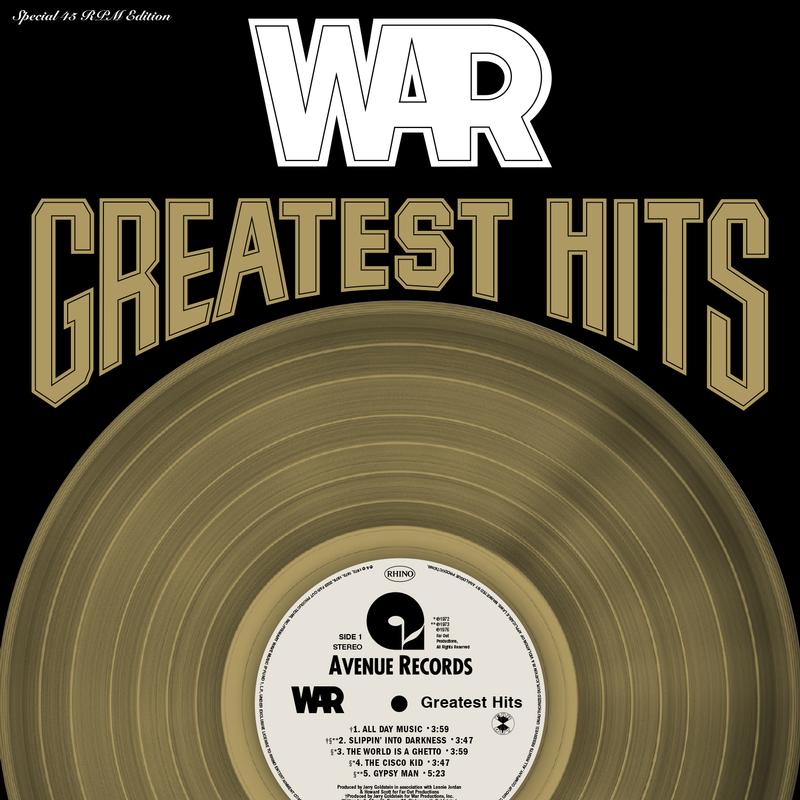
WAR’s Greatest Hits is not a studio album drawn from one recording session. Released in 1976, the collection traces several years of the band’s work and adds “Summer”, a new track at the time. That format is part of its interest. Instead of magnifying one phase, it reveals how an ensemble remains recognisable across different albums. Ten selections open a musical world in which soul, funk, blues, rock and Latin-influenced rhythms meet.
The Los Angeles group first reached a wider audience alongside Eric Burdon. That background belongs to WAR’s history, but not every famous song from it belongs on this LP. “Spill the Wine” is absent. The programme concentrates on the band after the Burdon period: musicians who shared singing, writing and arranging, and whose collective identity emerged through working together rather than through one dominant instrumental voice.
The sequence travels from “All Day Music” through “The World Is a Ghetto” to “Low Rider” and “Summer”. This offers a different perspective from an extended studio album. Both can have a place in a collection: the gradual development of a musical idea and the concentrated form through which a song entered radio programmes and everyday life. Shorter versions have a history of their own.

More than a singer and backing group
The classic line-up included Lonnie Jordan on keyboards, Howard Scott on guitar, B. B. Dickerson on bass and Harold Brown on drums. Lee Oskar’s harmonica and Charles Miller’s wind instruments expanded its melodic colours, while Thomas “Papa Dee” Allen’s percussion helped shape its rhythmic fabric. Vocal responsibilities were also shared. A picture of one frontman supported by interchangeable accompanists would miss the group’s working principle.
That arrangement suggests practical listening approaches. A riff can pass between instruments; a brief melodic figure can matter as much as a sung line. Bass, drums and additional percussion do not merely sit behind everything else. Their relationships help determine how much movement exists within an apparently stable repetition. Familiar songs provide opportunities to follow those small shifts, precisely because their broad outlines are already known.
The compilation credits document the ensemble without identifying every instrument on every track to the same degree. An album-level credit should therefore not become an invented score. Jerry Goldstein’s important production work also needs to be distinguished from an instrumental role. The personnel information focuses on performers, supplemented by production and source details. This allows the shared character of the music and the identities of its individual contributors to remain visible together.

A path through the seventies
“All Day Music” and “Slippin’ Into Darkness” lead back to the 1971 album All Day Music. “The World Is a Ghetto” and “The Cisco Kid” represent the group’s next major chapter. With a collection of this kind, the form of each track matters: some appear in shorter versions than those on their original studio albums. That concentration belongs to the hits programme. It should not be mistaken for music accidentally omitted from the reissue.
Deliver the Word supplies “Gypsy Man”, “Me and Baby Brother” and “Southern Part of Texas”. Together, these selections show a band extending its vocabulary while retaining a common character. Repeated figures are not the opposite of living music. Listening for entries and responses reveals how an ensemble organises repetition and maintains tension within a familiar movement. The arrangement can keep changing in detail while its foundation remains recognisable.
“Why Can’t We Be Friends?” and “Low Rider” take the sequence into 1975. Their proximity shows how differently memorable songs by the same musicians can be constructed. “Summer” then gives the collection a contemporary closing point. The running order consequently tells a release history as well. It is not an exhaustive chronicle and does not replace the individual albums; it has its own logic. For music lovers, it offers an invitation to reconsider apparently familiar hits as ensemble performances, and perhaps return from here to their longer album counterparts.

The original selection across two LPs
This edition, AAPP 149-45, is an Analogue Productions release of the original ten-track collection on two 180-gram LPs at 45 RPM. Ryan K. Smith handled mastering at Sterling Sound. The publisher identifies the original analogue master tapes as the source. Quality Record Pressings manufactures the records, while Stoughton Printing supplies the tip-on gatefold jacket.
These details describe the reissue, not the recording equipment used for every session represented in its programme. Catalogue number and barcode are likewise different identifiers for the same edition. What matters when choosing it is the content: the established 1976 hits sequence, rather than a later expansion featuring “Spill the Wine” or an anthology of every full-length version. Four sides give that programme a different physical structure. Its compact forms remain deliberate choices, while its musical richness comes from the interaction of seven personalities.

You order from Michael 45 in Germany. We arrange the US import and dispatch from Hilden.
Also on SACD: Greatest Hits
Musicians
Participants and documented credit status. Track references correspond to the tracklist.
- Lonnie Jordankeyboards, vocalsParticipation: Compilation ensemble
- Howard Scottguitar, vocalsParticipation: Compilation ensemble
- Harold Browndrums, vocalsParticipation: Compilation ensemble
- B. B. Dickersonbass, vocalsParticipation: Compilation ensemble
- Lee Oskarharmonica, vocalsParticipation: Compilation ensemble
- Charles Millersaxophone, flute, vocalsParticipation: Compilation ensemble
- Papa Dee Allenpercussion, vocalsParticipation: Compilation ensemble


Album credits do not imply every instrument on every track.
How Michael hears this edition
Listening impression · paraphrased from the video
Michael hears greater instrument separation, dynamics and space in the AP edition. He finds the gold-vinyl Record Store Day edition warmer and particularly coherent. His comparison values both presentations, with the AP edition offering advantages in punch and detail.
🎧 Review video: War Greatest Hits: Kevin Versus Ryan
This video is hosted by YouTube (Google). It only loads once you switch on “Functional” in the cookie settings.

theheepster –
What an absolute banger! These songs have never sounded so awesome. This is one of those records that you can put on for your friends to show how good vinyl can sound. This release is just the best AP Record for me personal.
If Chad Kassem could just get the rights to War’s Studio Albums, please do it on 45 rpm and Ryan K. Smith the cut. That could be a dream.