

Two tenors at Minton’s
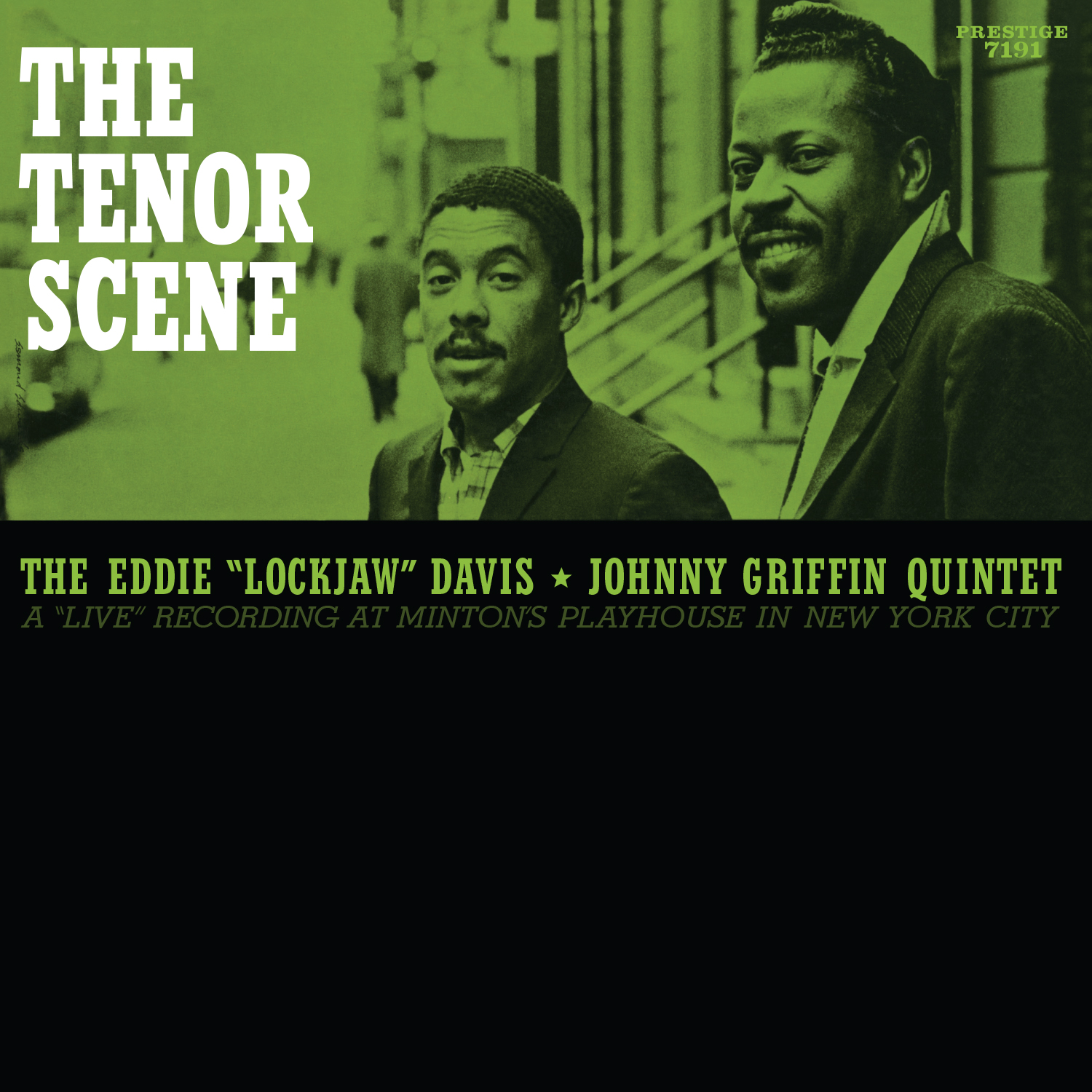
On 6 January 1961, Eddie “Lockjaw” Davis and Johnny Griffin played with their quintet at Minton’s Playhouse in Harlem. The material recorded there yielded several releases, including The Tenor Scene, issued by Prestige that year as PRLP 7191. This album is associated with the so-called “breakfast set”. That description places it within a larger recording occasion that yielded several distinct albums. The established event is a meeting of two tenor saxophonists with Junior Mance, Larry Gales and Ben Riley at a venue with a substantial jazz history.
Henry Minton founded the club in 1938 in the Cecil Hotel on 118th Street. During the early 1940s, its association with Thelonious Monk, Kenny Clarke, Charlie Christian, Charlie Parker and Dizzy Gillespie made it a major setting in the development of bebop. The 1961 recording does not document those earliest years. Instead, it shows a historically resonant place continuing to function as a working musical venue. Davis and Griffin brought their own band and their own present into that space.
The saxophonists’ partnership, active around 1960–62, became known as the “Tough Tenors”. Davis was associated with Prestige, Griffin with Riverside and Jazzland. According to the publisher’s account, the collaboration produced five albums for each of those label affiliations. The Tenor Scene is a particular part of that productive relationship. It has its own sequence and should not be merged indiscriminately with all the Minton’s recordings into a generic two-tenor programme.

Davis, Griffin and an individual rhythm section
Eddie “Lockjaw” Davis and Johnny Griffin both play tenor saxophone. Sharing an instrument makes their encounter interesting because the contrast is not supplied in advance by an obvious difference such as trumpet against saxophone. Two musicians must assert individual languages within related tonal resources while sustaining a common direction. The familiar notion of a saxophone duel captures only part of that work. A quintet also needs communication, response and a willingness to leave space for another player.
Griffin came from Chicago and attended DuSable High School. His career took him through Lionel Hampton’s band, the Jazz Messengers and work with Thelonious Monk. He played with Monk at the Five Spot after John Coltrane. Those experiences give his name context without explaining the present record in advance. Here he faces Davis, and both work with the rhythm section documented on all five selections: Junior Mance on piano, Larry Gales on double bass and Ben Riley on drums.
Mance, Gales and Riley deserve attention in their own right. The publisher’s description highlights Mance on “Light and Lovely”, Riley on “Woody’n You” and Gales on “Bingo Domingo”. These are useful starting points for hearing the album as more than a showcase for its two horns. A rhythm section does not merely support the foreground; it shapes the conditions in which a solo, an exchange or a jointly played passage can develop significance. Extended live performances allow time to follow those relationships.
A first hearing might move between the two tenors. On another, attention can turn to the piano’s harmonic guidance and the way bass and drums maintain continuity. Such approaches require no hierarchy among the participants. They recognise that five musicians share the record. The two familiar names on the sleeve provide an entrance, while the work of the full quintet makes continued attention worthwhile.

Five selections between originals and bebop repertoire
“Light and Lovely” opens side one with a documented duration of more than eleven minutes. Monk’s “Straight, No Chaser” follows in another extended performance. The first side therefore consists of two substantial forms rather than a series of short numbers, giving the album a clear opening arc. The publisher also points to the tenor exchanges in “Straight, No Chaser”. Monk’s composition connects the recording venue with a musician closely associated with Minton’s earlier history, while remaining material for this particular band to interpret.
Side two begins with Dizzy Gillespie’s “Woody’n You”. “Bingo Domingo” follows, before “I’ll Remember April” closes the programme. The final song was written by Gene de Paul, Patricia Johnston and Don Raye, and belongs to the standards that have acquired long independent lives in many jazz settings. “Bingo Domingo” is documented as a Davis composition. Sources differ over the authorship of “Light and Lovely”, naming either Davis alone or Davis with George Duvivier; that discrepancy is retained in the accompanying research rather than resolved by assumption.
The five selections combine originals, bebop repertoire and a widely performed standard. This gives a two-tenor quintet several kinds of material to work with. A familiar theme establishes common ground, while a longer performance permits individual development. Collectors with other versions of “I’ll Remember April” or “Straight, No Chaser” can follow the differences of personnel and setting particularly closely. Another performance earns its place not just through a recognisable title, but through the specific musicians bringing it to life together.
The side lengths also encourage a different pace of attention from a programme of compact song performances. A listener can stay within one piece long enough to follow the ensemble’s changing balance, then reconsider that experience in the next selection. This is one of the attractions of a live quintet album: repertoire supplies a structure, but the group’s interaction gives the structure its particular occasion.
These recordings were later reissued as The Breakfast Show, which explains why collectors may encounter the music under a different title and sleeve. The Tenor Scene remains the original album reference for this AP edition. Other Minton’s releases associated with the recording occasion contain other material. Neighbouring sets and additional numbers are not silently included in the five-track programme offered here.
A live recording and its stereo reissue
Rudy Van Gelder recorded the quintet on location, Esmond Edwards produced and Joe Goldberg wrote the liner notes. Van Gelder’s name here identifies a live recording at Minton’s, not a session at his Englewood Cliffs studio. That distinction matters to the album’s history. It does not establish the exact microphone positions or equipment transported to the club. The documented essentials are already specific: one band, one venue and the date 6 January 1961.
The Analogue Productions edition is APRJ 7191, part of the Prestige Stereo series. It contains the five selections on one LP running at 33⅓ RPM, pressed by Quality Record Pressings and supplied in a tip-on jacket. Kevin Gray is credited with the cut and Gary Salstrom with plating. A documented 2023 pressing additionally associates side A’s cutting with Momchil Zanev. That edition-specific detail should not be generalised to every pressing; it belongs to a careful distinction between release variants.
The publisher currently specifies 180 grams. An earlier AP pressing documented in 2017 is a numbered 200-gram edition, while the 2023 version is listed at 180 grams. The numbering and weight of a particular stock copy remain unconfirmed without inspecting it. The 33⅓ RPM format preserves two extended album sides and allows the long first half to unfold continuously. For a live-jazz collection, The Tenor Scene offers a precisely identified encounter between five musicians in a historically significant room. You order from Michael 45 in Germany. We arrange the US import and dispatch from Hilden.
Customer question: Buying Analogue Productions records in Europe
Series: Analogue Productions Prestige – all 50 records, musicians and session paths
Musicians
Participants and documented credit status. Track references correspond to the tracklist.
- Eddie “Lockjaw” DavisPortrait 1973tenor saxophoneParticipation: All tracks
- Johnny GriffinPortrait 1962tenor saxophoneParticipation: All tracks
- Junior MancePortrait 1965pianoParticipation: All tracks
- Larry Galesdouble bassParticipation: All tracks
- Ben RileyPortrait 1965drumsParticipation: All tracks


6 January 1961, Minton’s Playhouse, New York; Rudy Van Gelder, live recording; Esmond Edwards, production. Quintet on all five tracks. Later reissued as The Breakfast Show. APRJ7191: Kevin Gray; documented2023sideA additionally credits Momchil Zanev.

Reviews
There are no reviews yet.