

The big Texas tenor takes his time
Listeners who know Arnett Cobb primarily as the “Wild Man of the Tenor Sax” can move a little closer with Ballads by Cobb. These seven performances do not set out to justify that nickname through maximum volume. They bring another aspect of the same musician into focus: his ability to carry a melody, give it weight and preserve an individual shape at a slow tempo. The strength associated with the Texas tenor does not disappear. It operates on a different scale. The individual phrase matters more than the grand entrance, and the question becomes how long a note or a pause can sustain attention.
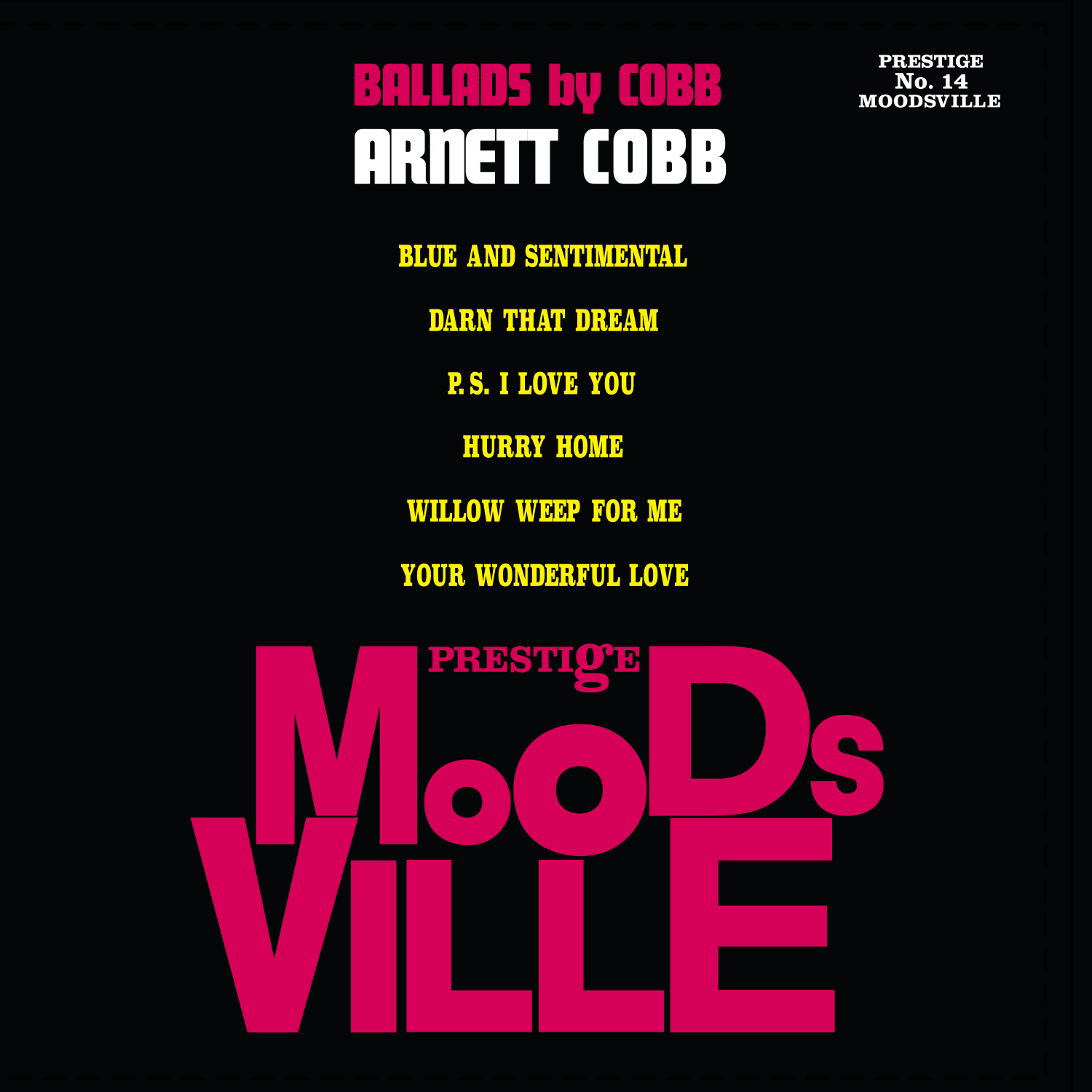
The album was recorded on 1 November 1960 at Van Gelder Studio in Englewood Cliffs, New Jersey, with Esmond Edwards producing. Its original home was Moodsville, the Prestige subsidiary, where it appeared as MVLP 14. That placement says something useful about the intention. A ballad programme was treated as a musical project in its own right, giving Cobb a complete LP on which to explore slower material. Sources differ over whether the first release belongs to 1960 or 1961; the November 1960 recording date, however, is firmly documented.
Cobb belonged to a Texas tenor tradition in which a personal sound could be immediately recognisable. His connections with swing and the expressive language of early rhythm and blues are part of this record’s background. Ballads by Cobb is especially inviting for anyone who does not confuse slow playing with a wish to remain unobtrusive. A ballad can speak with considerable authority. It can tell its story without hurrying, and sometimes make a musician’s individuality clearer than the fastest number in the set.

Red Garland and a quartet with room to breathe
The personnel are Arnett Cobb on tenor saxophone, Red Garland on piano and celesta, George Duvivier on double bass and J. C. Heard on drums. This is the album’s quartet throughout its seven selections. There is no need for a second horn. Cobb carries the principal melodic voice while the other three musicians shape the harmonic and rhythmic setting. On a programme devoted entirely to ballads, that is a revealing choice: variety has to develop within a familiar instrumental group, rather than through a succession of guests or large arrangements.
Red Garland is much more than a name attached to the accompaniment. Piano and tenor suggest two different ways of surrounding a melody: the saxophone through breath and sustained line, the keyboard through chords, responses and the relationship between attack and decay. The documented presence of a celesta adds another colour. Its keyboard operates hammers striking metal plates, giving it a more bell-like character than the piano. The sources do not all provide the same level of detail about its track assignment, so the album credits preserve both instruments without turning a qualified detail into a broader claim.
Duvivier and Heard are equally important to the picture. Calling them the rhythm section should not imply that slow music merely requires a steady background. At these tempos, the beginning, ending and spacing of a note can become particularly significant. One useful way into the record is to follow how bass and drums make the pulse perceptible while the melody seems free to speak above it. The small ensemble makes those relationships approachable. Each participant occupies a clear place, and the shared framework gives Cobb room to develop his lines.

Seven standards, seven ways of carrying a tune
Ann Ronell’s “Willow Weep for Me” opens the programme with a song that jazz musicians have repeatedly returned to. “Hurry Home” and “P.S. I Love You” follow. The latter is the composition by Gordon Jenkins and Johnny Mercer, a useful distinction when a title is familiar from more than one musical setting. The first side therefore places three songs together and gives them time to develop beyond simple recognition. This is not a hurried procession of well-known tunes, but an opportunity to consider their different attitudes.
Side two begins with “Blue and Sentimental,” associated with Count Basie, Mack David and Jerry Livingston. “Darn That Dream” leads to Jimmy Van Heusen and Eddie DeLange, while “Why Try to Change Me Now?” brings in Cy Coleman and Joseph McCarthy. “Your Wonderful Love” closes the sequence. Even the titles suggest how many shades can fit inside an apparently uniform ballad album: appeal, recollection, affection, longing and self-assertion. It is worth keeping those different starting points in mind rather than assigning every performance the same melancholy character before listening.
The single-LP presentation at 33⅓ RPM makes particular sense for this programme. Three selections occupy side A and four the second side, allowing the unhurried sequence to develop over substantial stretches. There is no need to interrupt it every few minutes to turn another side. That is an appealing format for an evening in which continuity of voice matters more than rapid movement between isolated tracks. Collectors who already know Cobb’s Party Time will find a revealing counterpart within the same musician’s work. The ballads do not redefine the expressive tenor, but they direct attention towards other aspects of his range.
The Prestige Stereo edition, APRJ 14
The record offered here is Analogue Productions APRJ 14, a stereo LP cut at 33⅓ RPM as part of the Prestige Stereo reissue series. Although the historical album appeared on Moodsville, it belongs to this reissue programme. Kevin Gray handled the mastering and Quality Record Pressings manufactured the record; the publisher also credits Gary Salstrom with the plating. A Stoughton tip-on jacket constructed on substantial board completes the presentation. These details identify a specific edition rather than simply another release carrying a familiar cover.
The series was announced with mastering from the original analogue tapes. Kevin Gray is the documented mastering engineer for Ballads by Cobb; this is distinct from the explicitly explained LP-transfer exception affecting Hopkins’ Soul Blues. The publisher currently lists this title on 180-gram vinyl, while the earlier AP edition from 2017 is documented as a 200-gram pressing. Earlier numbering or weight specifications should therefore not be assumed to describe every copy offered today. APRJ 14 identifies the edition, but its release history alone cannot establish a particular stock copy’s pressing batch.
There is also a useful distinction between production information and a personal listening judgement. Knowing who cut a record, where it was pressed and how it is packaged helps a collector understand the object being purchased. It does not replace the encounter with the music or prescribe how that record will behave in every system. Here, the appeal of a carefully identified reissue accompanies a programme that already has a strong musical reason to exist: one tenor player, three close partners and a sustained commitment to the expressive possibilities of a ballad.
For music lovers, the strongest invitation remains the combination of clearly chosen repertoire and a highly individual saxophone voice. Ballads by Cobb asks us to move speed away from the centre of attention. A held melody, a brief piano answer or a small rhythmic adjustment can be just as absorbing. This quartet offers an accessible but far from restricted space in which to notice them—seven selections long, with enough time to follow each one properly.
You order from Michael 45 in Germany. We arrange the US import and dispatch from Hilden.
Customer question: Buying Analogue Productions records in Europe
Series: Analogue Productions Prestige – all 50 records, musicians and session paths
Musicians
Participants and documented credit status. Track references correspond to the tracklist.
- Arnett CobbPortrait: 1979tenor saxophoneParticipation: All tracks
- Red GarlandPortrait: late 1950spiano, celestaParticipation: All tracks; celesta assignment qualified
- George DuvivierPortrait: existing portraitdouble bassParticipation: All tracks
- J. C. HeardPortrait: 1946drumsParticipation: All tracks


1 November 1960, Van Gelder Studio, Englewood Cliffs; producer Esmond Edwards, engineer Rudy Van Gelder, notes Joe Goldberg. Quartet on all seven tracks. Garland: piano/celesta; assignment of celesta to B3 appears in one edition source only and is not adopted as an unqualified track fact. Original release dated 1960/61 in conflicting sources.

Bernhard Hutter –
A hidden treasure that perhaps not everyone knows about. Wonderful compilation of titles, very digestible – with an almost unbelievable sound. Press quality is QRP typical of course top.