

Four!: Hampton Hawes in a quartet of individual voices
The title Four! initially tells us only how many musicians are involved. On this recording, that becomes a clear musical proposition: Hampton Hawes on piano, Barney Kessel on guitar, Red Mitchell on double bass and Shelly Manne on drums form the complete group. The edition credits explicitly feature all four. Treating the record solely as a pianist’s album with accompaniment would therefore miss part of its design. Piano and guitar create an additional conversation within the quartet, while bass and drums help shape the course of the music rather than merely supporting events elsewhere in the ensemble.
The album belongs to the world of Contemporary Records in Los Angeles. Lester Koenig produced it, Roy DuNann engineered it, and Nat Hentoff wrote the sleeve notes. That combination is familiar to collectors of the label, but it does not make the recordings interchangeable. Hawes, Kessel, Mitchell and Manne bring different responsibilities and possibilities. A piano’s attack behaves differently from a plucked guitar string; the double bass combines low pitches with its own agility; drums can organise events without carrying a continuous melody. The tension and interest of the instrumentation arise from those differences and from the ways the musicians connect them.
Four perspectives provide a particularly useful way into the record. Begin with Hawes and follow the piano lines. On another hearing, bring Kessel’s guitar into the foreground, then Mitchell’s bass or Manne’s drums. The aim is not to divide the performance into four isolated recordings, but to understand how the musicians share space. A quartet offers more possibilities than a trio and also introduces another task of coordination. That is central to the appeal of Four!: the instruments do not need to perform the same function in order to agree on a common direction and sustain the movement together.

Seven selections with room to develop
Side A opens with Yardbird Suite, followed by There Will Never Be Another You and Bow Jest. All three performances last more than six minutes. That gives the first side a concentrated structure: three substantial sections in which to settle into a particular musical situation. Duration alone does not guarantee depth, but it allows a thought to be followed through several turns and the relationships within the group to become clearer. Instead of moving quickly to another title, attention stays with the same starting idea and its development, giving the listener time to recognise how the ensemble responds.
The second side moves through Sweet Sue and Up Blues to Like Someone in Love and Love Is Around the Corner. Four selections create a different balance. At 3:14, Like Someone in Love is the album’s shortest piece, while the other three tracks on this side run between just over five and nearly six minutes. The movement between longer and more compact forms is part of the record’s shape. Its seven selections are not simply equivalent units. Two differently constructed halves complement one another, producing a balance that becomes especially apparent when the album is heard in full.
Familiar song titles may offer an easy starting point, but knowledge of previous interpretations is not required. Try remembering a melody first, then listening to its accompaniment. Which instruments provide orientation, and which introduce a different emphasis? Where does the movement seem open, and where more closely gathered? These are questions for personal listening rather than fixed judgements about particular passages. They make attentive engagement possible without extensive background knowledge. A compact programme of this kind can continue revealing details over repeated hearings, because familiarity with its overall shape gradually leaves more attention available for the relationships inside each performance.

Piano and guitar sharing the musical space
Hawes and Kessel can both connect melody with harmony. That creates a particular challenge: two instruments might occupy similar areas, but need not perform the same function at the same moment. One rewarding focus is therefore the distinction between their contributions. A piano line can breathe differently from a guitar phrase, and contrasting attacks allow even nearby pitches to register as separate voices. The quartet benefits from that individuality. The guitar is not an incidental colour at the edge of a piano-led group; it belongs to the explicitly featured four-piece ensemble around which the album is organised.
Red Mitchell and Shelly Manne complete the setting. Bass can clarify harmonic movement while also carrying an independent line. Drums establish another relationship between sound and time. If piano and guitar usually command most of your attention, use another hearing to explore the lower register and the edges of the ensemble. This change of perspective can alter the meaning of a phrase: what first seemed to be a soloist’s decision may become audible as part of a collective movement. A quartet is especially interesting when its members do more than take turns receiving attention, remaining connected throughout the musical exchange.
The musician panel identifies all four players across all seven tracks, separately from the production and engineering credits. An exact recording date is not inferred from the date beneath the sleeve notes: October 12, 1958, dates Hentoff’s text and does not automatically establish the session. That distinction belongs in the documentation without taking over the musical story. The Contemporary recording setting, the four musicians and the programme are established. Together, they provide a firm basis for understanding the record as a specific ensemble album without turning an unsupported calendar date into an apparently decisive piece of information.
The Contemporary reissue for the collection
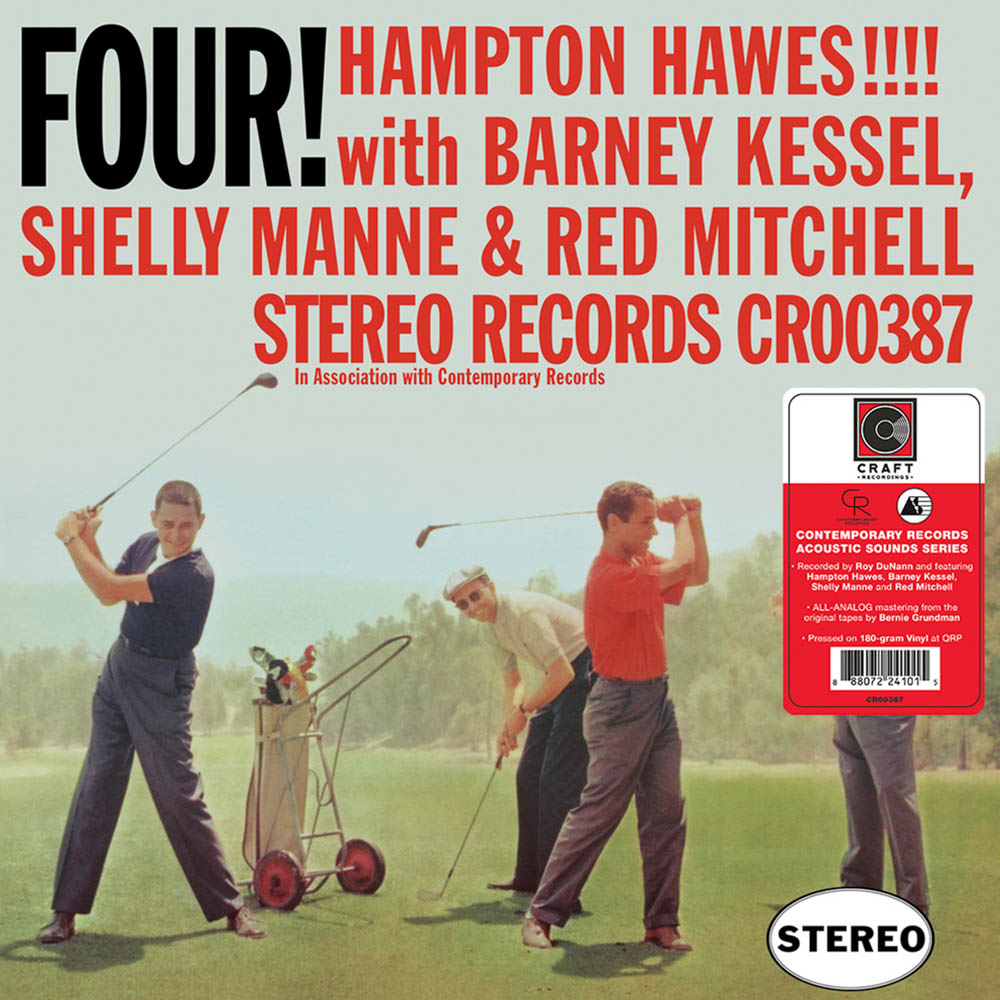
This edition belongs to the Contemporary Records Acoustic Sounds Series. It carries the catalogue number CR00387, with shop reference ACONC 387, and presents the album on one 180-gram stereo LP at 33⅓ RPM. Bernie Grundman handled mastering and lacquer cutting, and the record was pressed at Quality Record Pressings. The reissue appeared in 2022. These details identify the particular version more helpfully than a generic description that could apply to every release of the album. The ensemble remains the centre of its musical identity, while accurate edition information helps establish exactly which record is being considered for purchase.
The LP retains three selections on side A and four on side B, a suitable shape for music whose longer performances encourage sustained attention. Listeners familiar with The Poll Winners encounter Kessel and Manne again, now in a different combination with Hawes and Mitchell. Those approaching through Hampton Hawes discover three further clearly identified musicians whose contributions belong to the record’s character. Such connections can provide a satisfying way to develop a collection: following specific musical relationships, rather than organising everything only by label or by the largest name printed on an album cover.
Four! is therefore an apt title. It directs attention towards the ensemble and invites curiosity about how four instruments divide their responsibilities. Seven performances provide different opportunities to follow that question through listening. Michael 45 dispatches orders from Hilden in Germany, allowing customers in Germany and the EU to order without importing it themselves from the United States or waiting for customs clearance. If you want to buy Hampton Hawes’s Four! on vinyl, this Contemporary edition is presented with its complete running order, all four musician credits and the documented manufacturing details of this particular reissue.
Current availability and delivery information appear beside the purchase controls; this edition description is not a statement of stock availability.
Series: Contemporary – all 24 records: sunny jazz from Los Angeles
Musicians
Participants and documented credit status. Track references correspond to the tracklist.
- Hampton HawesPortrait reference: 1953pianoParticipation: all seven tracks
- Barney KesselExisting portrait; not a session depictionguitarParticipation: all seven tracks
- Red MitchellExisting portrait; not a session depictiondouble bassParticipation: all seven tracks
- Shelly ManneExisting portrait; not a session depictiondrumsParticipation: all seven tracks


Production: Lester Koenig. Recording: Roy DuNann. Liner notes: Nat Hentoff. Design: Robert Guidi. Cover photography: Richard Gross. Mastering/lacquer cutting: Bernie Grundman. Pressing: QRP. The date 12 October 1958 belongs to the liner notes and is not an established session date.

Reviews
There are no reviews yet.