

A drummer makes room for four personalities
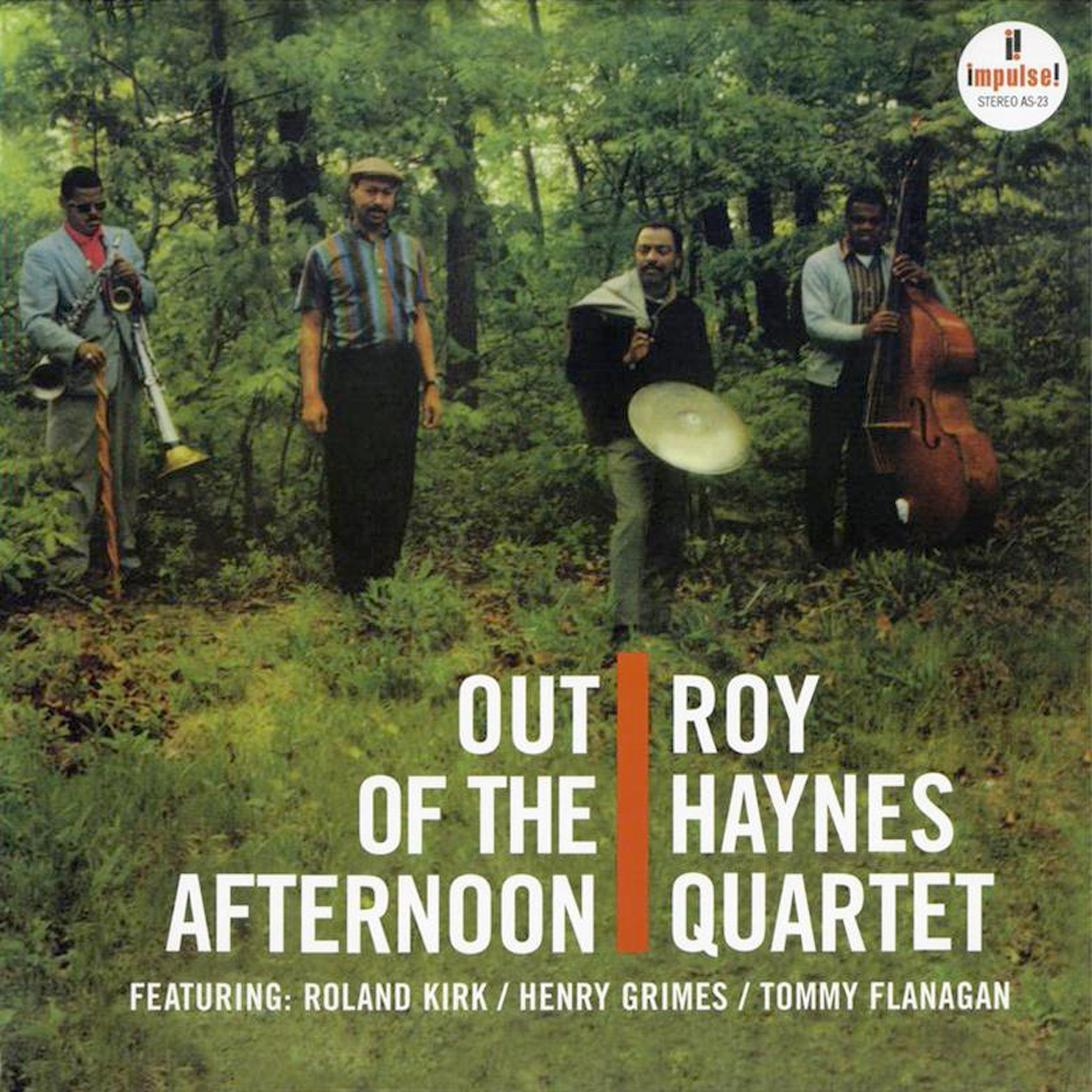
A quartet can suggest a much larger musical world when its four members bring different ideas about movement and colour. On Out of the Afternoon, Roy Haynes assembles precisely that kind of group: Roland Kirk on several wind instruments, Tommy Flanagan at the piano and Henry Grimes on double bass. Haynes leads from the drums. The combination joins a familiar foundation in modern jazz to a range of sounds that cannot be contained by a simple division between soloist and accompaniment. The personnel alone help explain why this recording occupies such a distinctive place in his extensive body of work.
The sessions took place on 16 and 23 May 1962 at Van Gelder Studio in Englewood Cliffs, New Jersey. Bob Thiele produced the recording for Impulse!, which released the album that summer. Seven pieces make up the programme, with three on the first side and four on the second. Haynes contributes three compositions of his own: “Raoul”, “Snap Crackle” and “Long Wharf”. Four standards complete the selection, drawing on different parts of the American songbook. It is a framework in which new ideas need neither an uninterrupted sequence of original pieces nor a theatrical rejection of familiar material.
The appeal of an album led by a drummer need not rest primarily on extended drum solos. Another, more revealing question is how the leader shapes the conversation: where an accent arrives, how another voice answers it, when the texture becomes more or less crowded. Those questions lead directly into the ensemble. Listeners who know Haynes principally through the personnel of other important jazz records encounter him here as the host of a carefully chosen gathering. The title proposes no elaborate programme. It leaves four unmistakable individuals room to turn seven themes into a shared musical story.

Roland Kirk and an unusually broad palette
Roland Kirk, subsequently known as Rahsaan Roland Kirk, brings an exceptional variety of timbres to the quartet. The album credits list tenor saxophone, manzello, stritch, C flute and nose flute. That inventory matters because it describes more than a saxophonist occasionally changing instruments. It helps explain how a small group can move beyond the customary sound of one horn with a rhythm section. The collective album credit is not, however, a complete track-by-track account of every instrumental change. The detailed personnel retain that distinction rather than assigning an instrument to a piece without sufficient evidence.
Kirk is easily reduced to the visible unusualness of his playing. A rewarding approach to this album begins instead with the tunes and their shapes. “Moon Ray”, “Fly Me to the Moon” and “If I Should Lose You” provide melodic reference points against which changes in articulation, register and colour can be followed. A familiar song is not an obstacle to individuality here; it provides a shared language. Recognition of the melody can make an individual musician’s choices more apparent, allowing the listener to move beyond the mere novelty of the instrumental resources involved.
Tommy Flanagan and Henry Grimes are essential participants rather than support staff for two conspicuous personalities. Piano and bass make the encounter a quartet. Flanagan’s role involves harmonic relationships as well as the progress of the solo passages; Grimes invites attention to line and to the transitions between supporting the group and taking an independent part. The publisher specifically draws attention to a bowed bass solo in “Raoul”. That concrete detail is a reminder that the record’s variety does not originate exclusively in Kirk’s collection of instruments. Haynes has brought together musicians whose individual possibilities enlarge one another’s field of action.

Seven pieces and several ways into the music
Side one opens with “Moon Ray”, a composition associated with Artie Shaw, then moves to Bart Howard’s “Fly Me to the Moon (In Other Words)”. The parenthetical title recalls the history of a song that existed before its most celebrated pop interpretations. “Raoul”, the first of the leader’s contributions, follows. Two familiar melodic starting points and a Haynes original thus sit alongside one another without separating into dutiful repertoire and experimental material. The side gives the listener time to follow the individual voices while keeping their collective direction in view.
“Snap Crackle” opens side two. Its title is closely associated with Haynes’ musical identity and remains one of the memorable names in his repertoire. Next comes “If I Should Lose You”, by Ralph Rainger and Leo Robin. “Long Wharf” introduces another original before “Some Other Spring”, by Irene Kitchings and Arthur Herzog Jr., closes the album. The programme therefore ends with a song whose history extends beyond this quartet but which acquires a new context within it. Standards and originals remain interwoven throughout the record rather than being assigned separate musical territories.
One way to spend time with the album is to shift attention between hearings. The themes can provide the first route through it; the exchanges between drums and winds another; the work of piano and bass a third. This need not mean taking the music apart. It is a way of noticing all four players as active participants even when one of them is not taking a solo. That flexibility is one of the pleasures a thoughtfully assembled small group can offer a record collection: the same programme allows a different voice to become the focus of attention on a later visit.
The seven-track sequence also provides a useful scale. There is enough room for individual expression without turning the album into a sprawling survey of sessions. The listener can retain a sense of the opening themes while reaching the final song. In this context, variety comes from relationships within the group and from the repertoire itself, rather than from adding personnel or multiplying pieces. The compact programme makes the musicians’ differences easier to hold together as parts of one recording.
The Acoustic Sounds edition on one stereo LP
This edition, catalogue number AIMP 79801, belongs to the Acoustic Sounds Series from Verve and Universal Music Enterprises. It presents the album on a 180-gram stereo LP playing at 33⅓ RPM. The publisher identifies Ryan K. Smith at Sterling Sound as the mastering engineer, working from the original analogue tapes. Quality Record Pressings manufactures the record, while Stoughton Printing supplies the old-style tip-on gatefold jacket. These are specific details of the reissue’s production rather than a general promise attached to the word audiophile.
The release follows the original seven-piece programme. It is not an expanded collection of other sessions, and the recording dates, personnel and repertoire described here refer to this album. The 33⅓ format keeps the music together on two sides. For someone who enjoys following an album as a continuous sequence, the original arrangement of three pieces followed by four involves a single side change. That practical characteristic does not establish a sound-quality ranking against other formats; it identifies the particular form in which this release is offered to the listener and collector.
The combination of a drummer leading the group, Kirk’s unusual palette and the independent contributions of Flanagan and Grimes gives Out of the Afternoon its enduring interest. This carefully specified reissue brings the focus back to the complete quartet and its seven selections. You order from Michael 45 in Germany. We arrange the US import and dispatch from Hilden. For a collection exploring Impulse! through imaginative combinations of musicians as well as its most familiar names, this album provides an especially engaging place to begin.
Series: Impulse! – all 19 records: the house that Trane built
Musicians
Participants and documented credit status. Track references correspond to the tracklist.
- Roy Haynesportrait reference 1954drumsParticipation: All tracks
- Roland Kirkearly 1960stenor saxophone, manzello, stritch, C flute, nose fluteParticipation: Album credits; individual instrument changes not fully assigned to tracks
- Tommy Flanaganlater existing portraitpianoParticipation: All tracks
- Henry Grimesportrait reference 2005double bassParticipation: All tracks


Quartet on all seven tracks. Kirk’s list of instruments describes the album as a whole. Three compositions by Roy Haynes: Raoul, Snap Crackle and Long Wharf.

Reviews
There are no reviews yet.