

One voice carries the quartet
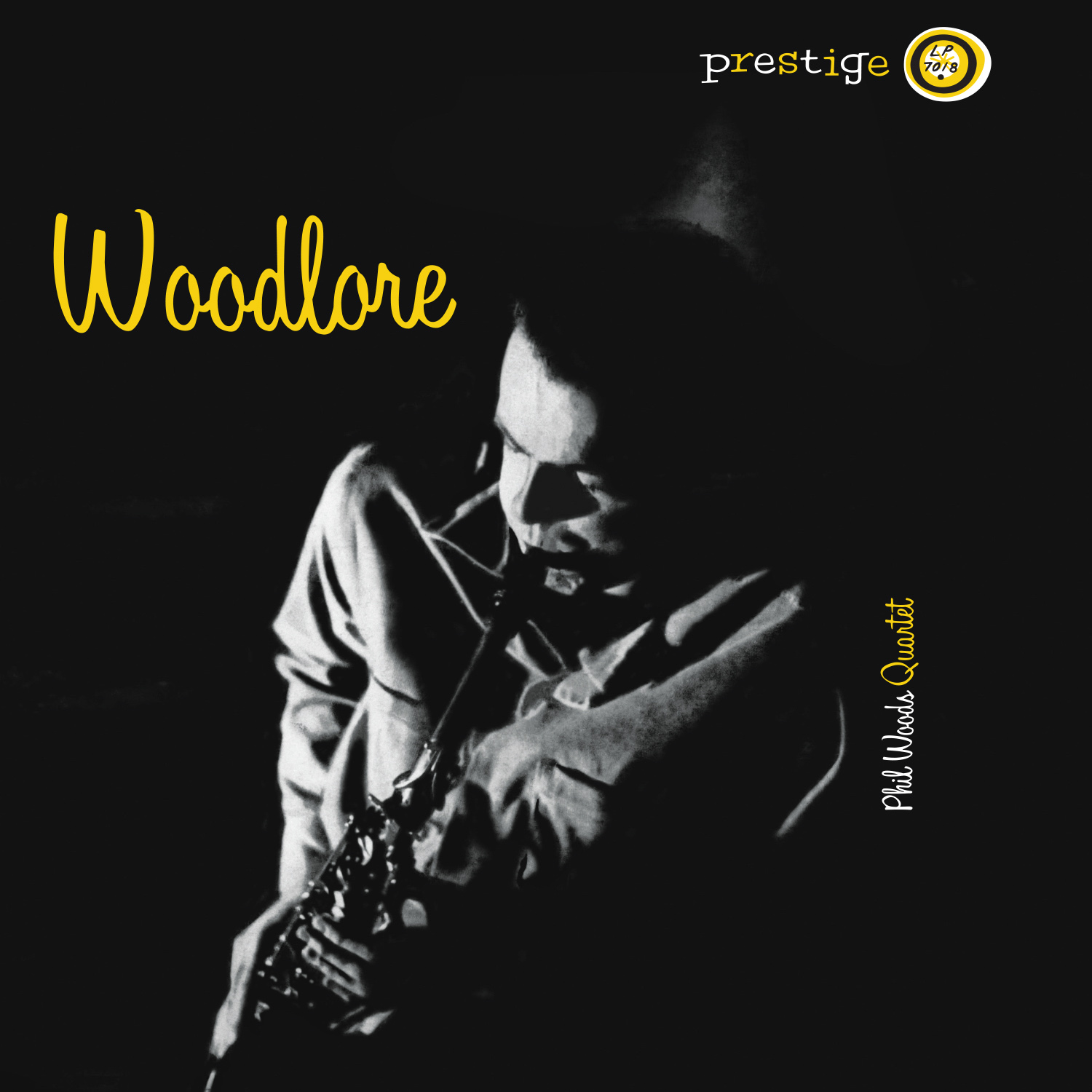
On Woodlore, Phil Woods needs no second horn to give an entire record its character. His alto saxophone stands alone in front of piano, double bass and drums. It is a small ensemble with a substantial task: every turn of the melody, every fresh start to a solo and every moment of silence acquires particular weight. Woods was only twenty-four when this music was recorded in November 1955. Yet this is not the tentative statement of someone cautiously trying on the role of leader. Across six pieces, we meet an instrumentalist who already understands his resources and can use them to reveal quite different aspects of his personality.
Woods had previously recorded with guitarist Jimmy Raney and with his own quintet featuring trumpeter Jon Eardley. The distinction of Woodlore, therefore, is not that his name appears on a recording for the very first time. This was his first session planned specifically for a twelve-inch LP with himself as the only horn. That difference matters musically. A quintet can present a melody in two contrasting instrumental voices and alternate its frontline soloists. Here Woods must sustain the thread himself. The rhythm section consequently becomes an even more conspicuous partner in the conversation.
The recording was made at Rudy Van Gelder’s Hackensack studio during the early Prestige years, when a relatively close circle of young musicians encountered one another in changing combinations. Bob Weinstock supervised the production. Woods’ musical language is firmly rooted in bebop, but a family tree alone does not explain the attraction of the record. An alto saxophone can be agile and technically assured while telling a story in very different ways: through the momentum of a rapid line, the emphasis placed on one note or a small displacement of rhythm. An album without another horn offers an especially direct opportunity to notice those distinctions.
Ira Gitler framed the original sleeve notes as a baseball scouting report, presenting Woods as a young player whose potential had by no means been exhausted. Beneath the playful conceit lay an appreciation of the connection between technique, ideas and swing. The notes also give Strollin’ With Pam a personal context: it is dedicated to one of Woods’s daughters, while “strollin’” refers here to playing with the piano laying out. These details bring the record back from catalogue history into the lives and working vocabulary of its musicians.

John Williams, Teddy Kotick and Nick Stabulas
The pianist is John Williams, the jazz musician rather than the film composer of the same name. His contribution is one of the rewarding discoveries within this album. Accompaniment has a different responsibility from an additional melody instrument: it can answer a phrase with a chord, suggest a harmonic possibility and then step back. The label’s account places Williams in the school of Bud Powell while also acknowledging Horace Silver’s influence. That provides a useful starting point for attending to the relationship between bebop fluency and an earthy, rhythmically explicit approach to supporting a soloist.
Teddy Kotick on double bass and Nick Stabulas on drums complete the quartet. Their names deserve more than a passing glance at the bottom of a personnel list. In this setting, neither a lavish horn section nor an elaborate arrangement can conceal the work of the rhythm players. The bass gives harmonic movement a physical presence, while the drums articulate time and supply accents. Follow these two voices for a while and the saxophone solo becomes part of a larger exchange. Much of its apparent freedom depends on the musicians around it. This is a quartet, not a soloist placed against an anonymous background.
The relationship between a fuller texture and a more open space is particularly inviting. When the piano withdraws, Woods’ line is framed differently by bass and drums; when Williams offers another harmonic response, the balance changes again. No knowledge of chord symbols is required to appreciate the process. Listen for the places where an answer arrives, is withheld or places an accent somewhere unexpected. Woodlore makes that kind of attention manageable. The same four musicians remain together while tempo, melodic character and the origins of the repertoire change. The variety of the pieces becomes inseparable from the identity of the ensemble.

Six pieces between song and bebop
The title piece, Woodlore, and the closing Strollin’ With Pam are Phil Woods compositions. They frame a programme that also draws on several established songwriters. That mixture gives the record an additional attraction for a collector: Woods is documented not simply as an interpreter of familiar repertoire, but as a musician placing his own material within it. The album title is also the name of an actual composition, rather than a general label attached to six standards. The different sources of the music are part of the pleasure of following its sequence.
Falling In Love All Over Again is by Neal Hefti. Be My Love brings in Nicholas Brodszky’s melody, originally joined to words by Sammy Cahn. In an instrumental performance the words disappear, but the design of the song remains a point of orientation. This suggests a rewarding way into the music: hold the outline of the theme in mind, then follow Woods as he moves away from it. A ballad asks different questions from a brisk bebop performance. Breath, the duration of a note and the balance between melodic closeness and improvisational freedom become especially significant.
The second side contains Frank Loesser’s On a Slow Boat to China, Get Happy by Harold Arlen and Ted Koehler, and Strollin’ With Pam. The label singles out the swift minor-key treatment of Get Happy as a particularly revealing performance. A transformation of a familiar song can sharpen the listener’s attention: recognition and surprise work together. The closing blues offers another kind of concentration. Instead of continually changing harmonic landscapes, a recurring framework becomes a place for personal invention. Consider the two performances alongside one another and tempo, phrasing and emphasis emerge as powerful expressive choices, rather than merely technical details.
The mono LP as a complete programme
This edition carries catalogue number APRJ 7018 and belongs to the Analogue Productions Prestige Mono Series. The publisher credits Kevin Gray with cutting from analogue master tapes and Quality Record Pressings with manufacturing the record. Its current specification describes a 180-gram LP with a high-gloss tip-on jacket. The combination of mono presentation, analogue cutting and a traditional jacket construction places this edition within the context of the early Prestige LPs. For a collection following Woods’s development, the complete programme is central: his originals and the song selections remain together in the sequence that presents the quartet as a coherent ensemble.
A single record played at 33⅓ rpm preserves the programme in two clearly defined parts, with three pieces on each side. That suits an album whose variety comes from asking different musical questions of the same small ensemble. A complete side can unfold without an interruption after every substantial solo, allowing the relationship between original compositions and familiar songs to emerge as a sequence. This is both a practical and a musical advantage of the LP format. A higher playback speed need not be an end in itself when the continuity of the album is central to the experience.
Mono is also part of this recording’s identity. Attention turns towards a shared musical centre and the relationships inside the quartet. The interesting question is how Woods’ line, Williams’ responses and the impulses of bass and drums work together as one unfolding event. Woodlore offers a particularly direct invitation to explore that question: a young alto player, three attentive partners and six pieces with enough contrast to reveal more than a single aspect of their playing. In a collection of early Prestige recordings, this is an album whose concentrated instrumentation allows it to say a great deal.
You order from Michael 45 in Germany. We arrange the US import and dispatch from Hilden.
Customer question: Buying Analogue Productions records in Europe
Series: Analogue Productions Prestige – all 50 records, musicians and session paths
Musicians
Participants and documented credit status. Track references correspond to the tracklist.
- Phil Woodsalto saxophoneParticipation: Album personnel
- Teddy Kotickdouble bassParticipation: Album personnel
- Nick StabulasdrumsParticipation: Album personnel
- John WilliamspianoParticipation: Album personnel


Track and side references refer to this LP edition.

Reviews
There are no reviews yet.