


Seven compositions and an individual direction
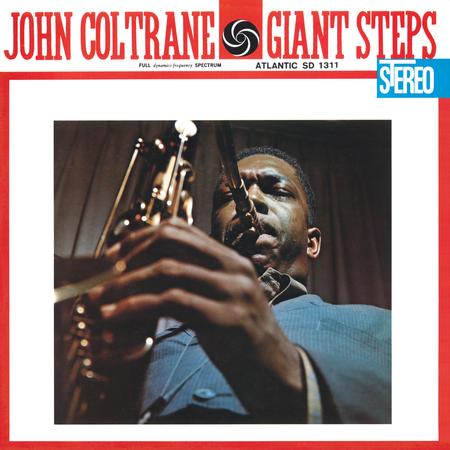
The reputation of Giant Steps often arrives before a listener encounters the record itself. Difficult chord sequences, remarkable speed and a new level of jazz saxophone playing are familiar parts of that reputation. They touch important aspects of the music without describing the entire album. Between the title track and Naima, or the relentless movement of Countdown and the melodic lines of Syeeda’s Song Flute, lie very different expressive possibilities. John Coltrane is doing more than demonstrating what can be played on a tenor saxophone. He shapes seven original compositions into a programme in which concentration, lyricism and rhythmic momentum complement one another.
Recorded in 1959 and released by Atlantic in February 1960, this was Coltrane’s first album issued as a leader for the label. He had recently worked with Miles Davis on Kind of Blue. The main Giant Steps sessions followed in May, shortly after his final recording date for that album. Their proximity is fascinating because it places the same musician inside strikingly different approaches to musical form and improvisation. One experience does not fully explain the other. Together they reveal the extraordinary mobility of his musical thinking at this point in his career.
Coltrane composed all seven pieces. That gives the album a particular coherence without restricting it to a single mood. Anyone approaching its famous title with some apprehension will find several other entrances: a blues, a lyrical theme, a ballad with room for a sustained melodic voice. The value of this music is not exhausted by analysing it. Its lines and movements invite a listener to follow without having to read a page of chord symbols alongside them.

Two rhythm sections and a shared bassist
The route to the released performances was not straightforward. An initial attempt in March 1959 with Cedar Walton, Paul Chambers and Lex Humphries produced recordings that were not included on the original album. For the principal sessions on May 4 and 5, Coltrane worked with Tommy Flanagan at the piano, Chambers on double bass and Art Taylor on drums. Six of the seven released tracks came from those dates. The recordings took place at Atlantic Studios in New York, with Nesuhi Ertegun supervising production and Tom Dowd and Phil Iehle credited for recording engineering.
A different group appears on Naima. Recorded on December 2, 1959, that performance features Wynton Kelly at the piano and Jimmy Cobb on drums, with Chambers remaining on bass. Chambers is therefore the only accompanist connecting both rhythm sections heard on the album. This offers an appealing point of attention: beneath the same tenor voice, the relationship between piano and drums changes while the double bass preserves a personal link between the sessions.
Flanagan and Kelly consequently occupy different places in the programme, as do Taylor and Cobb. Listing those names together must not create the impression of a sextet playing throughout. The released music comes from two quartet line-ups. With an album discussed as frequently as this one, such distinctions help restore the individual recordings as actual encounters between musicians, each with particular responsibilities and responses, shaping their time together.

Motion, blues and the stillness of Naima
The title composition presents its challenge through rapidly changing harmonic centres. The relationships later known as “Coltrane changes” move between tonal centres a major third apart. A listener can begin by following that motion directly: the theme establishes striking points while the improvisation continually searches for routes between them. Understanding every part of the construction is not a prerequisite for experiencing the tension between a clear form and an agile melodic line. That relationship helped make the piece an enduring reference for later generations of musicians.
Cousin Mary offers another approach. Its blues structure supplies a more familiar framework within which Coltrane’s phrases develop their own density. The brief Countdown compresses the movement again, while Spiral and Syeeda’s Song Flute allow longer shapes to unfold. The sequence changes the listener’s distance from the music: close to the quick turns of a line at one moment, then following a theme whose outline emerges across several phrases.
Naima places the ballad at a particularly effective point. Kelly, Chambers and Cobb accompany a tenor voice whose expression depends on sustaining and connecting notes. The spaces between them deserve attention alongside the melody. Finally, Mr. P.C. returns to the collective movement of the May quartet. The album concludes as music made by four interdependent voices, each part helping the others find direction. For collectors, that offers a good reason to return regularly to a supposedly familiar classic. Its reputation may be established, but the relationships inside its performances remain alive and available to renewed attention.
The Atlantic 75 SACD in stereo
The edition offered here is CAPA 010 SA, part of the Analogue Productions Atlantic 75 Series. It contains the seven original tracks on a Hybrid Stereo SACD. The CD layer is compatible with ordinary CD players; an SACD player is needed for the DSD layer. Bonus recordings, alternate takes and the abandoned March line-up do not form part of this programme. The disc is supplied in a Super Jewel Box.
Ryan K. Smith at Sterling Sound is responsible for the mastering. Analogue Productions describes a direct transfer from the original master tape to DSD. This is the publisher’s source statement; no particular DSD rate or converter is specified. The programme is stereo and should not be confused with the earlier Japanese mono SACD. Likewise, the speed, four record sides and pressing-plant information belonging to the separate Atlantic 75 vinyl release do not describe this disc.
On SACD, the sequence from Giant Steps to Mr. P.C. can be experienced without changing sides. That is a different practical way of spending time with the album, rather than a predetermined verdict on its superiority to another edition. Clearly identified specifications help collectors choose this particular release. The music supplies the reason to give it time. You order from Michael 45 in Germany. We arrange the US import and dispatch from Hilden.
Also on 45 RPM vinyl: Giant Steps
More by John Coltrane: Lush Life · Soultrane
Artist page: All titles by John Coltrane
Customer question: Buying Analogue Productions records in Europe
Musicians
Participants and documented credit status. Track references correspond to the tracklist.
- John Coltranetenor saxophone (1, 2, 3, 4, 5, 6, 7)Participation: 1–7
- Tommy Flanaganpiano (1, 2, 3, 4, 5, 7)Participation: 1–5, 7
- Wynton Kellypiano (6)Participation: 6
- Paul Chambersdouble bass (1, 2, 3, 4, 5, 6, 7)Participation: 1–7
- Art Taylordrums (1, 2, 3, 4, 5, 7)Participation: 1–5, 7
- Jimmy Cobbdrums (6)Participation: 6


Album credits do not mean that every instrument appears on every track. Documented track assignments are given beside the relevant roles; further assignments remain unconfirmed.

Reviews
There are no reviews yet.