
A meeting between equals
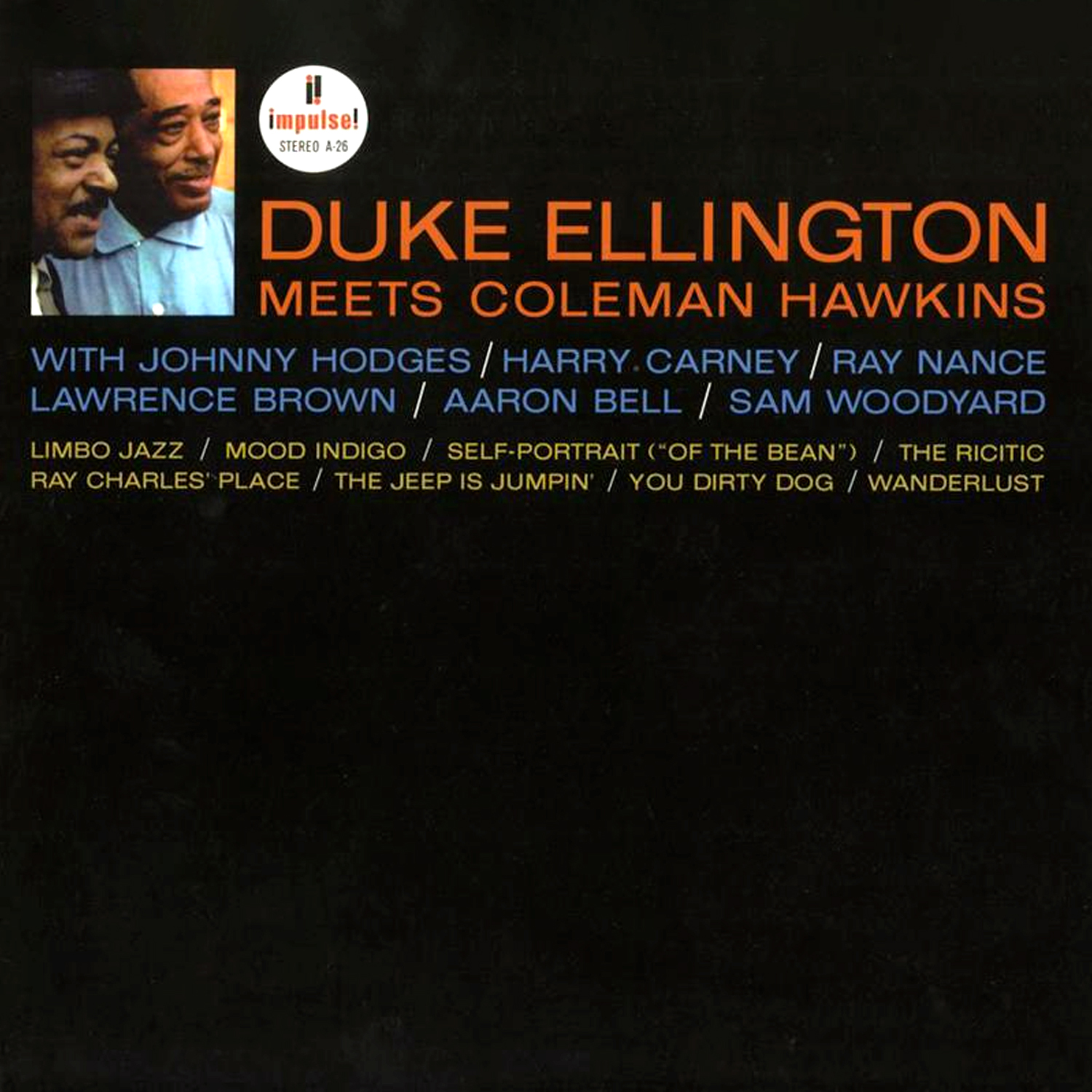
On 18 August 1962, Duke Ellington recorded with Coleman Hawkins at Rudy Van Gelder’s studio in Englewood Cliffs. Bob Thiele produced the session, and the resulting Duke Ellington Meets Coleman Hawkins appeared on Impulse! in early 1963. The title offers no elaborate concept. It names two musicians and places their encounter at the centre. That simplicity is appropriate: these are personalities whose names suggest musical worlds of their own, without either needing to be reduced to a supporting role within the other’s reputation. The record gives their actual collaboration a clear and direct frame.
Ellington plays piano and Hawkins tenor saxophone. Around them is a small, precisely identifiable ensemble: Johnny Hodges, Harry Carney, Lawrence Brown, Ray Nance, Aaron Bell and Sam Woodyard. These eight musicians do not constitute a full big band, and the album should not be described as one. The smaller format changes the proportions. Individual voices can emerge within a manageable setting, while there remains sufficient instrumental variety to place different colours together. Ellington is both pianist and the programme’s principal composer. Hawkins brings his own voice into surroundings largely defined by Ellington’s repertoire and the musicians participating in its interpretation.
For music lovers, albums built around an encounter often create a double expectation: the wish to recognise each participant’s familiar qualities and the curiosity to discover what changes when they are placed together. This record offers an especially clear framework for both. Eight selections, one session and a compact group of distinctive instrumentalists establish the situation. There is no need to invent a generational conflict or a contest between celebrated names. The more interesting question is musical: how do individual personalities sustain a shared form, and what relationships emerge when a tenor saxophonist of Hawkins’ standing works within this ensemble? The album invites time and attention for those connections.

Eight pieces from Ellington’s musical world
“Limbo Jazz” opens the programme, followed by “Mood Indigo”, “Ray Charles’ Place” and “Wanderlust”. The first side already shows that a meeting of two prominent musicians need not turn to a supposedly neutral selection of standards. Ellington’s compositional identity and musical surroundings provide the connection. “Mood Indigo” carries the additional writing credits of Irving Mills and Barney Bigard alongside Ellington; Johnny Hodges is named as co-writer of “Wanderlust”. These details recall that the repertoire itself grew from relationships. Collaboration therefore begins before the moment when several instruments are heard together in the recording studio.
The second side contains “You Dirty Dog”, “Self Portrait of the Bean”, “The Jeep Is Jumpin’” and “Ricitic”. Billy Strayhorn shares the writing credit on “Self Portrait of the Bean”, and Johnny Hodges on “The Jeep Is Jumpin’”. For attentive listening, this list offers a useful guide: the pieces belong to a connected artistic environment, but they are not eight interchangeable vehicles for the same sequence of solos. Their titles, themes and forms establish different starting points. The record benefits from those changes of perspective while its personnel preserve a sense of continuity across the programme.
Four selections on each side give the album a clear, approachable shape. This makes it easier to consider the sequence rather than extracting only individual favourites. What changes when another character comes forward in the next piece? How does the group remain recognisable as an ensemble while the themes vary? Such questions require no claim about an exactly documented solo order or an unverified instrumental switch. They direct attention towards the programme actually presented. For collectors, the relationship between celebrated names and a specific selection of compositions is valuable: the record offers more than an encounter advertised on a cover. It preserves a particular musical sequence with its own proportions.

Individual characters, not anonymous orchestral colours
Coleman Hawkins plays tenor saxophone and Johnny Hodges alto saxophone. Harry Carney’s credits include baritone saxophone and bass clarinet. Lawrence Brown plays trombone; Ray Nance is listed on cornet and violin. These distinctions deserve care. Cornet is not simply an interchangeable word for trumpet, and bass clarinet should not become another saxophone in a description. Likewise, a credit naming two instruments does not automatically mean that both appear on every track. Where the sources do not establish a secure individual allocation, the information remains album personnel. It identifies people and documented instruments without adding unsupported details to make the account appear more complete.
Ellington’s piano, Aaron Bell’s double bass and Sam Woodyard’s drums form the rhythmic and harmonic core. Their responsibilities are connected but distinct. The piano can comment on the music as well as help define its harmonic setting; bass and drums sustain the shared sense of time while responding to the other voices. In a small group of this kind, the relationship between foreground and accompaniment is particularly worth considering. A musician need not remain continuously in a solo role to be decisive for a piece’s character. Form also develops through space, weighting and the willingness to allow another voice to become audible within the group.
Englewood Cliffs and the precise recording date place this meeting within a specific period of the musicians’ careers. Rudy Van Gelder was responsible for recording and Bob Thiele for production. These names establish the historical setting without eclipsing the musicians’ work. The documentation is useful because it identifies the actual session and its participants. The primary interest nevertheless remains in the small community working in the studio. Hawkins and Ellington appear in the title; Hodges, Carney, Brown, Nance, Bell and Woodyard turn the announced encounter into an ensemble possessing its own weight, variety and identity.
The Acoustic Sounds Series edition at 33⅓ rpm
This release carries catalogue number AIMP 79501 and belongs to the Acoustic Sounds Series. It presents the album on a single stereo LP running at 33⅓ rpm. Ryan K. Smith cut the master from the original tapes, and the 180-gram record is manufactured at Quality Record Pressings. A Stoughton tip-on gatefold jacket completes the presentation. These details identify the offered edition concretely: format, cutting credit, pressing plant and jacket construction can be named without confusing it with an original Impulse! pressing or another subsequent release. For a carefully assembled collection, those distinctions are more useful than a general promise of superiority.
The original release and this reissue are separated by many years. The musical event remains the August 1962 session; the later manufacture of the LP is a separate stage in its continued availability. Keeping those dates distinct allows both the historic album and the particular edition to be taken seriously. Mastering and record production make the existing programme accessible. They do not change its personnel or retrospectively turn a compact ensemble into a large orchestral recording. With famous names especially, it is worthwhile allowing the actual record to define expectations rather than importing assumptions from the musicians’ wider and much larger bodies of work.
With four selections per side, the 33⅓ format offers a connected sequence and a single side change. That is a practical virtue of this presentation, not a claim that another speed must be musically or sonically inferior. You order from Michael 45 in Germany. We arrange the US import and dispatch from Hilden. Duke Ellington Meets Coleman Hawkins rewards an interest in individual voices and in the way they work together. The prominent names open the door; beyond them lies a clearly defined session whose repertoire and other participants deserve equal attention. Even for listeners already familiar with Ellington and Hawkins, considering the entire ensemble can make this particular encounter newly engaging and give the record a distinct place within a collection.
Series: Impulse! – all 19 records: the house that Trane built
Musicians
Participants and documented credit status. Track references correspond to the tracklist.
- Duke EllingtonPortrait: existing verified portraitpianoParticipation: Album personnel; track assignments unconfirmed
- Coleman HawkinsPortrait: existing portraittenor saxophoneParticipation: Album personnel; track assignments unconfirmed
- Johnny HodgesPortrait: existing verified portraitalto saxophoneParticipation: Album personnel; track assignments unconfirmed
- Harry CarneyPortrait: 1930sbaritone saxophone, bass clarinetParticipation: Album personnel; track assignments unconfirmed
- Lawrence BrownPortrait: circa 1946, earlyres PorträttromboneParticipation: Album personnel; track assignments unconfirmed
- Ray NancePortrait: 1946cornet, violinParticipation: Album personnel; track assignments unconfirmed
- Aaron Belldouble bassParticipation: Album personnel; track assignments unconfirmed
- Sam WoodyardPortrait: existing portraitdrumsParticipation: Album personnel; track assignments unconfirmed


Album recording personnel. Listing multiple instruments does not imply that each is played on every track.
How Michael hears this edition
Listening impression · paraphrased from the video
Michael praises the punch, dynamics and stereo soundstage of this edition. Compared with the older 45 RPM edition, he explicitly prefers the newer Acoustic Sounds Series 33⅓ RPM edition.
🎧 Review video: Acoustic Sounds Series: Duke Ellington Meets Coleman Hawkins vs. Analogue Production 45 RPM Version
This video is hosted by YouTube (Google). It only loads once you switch on “Functional” in the cookie settings.

Reviews
There are no reviews yet.