




A new beginning with a persistent pulse
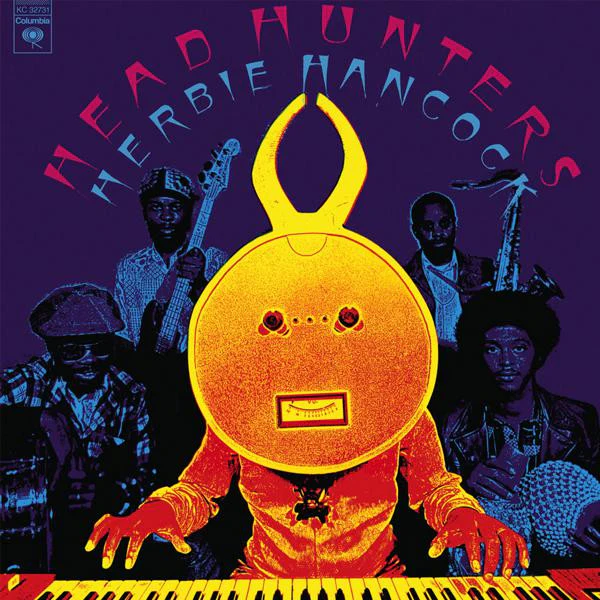
Four pieces are enough to open a musical world. Head Hunters begins with an idea that stays in the mind and gives the band room to explore, rather than a lengthy statement of intent. Herbie Hancock assembled a new group for the album in 1973. Funk moved to the centre, but his experience as a jazz pianist and composer remained within the music. Repetition and improvisation become partners: a stable point of reference allows individual voices to travel in different directions around it.
Released by Columbia in October 1973, the album reached listeners well beyond the immediate jazz audience. It rose to number 13 on the American album chart and also found a substantial R&B audience. Those figures cannot explain the music, but they indicate the reach of Hancock’s change of direction. Musical curiosity and an immediate physical appeal did not have to be mutually exclusive. A recurring bass idea, a distinctive keyboard figure or a drum accent can provide the entrance while more complex relationships develop behind it.
For collectors, Head Hunters therefore occupies an especially interesting position in Hancock’s work. A clear new band identity coexists with a return to earlier material: Watermelon Man was already part of his repertoire and is placed here in a different environment. Alongside it are Chameleon, Sly and Vein Melter. These four titles do not constitute a display of unrelated stylistic exercises. They explore different ways for the same ensemble to combine a shared pulse with changing instrumental colours and individual freedom.

Five musicians and an expanded palette
The recordings were made in San Francisco in August and September 1973, at Wally Heider Studios and Different Fur Trading Co. Hancock produced the album with David Rubinson. Engineering credits name Fred Catero and Jeremy Zatkin at Wally Heider, and Dane Butcher and John Vieira at Different Fur. The band consists of Hancock, Bennie Maupin, Paul Jackson, Harvey Mason and Bill Summers. Their complementary roles are essential to the record’s character; this is far more specific than a keyboard soloist accompanied by interchangeable supporting players.
Hancock’s instruments include Fender Rhodes, Hohner Clavinet D6, ARP Odyssey and ARP Pro Soloist. They offer different approaches to attack, sustain and the shaping of a sound. Maupin’s reed and wind instruments include tenor and soprano saxophones, bass clarinet and alto flute; the album credits also list saxello. Jackson contributes electric bass and marimbula, while Mason plays drums. These are credits for the album as a whole, not an assertion that every listed instrument appears together on every track.
Summers extends the ensemble with a broad range of percussion, including congas, balafon, agogô, cabasa, gankogui, shekere, surdo, tambourine and log drum. Even a beer bottle appears in the credits. This makes the record an invitation to notice sounds that do not initially resemble the conventional equipment of a jazz group. Percussion does more than decorate a rhythm already established elsewhere. It can introduce structure, movement and another independent voice into the interplay of bass, drums, keyboards and reeds.

Chameleon, Watermelon Man, Sly and Vein Melter
Chameleon provides a particularly direct entrance: a recognisable recurring idea and enough time to hear changes within its framework. Attention can move between the different layers as the piece progresses. What stays in place while another part becomes freer? Where does the arrival of a new sound alter the effect of a familiar figure? These questions need not turn listening into homework. They describe the pleasure of a readily approachable piece that continues to move after its opening identity has become familiar.
Watermelon Man is more than the return of a known title. The introduction was Bill Summers’ idea. He later described tuning a bottle to middle C with water and blowing into it, drawing on a Central African flute technique. Several layered parts create that unusual opening. A familiar composition thus acquires a new beginning before its well-known melody even arrives. Moving a composition into another ensemble and rhythmic environment changes its internal relationships. The melody brings a history with it, while the instrumentation and arrangement create a new context. For anyone building a Hancock collection, this treatment of earlier material is especially revealing. The album does not simply close the door on preceding work. It shows how a musician can use something familiar as the starting point for a different direction.
Sly and Vein Melter continue the album’s arc. The pieces allow more development than a brief song, while the programme remains concentrated on four titles. Following the sequence to its end is rewarding, rather than defining the record solely through its famous opening. Its addition to the Library of Congress National Recording Registry in 2008 recognises its historical importance. A personal connection can still begin much more simply: with a rhythm, an instrumental colour or an individual band member whose part invites closer attention.
The Analogue Productions double LP at 45 RPM
The edition offered here is AAPJ 084-45 from Analogue Productions: two 180-gram LPs playing at 45 RPM. It should be distinguished from the separate 33⅓ RPM edition and hybrid SACD. Each selection occupies its own side: Chameleon on A, Watermelon Man on B, Sly on C and Vein Melter on D. The long Chameleon is therefore not split. In practical listening terms, the programme is distributed across four record sides, requiring more frequent turning. Speed is a specific characteristic of this cut; on its own, it does not establish superiority over every other edition of the album.
Ryan K. Smith at Sterling Sound handled mastering and lacquer cutting. The documented runouts carry “RKS STERLING”, consistent with that credit. Quality Record Pressings is identified as the pressing plant. The double LP comes in a film-laminated tip-on gatefold jacket made by Stoughton Printing. These details help identify the particular release being offered. The edition-specific documentation consulted does not expressly establish a tape source or a complete AAA chain, so neither is added as an unsupported promise.
For enthusiasts of electric jazz, the instrumentation is as interesting as the meeting of repetition and freedom. This edition offers a clearly identified 45 RPM double LP, a documented lacquer cut and carefully specified packaging. Choosing a version for a collection also involves the desired format and listening sequence. At the centre of the record remain five musicians discovering a new shared language, one whose individual parts continue to invite attention. You order from Michael 45 in Germany. We arrange the US import and dispatch from Hilden.
Also in another edition: Head Hunters
Customer questions: 45 or 33⅓ RPM: which edition is worth it? · Buying Analogue Productions records in Europe
Musicians
Participants and documented credit status. Track references correspond to the tracklist.
- Herbie HancockFender Rhodes electric piano, Hohner Clavinet D6, ARP Odyssey, ARP Pro SoloistParticipation: Album personnel
- Bennie Maupintenor/soprano saxophones, saxello, bass clarinet, alto fluteParticipation: Album personnel
- Paul Jacksonelectric bass, marimbulaParticipation: Album personnel
- Harvey MasondrumsParticipation: Album personnel
- Bill Summersagogô, balafon, cabasa, congas, gankogui, log drum, shekere, surdo, tambourine, beer bottleParticipation: Album personnel; bottle: B · Watermelon Man


The instrument list describes the album personnel. Individual track assignments are included where documented.
🎧 Review video: 20 Albums to start an Audiophile Jazz Collection
This video is hosted by YouTube (Google). It only loads once you switch on “Functional” in the cookie settings.

Reviews
There are no reviews yet.