

Bird remembered, Rollins in the present
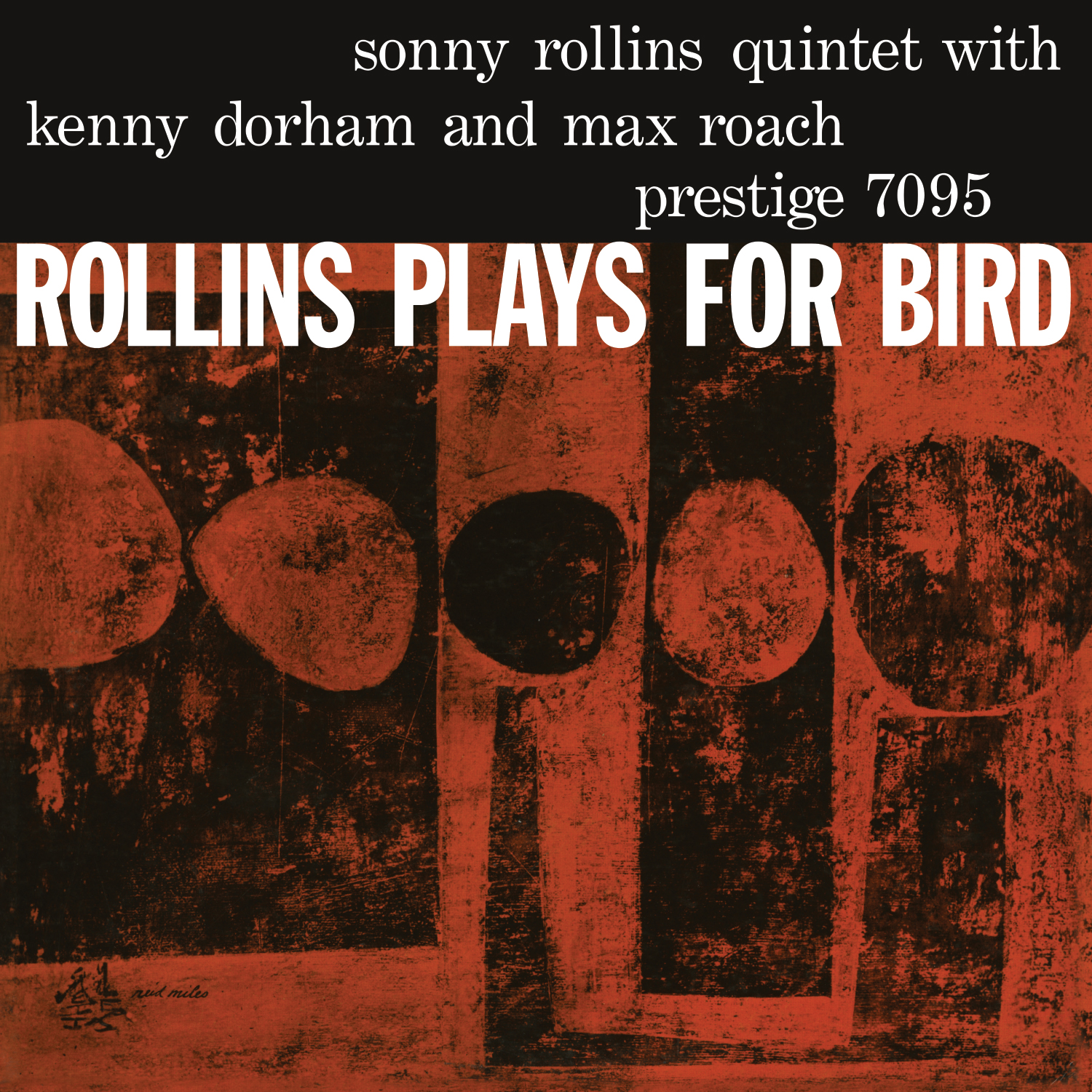
A tribute can assemble familiar themes. It can also show what one musician makes of another’s legacy. Rollins Plays for Bird takes the latter approach. Sonny Rollins dedicates an extended opening side to Charlie Parker without simply making an album consisting entirely of Parker compositions. Instead, he selects melodies associated with “Bird” and arranges them as a medley. My Little Suede Shoes contributes an actual Parker original. Remembrance becomes a matter of selection, sequence and deciding who within a small ensemble should have the foreground at a particular moment. The tribute is shaped through musical relationships.
The recording took place on 5 October 1956 at Rudy Van Gelder’s studio in Hackensack. Prestige released it as PRLP 7095 in July 1957. Those dates explain why different years sometimes accompany the title: 1956 identifies the session, 1957 the original release. Rollins plays tenor saxophone, Kenny Dorham trumpet, Wade Legge piano, George Morrow double bass and Max Roach drums. Bob Weinstock supervised the date, Van Gelder recorded it, and Ira Gitler wrote the notes. This is a clearly defined quintet recording that deliberately reduces its forces at particular points in the programme.
Looking towards Parker does not remove the participating musicians from their own present. Rollins, Dorham and Roach were independent artists; Legge and Morrow are not interchangeable names in the background. The tribute is created through what these five can do together. That makes the album particularly interesting within a collection. It offers a specific response to a musical inheritance rather than simply an exercise in commemoration. The title looks back towards Bird, while the realisation belongs to Rollins and his partners. The balance between those two perspectives gives the record more substance than its title alone might suggest.

Seven melodies and changing responsibilities
The first side of the original LP comprises the Bird Medley, lasting a little over 26 minutes. Its seven sections are I Remember You, My Melancholy Baby, Old Folks, They Can’t Take That Away from Me, Just Friends, My Little Suede Shoes and Star Eyes. The sequence moves through standards and one Parker original, rather than seven compositions by the same writer. That mixture is revealing. Parker had established his identity not only through his own themes, but also through his treatment of existing material. This tribute acknowledges that relationship and finds room within it for several different musical voices.
Responsibilities are deliberately distributed. Rollins leads the melody on I Remember You and They Can’t Take That Away from Me, while Dorham takes My Melancholy Baby and Just Friends. Old Folks and My Little Suede Shoes are given to the rhythm trio of Legge, Morrow and Roach; the full ensemble comes together for Star Eyes. That is an important distinction from a blanket statement that the quintet plays on every selection. The larger arc contains smaller combinations. Following the names alongside the individual sections shows how giving space to others can itself become part of a tribute’s design.
Wade Legge deserves particular attention here. The two trio sections make the piano more than a harmonic foundation beneath a pair of horns. Together with Morrow and Roach, it has an independent place inside the medley. Reducing the ensemble also changes the scale before the horns return. A useful listening approach is therefore to take the transitions as seriously as the familiar melodies. When is the foreground occupied by an individual instrument, and when by a group? How does continuity survive the changing responsibilities? The long first side allows those relationships to be experienced as one sustained development.

Two further pieces and two different perspectives
The second side of the original LP begins with Kids Know, a Rollins composition. Lasting over eleven minutes, it has considerable weight of its own. The piece is a waltz, performed by the quintet. After the sequence of Parker-associated melodies, Rollins the composer comes more explicitly into view. The tribute does not occupy the entire album; it sits beside an independent statement by the tenor saxophonist. That makes the LP more varied than its title might initially imply. It connects remembrance with the present without forcing both into a single programme idea or treating the remaining music as an afterthought.
The concluding piece is I’ve Grown Accustomed to Her Face from Lerner and Loewe’s My Fair Lady. The musical was new in 1956, so the tune belonged to the immediate contemporary world of this session. Dorham sits out, leaving a quartet of Rollins, Legge, Morrow and Roach. Once again, a smaller line-up is an intentional part of the programme. After the long opening medley and the extended Kids Know, the album closes with an interpretation lasting just under five minutes. A different form and a different timescale give the ending a character distinct from the chapters that precede it.
Historical side paths also benefit from precision. The House I Live In was recorded on the same date, but it is not part of this original LP; it appeared later on Sonny Boy and expanded editions. Dorham is the trumpeter here, despite a documented reissue sleeve mistakenly crediting him with tenor saxophone. Such details do not change the performance, but they can distort the listener’s picture of it. The actual instrumentation is interesting precisely because trumpet, tenor saxophone and rhythm trio appear in changing combinations. Each musician has a recognisable role in the way the album is organised.
Bird as a continuous programme on hybrid SACD
The Analogue Productions hybrid mono SACD carries catalogue number CPRJ 7095 SA. It belongs to the Prestige Mono series and presents the same album in a digital format. A hybrid SACD provides a CD layer for playback on a conventional CD player in addition to its SACD layer; the latter requires a suitably equipped player. This edition is explicitly identified as mono. The SACD format by itself implies neither stereo nor a multichannel version. The musical perspective remains that of the historical mono recording rather than a different spatial presentation inferred from the carrier.
The sequence needs to be considered separately for this edition. The documented SACD divides the medley into seven selectable sections, followed by I’ve Grown Accustomed to Your Face as track 8 and Kids Know as track 9. This differs from the original LP, whose second side places Kids Know before the ballad. “Your Face” follows the documented SACD listing here; in the musical and LP context, the song is usually called I’ve Grown Accustomed to Her Face. The duration of 26:52 applies to the complete medley, not solely to its first indexed section. No unverified individual section times are supplied.
This format allows the long medley to unfold without a side change while also making it straightforward to revisit individual sections. The responsibilities of Rollins, Dorham and the rhythm trio can therefore be compared conveniently. The packaging takes the form of a miniature traditional record jacket, using printed wraps mounted on card and documented as a gatefold cardboard wallet. Vinyl cutting and pressing specifications are not transferred to the SACD. For collectors maintaining both formats, the historical relationships remain the same, while navigation, sequence and physical presentation take a distinct form. You order from Michael 45 in Germany. We arrange the US import and dispatch from Hilden.
Also on mono vinyl: Rollins Plays For Bird
More by Sonny Rollins: Saxophone Colossus · Way Out West
Artist page: All titles by Sonny Rollins
Customer question: Buying Analogue Productions records in Europe
Musicians
Participants and documented credit status. Track references correspond to the tracklist.
- Sonny RollinsPortrait circa 1956tenor saxophoneParticipation: Medley excluding trio sections 3/6; 8, 9
- Kenny DorhamPortrait facial reference 1963trumpetParticipation: Medley excluding trio sections 3/6; 9; not 8
- Wade LeggepianoParticipation: All tracks
- George Morrowdouble bassParticipation: All tracks
- Max RoachPortrait 1956drumsParticipation: All tracks


5 October 1956, Van Gelder Studio, Hackensack. Bob Weinstock: supervision; Rudy Van Gelder: engineer; Ira Gitler: liner notes. Released July 1957. Medley: Rollins leads I Remember You/They Can’t Take That Away from Me, Dorham My Melancholy Baby/Just Friends; Old Folks/My Little Suede Shoes feature Legge/Morrow/Roach only; Star Eyes features the full quintet. Kids Know: quintet; Accustomed: quartet without Dorham. SACD: medley 1–7, total 26:52; Accustomed 8; Kids Know 9. Sequence follows the documented edition, differing from the LP and publisher webpage.

Reviews
There are no reviews yet.