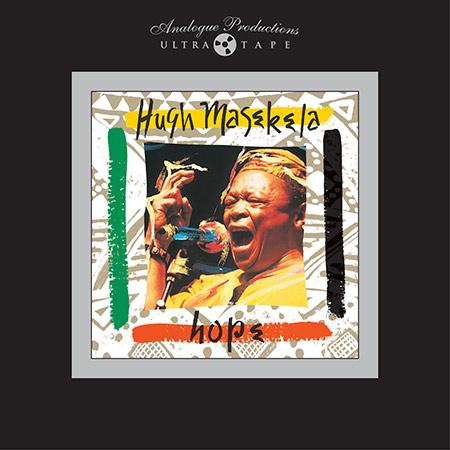



Hope captures Hugh Masekela live at Blues Alley in Washington, D.C., with the shape of an evening preserved across a broad South African repertoire. His flugelhorn, voice and spoken presence connect township rhythm, jazz improvisation, political memory and communal celebration. The band does not treat those elements as separate styles; grooves can carry history, and a solo can become part of the story being told from the stage.
“Abangoma” establishes a ceremonial opening, voices and rhythm creating a collective space before Masekela’s horn takes its place inside it. “Uptownship” is more agile, its repeating figures giving the ensemble a springboard for quick instrumental exchange. “Marketplace” turns bustling motion into musical form, while “Ntyilo Ntyilo” draws the focus inward through a melody associated with the love bird. The long “Stimela (The Coal Train)” is the emotional centre of the performance. Masekela uses speech, breath and rhythm to evoke migrant workers carried toward the mines, then the band transforms the narrative’s gathering pressure into a complete dramatic arc. The piece explains why Hope matters as a live album: applause is not simply atmosphere, and virtuosity is not an end in itself. Performer and audience share in music that remembers, warns and celebrates at the same time.
This Analogue Productions Ultra Tape is an analogue tape, not vinyl and not an optical disc. Playback requires a compatible tape machine and attentive operation of the collector’s own equipment. The specialist format makes the complete concert a deliberately handled listening object while leaving Masekela’s music and stage narrative at the centre.
This edition: Ultra Tape, and what you need to play it
Analogue Productions issues this recording in its Ultra Tape series: a ¼-inch analogue tape running at 15 ips with IEC equalisation, in two-track (half-track) stereo. Each copy is made in real time from a copy of the original analogue master tape, transferred on an ATR-modified Ampex machine with flux magnetic heads, and it arrives in a custom slipcase.
Playing it needs a reel-to-reel machine that runs at 15 ips and reads two tracks. The format leaves out the steps a record takes between master tape and groove, which is the reason collectors reach for it.
Customer question: Buying Analogue Productions records in Europe
