


When unfamiliar metres begin to feel natural
It is possible to recognise “Take Five” long before considering why its rhythm feels different. That is one of the great qualities of Time Out. The Dave Brubeck Quartet turns unusual metres into the basis of memorable music rather than an obstacle to hearing it. Themes have clear outlines, the four instruments remain recognisable as individual voices, and the rhythmic distinctions become part of a sequence that can be followed intuitively. The record does not require a counting exercise, although closer attention to the count reveals a great deal about its construction.
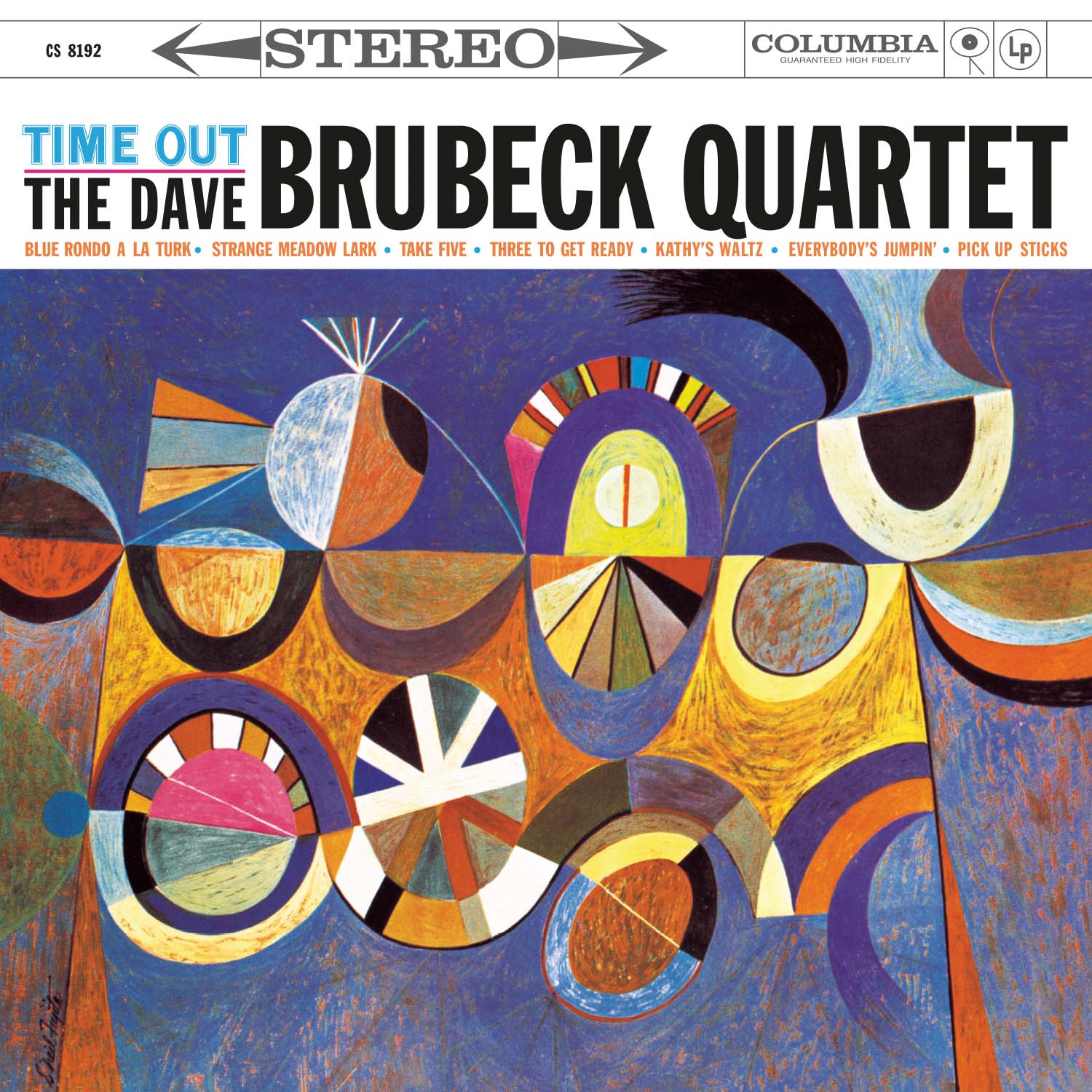
The album was recorded during the summer of 1959 at Columbia’s 30th Street Studio in New York and released towards the end of that year. Dave Brubeck plays piano, Paul Desmond alto saxophone, Eugene Wright double bass and Joe Morello drums. Seven pieces make up the original programme. “Take Five” is Desmond’s composition, while the other pieces are attributed to Brubeck in the album credits. The most famous track thus carries another member’s compositional identity beneath the bandleader’s name, an appropriate reminder of the individual contributions within this exceptionally recognisable quartet.
Brubeck’s interest in rhythmic forms beyond the usual jazz environment had been encouraged in part by encounters on a tour abroad. For “Blue Rondo à la Turk,” a nine-beat grouping heard in Turkey was particularly significant. The result is not a reconstruction of folk performance. The quartet takes a rhythmic idea and brings it into contact with its own musical language. The move between an unfamiliar grouping and more familiar swing belongs to the composition itself, giving the contrast an active role rather than presenting the unusual metre as an isolated curiosity.
Time Out consequently feels both coherent and varied. Its shared idea is clear, but not every selection demonstrates that idea in the same fashion. Some remain in a conspicuous metre for extended passages, while others change between different patterns or begin without a clearly regular pulse. The fascination lies in hearing these differences as musical characters. The experiment succeeds because its metres generate melodies, shaped developments and distinctive ensemble relationships, rather than simply because the numbers at the beginning of the bar differ from those most commonly used.

Four voices with room for one another
Brubeck and Desmond create a particularly clear contrast within the group. The piano can place powerful chords, define rhythmic figures sharply and give a section considerable weight. Desmond’s alto often carries a slender, apparently light line in response. These are not fixed duties: both musicians react and can change their function. Nevertheless, the contrast between their basic colours helps the listener follow the musical activity even when the rhythmic design initially feels unfamiliar. The difference is audible before it requires any verbal explanation, providing an immediate point of entry into the ensemble.
Wright offers orientation on double bass without becoming a mechanical pulse. A recurring bass figure can make an unfamiliar metre sufficiently clear to allow considerable freedom above it. The bass is therefore a useful starting point for a second listening pass. Having first followed the famous saxophone melody, the listener can then attend to the way Wright keeps the form together and connects his line with Brubeck’s accompaniment. What initially seemed effortless or self-evident becomes a substantial musical decision. The apparent ease of the whole depends on this continuing work within it.
Morello has a distinctive role in that relationship. The drums must keep the rhythmic idea mobile, not merely mark it out. Accents can resist an expected emphasis without losing the shared form. “Take Five” makes especially clear how closely a memorable composition and the opportunity for an extended drum feature can be connected. The accompaniment establishes a dependable reference while Morello pursues developments of his own within the frame. Metre becomes an area for play and invention, rather than a warning that has to be reissued every time another bar begins.
Teo Macero produced the recordings, with Fred Plaut named as recording engineer. The original album’s visual identity is associated with S. Neil Fujita’s cover design. These details belong to the original production and need to be distinguished from the people responsible for a later reissue. The performing quartet likewise remains clearly defined across the seven original selections. Additional players are not required to explain the range of colours in the programme: those differences arise from the relationship between these four voices and from the particular construction of each composition.

Beyond the famous five-beat pattern
“Blue Rondo à la Turk” opens the record with its striking organisation of nine eighth-notes. Grouping them as two plus two plus two plus three creates a different movement from three equal groups of three. Crucially, the piece connects that pattern with passages in four. The transitions belong to its wit and tension. Looking only at an abstract time signature would miss the exchange between an unfamiliar starting figure and a more established kind of jazz movement, which is what gives the performance its particular shape and forward direction.
“Strange Meadow Lark” begins with a freely paced piano introduction before the quartet settles into regular four-beat swing. By its second track, the album has already shown that its subject extends beyond a collection of odd metres. Time can be stretched, initially left open and then organised clearly. “Take Five” subsequently places five beats to the bar at the centre. Its recurring pattern supports Desmond’s theme and provides the framework for Morello’s drumming. The melody is so direct that the unusual sequence begins to feel entirely natural after only a few repetitions.
On side B, “Three to Get Ready” begins with a waltz idea, then combines passages in three and four. “Kathy’s Waltz” is not a straightforward, continuous waltz either: it opens in four and brings the waltz character into its course later. Both performances demonstrate that a change of metre need not create a rupture. A melody can preserve its identity while the ground beneath it shifts. The quartet makes those adjustments part of the musical conversation, allowing different patterns to relate to one another rather than presenting them as separate technical demonstrations.
“Everybody’s Jumpin’” and “Pick Up Sticks” bring the programme into six-beat territory with differing degrees of flexibility and regularity. The final piece gives its recurring figure a particularly clearly defined function. A rewarding listening route therefore avoids treating the whole album merely as an extension of “Take Five.” The relationship between fixed pattern and free movement can be followed through all seven selections. Heard that way, Time Out becomes a carefully constructed whole whose best-known moment grew from a wider curiosity about the organisation of musical time.
The single 180-gram Analogue Productions LP
The edition described here carries catalogue number AAPJ 8192. Analogue Productions presents it as one 180-gram stereo LP playing at 33⅓ RPM. Bernie Grundman is responsible for mastering, and manufacture is by Quality Record Pressings. Packaging is a substantial Stoughton tip-on gatefold jacket. The presentation includes eight historical black-and-white session photographs supplied by Sony Music for this release, adding a visual connection with the quartet’s work alongside the original musical programme. These are concrete features of this particular edition rather than generic descriptions of every Time Out reissue.
The specifications refer expressly to the 33⅓ RPM version. Reviews or technical details concerning a two-record 45 RPM edition should not automatically be assigned to it. The same applies to digital releases, later collections of alternate takes and editions involving different mastering personnel. This LP contains the seven familiar original tracks in their documented order, three on side A and four on B. No additional claim of a fully documented all-analogue signal path is inferred here from information that does not establish every stage of that path.
A single LP retains the manageable flow of the original programme with one side change. Weight, pressing plant and jacket construction are specific identifying features. They do not replace an individual listening assessment or establish a universal judgement about the record’s performance on every playback system. From a musical perspective, the important continuity is the quartet and the original album’s sequence, allowing the relationships between its contrasting approaches to rhythm to remain intact. The edition can be understood clearly without borrowing claims made for a different physical release.
This is an explicitly identified vinyl version of an album whose familiarity has by no means exhausted its possibilities for discovery. Time Out can appeal immediately while also encouraging closer listening to the organisation of rhythm. The five-beat pattern is its best-known emblem. Its broader story, however, is told by four musicians turning different arrangements of musical time into a shared and remarkably approachable language. That relationship between invention and ease remains the reason to return to the complete programme.
You order from Michael 45 in Germany. We arrange the US import and dispatch from Hilden.
Customer questions: 45 or 33⅓ RPM: which edition is worth it? · Buying Analogue Productions records in Europe
Musicians
Participants and documented credit status. Track references correspond to the tracklist.
- Dave BrubeckOriginal illustration · portrait reference 1964pianoParticipation: All seven original tracks
- Paul DesmondOriginal illustration · portrait reference 1954alto saxophoneParticipation: All seven tracks; composer of A3 · Take Five
- Eugene WrightOriginal illustration · portrait reference 1962double bassParticipation: All seven original tracks
- Joe MorelloOriginal illustration · portrait reference 1960drumsParticipation: All seven original tracks


Columbia 30th Street Studio, New York, summer 1959; original release 1959. Teo Macero: producer; Fred Plaut: engineering; S. Neil Fujita: cover design. Dave Brubeck: piano; Paul Desmond: alto saxophone and composer of Take Five; Eugene Wright: double bass; Joe Morello: drums. Seven original tracks. Bernie Grundman: mastering for this single 33⅓ RPM LP; no transfer of 45 RPM reviews, CD mastering or alternate takes.
🎧 Review video: The 20 Best Audiophile Analogue Production Editions (Still in Print 2021)
This video is hosted by YouTube (Google). It only loads once you switch on “Functional” in the cookie settings.

Reviews
There are no reviews yet.